
Politics
US tariffs on European goods threaten to shake up the world’s largest trade relationship – National TenX News


The European Union expects to find out on Monday whether President Donald Trump will impose punishing tariffs on America’s largest trade partner in a move economists have warned would have repercussions for companies and consumers on both sides of the Atlantic.
Trump imposed a 20 per cent import tax on all EU-made products in early April as part of a set of tariffs targeting countries with which the United States has a trade imbalance. Hours after the nation-specific duties took effect, he put them on hold until July 9 at a standard rate of 10 per cent to quiet financial markets and allow time for negotiations.
Expressing displeasure with the EU’s stance in trade talks, however, Trump said he would increase the tariff rate for European exports to 50 per cent, which could make everything — from French cheese and Italian leather goods to German electronics and Spanish pharmaceuticals — much more expensive in the U.S.

The EU’s executive commission, which handles trade issues for the bloc’s 27-member nations, said its leaders hope to strike a deal with the Trump administration. Without one, the EU said it was prepared to retaliate with tariffs on hundreds of American products, ranging from beef and auto parts to beer and Boeing airplanes.
U.S. Treasury Secretary Scott Bessent told CNN’s “State of the Union” program on Sunday that “the EU was very slow in coming to the table” but that talks were now making “very good progress.”
Here are important things to know about trade between the United States and the European Union.
US-EU trade is enormous
The European Commission describes the trade between the U.S. and the EU as “the most important commercial relationship in the world.”
The value of EU-U.S. trade in goods and services amounted to 1.7 trillion euros (US$2 trillion) in 2024, or an average of 4.6 billion euros a day, according to EU statistics agency Eurostat.
The biggest U.S. export to Europe was crude oil, followed by pharmaceuticals, aircraft, automobiles, and medical and diagnostic equipment.
Europe’s biggest exports to the U.S. were pharmaceuticals, cars, aircraft, chemicals, medical instruments, and wine and spirits.
EU sells more to the US than vice versa
Trump has complained about the EU’s 198 billion-euro trade surplus in goods, which shows Americans buy more stuff from European businesses than the other way around.

Get breaking National news
For news impacting Canada and around the world, sign up for breaking news alerts delivered directly to you when they happen.
However, American companies fill some of the gap by outselling the EU when it comes to services such as cloud computing, travel bookings, and legal and financial services.
The U.S. services surplus took the nation’s trade deficit with the EU down to 50 billion euros (US$59 billion), which represents less than three per cent of overall U.S.-EU trade.
What are the issues dividing the two sides?
Before Trump returned to office, the U.S. and the EU maintained a generally cooperative trade relationship and low tariff levels on both sides. The U.S. rate averaged 1.47 per cent for European goods, while the EU’s averaged 1.35 per cent for American products.
But the White House has taken a much less friendly posture toward the longstanding U.S. ally since February. Along with the fluctuating tariff rate on European goods Trump has floated, the EU has been subject to his administration’s 50 per cent tariff on steel and aluminum, and a 25 per cent tax on imported automobiles and parts.
Trump administration officials have raised a slew of issues they want to see addressed, including agricultural barriers such as EU health regulations that include bans on chlorine-washed chicken and hormone-treated beef.

Trump has also criticized Europe’s value-added taxes, which EU countries levy at the point of sale this year at rates of 17 per cent to 27 per cent. But many economists see VAT as trade-neutral since they apply to domestic goods and services as well as imported ones. Because national governments set the taxes through legislation, the EU has said they aren’t on the table during trade negotiations.
“On the thorny issues of regulations, consumer standards and taxes, the EU and its member states cannot give much ground,” Holger Schmieding, chief economist at Germany’s Berenberg bank, said. “They cannot change the way they run the EU’s vast internal market according to U.S. demands, which are often rooted in a faulty understanding of how the EU works.”
‘Consequence for many companies’
Economists and companies say higher tariffs will mean higher prices for U.S. consumers on imported goods. Importers must decide how much of the extra tax costs to absorb through lower profits and how much to pass on to customers.


Mercedes-Benz dealers in the U.S. have said they are holding the line on 2025 model year prices “until further notice.” The German automaker has a partial tariff shield because it makes 35 per cent of the Mercedes-Benz vehicles sold in the U.S. in Tuscaloosa, Alabama, but the company said it expects prices to undergo “significant increases” in coming years.
Simon Hunt, CEO of Italian wine and spirits producer Campari Group, told investment analysts that prices could increase for some products or stay the same depending what rival companies do. If competitors raise prices, the company might decide to hold its prices on Skyy vodka or Aperol aperitif to gain market share, Hunt said.

Trump has argued that making it more difficult for foreign companies to sell in the U.S. is a way to stimulate a revival of American manufacturing. Many companies have dismissed the idea or said it would take years to yield positive economic benefits. However, some corporations have proved willing to shift some production stateside.
France-based luxury group LVMH, whose brands include Tiffany & Co., Luis Vuitton, Christian Dior and Moet & Chandon, could move some production to the United States, billionaire CEO Bernaud Arnault said at the company’s annual meeting in April.
Arnault, who attended Trump’s inauguration, has urged Europe to reach a deal based on reciprocal concessions.
“If we end up with high tariffs, … we will be forced to increase our U.S.-based production to avoid tariffs,” Arnault said. “And if Europe fails to negotiate intelligently, that will be the consequence for many companies. … It will be the fault of Brussels, if it comes to that.”
‘Road could be rocky’
Some forecasts indicate the U.S. economy would be more at risk if the negotiations fail.
Without a deal, the EU would lose 0.3 per cent of its gross domestic product and U.S. GDP would fall 0.7 per cent, if Trump slaps imported goods from Europe with tariffs of 10 per cent to 25 per cent, according to a research review by Bruegel, a think tank in Brussels.
Given the complexity of some of the issues, the two sides may arrive only at a framework deal before Wednesday’s deadline. That would likely leave a 10 per cent base tariff, as well as the auto, steel and aluminum tariffs in place until details of a formal trade agreement are ironed out.
The most likely outcome of the trade talks is that “the U.S. will agree to deals in which it takes back its worst threats of ‘retaliatory’ tariffs well beyond 10 per cent,” Schmieding said. “However, the road to get there could be rocky.”
The U.S. offering exemptions for some goods might smooth the path to a deal. The EU could offer to ease some regulations that the White House views as trade barriers.
“While Trump might be able to sell such an outcome as a ‘win’ for him, the ultimate victims of his protectionism would, of course, be mostly the U.S. consumers,” Schmieding said.

Politics
Wildfires raging across Chile kill at least 18, force thousands to flee – National TenX News
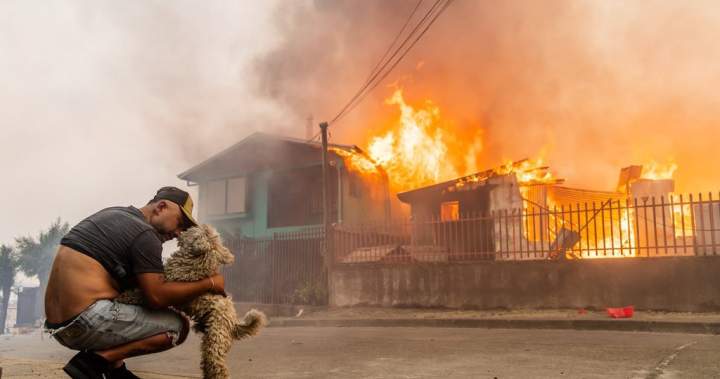
Wildfires raging across central and southern Chile on Sunday left at least 18 people dead, scorched thousands of acres of forest and destroyed hundreds of homes, authorities said, as the South American country swelters under a heat wave.
Chilean President Gabriel Boric declared a state of catastrophe in the country’s central Biobio region and the neighboring Ñuble region, around 500 kilometers (300 miles) south of Santiago, the capital.
The emergency designation allows the suspension of constitutional rights and greater coordination with the military to rein in over two dozen active wildfires that have so far blazed through 8,500 hectares (21,000 acres), according to the national forestry agency.
In a press conference from the hard-hit city of Concepción in the Biobio region, Boric expressed his support and condolences to the victims and warned that the government’s initial reports of 18 people killed and 300 houses destroyed were expected to rise as the extent of the losses came into focus.
He estimated the total number of affected homes in the Biobio region alone to be “certainly more than a thousand, just so far.”
Get daily National news
Get the day’s top news, political, economic, and current affairs headlines, delivered to your inbox once a day.
“The first priority, as you know, in these emergencies is always to fight and extinguish the fire. But we cannot forget, at any time, that there are human tragedies here, families who are suffering,” he said. “These are difficult times.”
His address followed complaints from local authorities that for hours Sunday as fires ravaged the hillsides and prompted 50,000 people to evacuate, destruction was everywhere and help was nowhere.
“Dear President Boric, from the bottom of my heart, I have been here for four hours, a community is burning and there is no (government) presence,” Rodrigo Vera, the mayor of the small coastal town of Penco in the Biobio region, said on a local radio station earlier Sunday. “How can a minister do nothing but call me to tell me that the military is going to arrive at some point?”
Firefighters struggled to extinguish the flames, with the heat and strong winds hampering their efforts. Temperatures topped 38 C (100 F) on Sunday, and the scorching weather was expected to persist through Monday.
“Weather conditions for coming hours are not good and indicate extreme temperatures,” said Interior Minister Álvaro Elizalde.


Residents said the fires took them by surprise after midnight, trapping them in their homes.
“Many people didn’t evacuate. They stayed in their houses because they thought the fire would stop at the edge of the forest,” said John Guzmán, 55, surveying the scene in Penco, where smoke blanketed the sky in an orange haze. “It was completely out of control. No one expected it.”
“We fled running, with the kids, in the dark,” said Juan Lagos, 52, also in Penco. The fire engulfed most of the city, burning cars, a school and a church.
Charred bodies were found across fields, homes, along roads and in cars.
“From what we can see, there are people who died … and we knew them well,” said Víctor Burboa, 54. “Everyone here knew them.”
Wildfires afflict central and southern Chile every summer, typically reaching a peak in February as temperatures surge and the country continues to reel from a yearslong drought. In 2024, massive fires ripping across Chile’s central coastline killed at least 130 people, becoming the nation’s deadliest natural disaster since a devastating 2010 earthquake.
Neighboring Argentina has also struggled to contain wildfires consuming thousands of acres of forest in recent weeks as the country’s southern Patagonia area experiences a spell of hot, dry weather.
© 2026 The Canadian Press
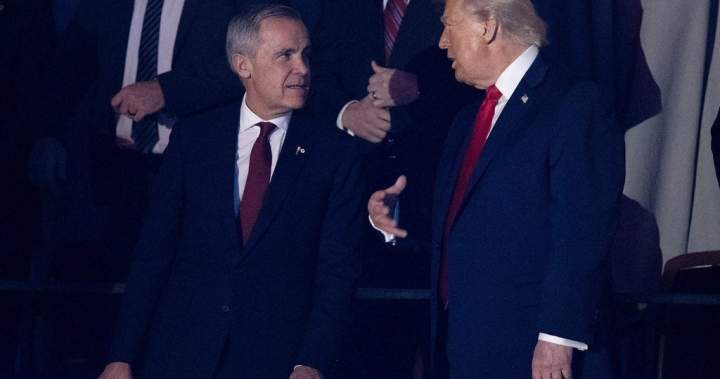
Prime Minister Mark Carney told reporters Sunday he has agreed in principle to join U.S. President Donald Trump’s controversial “Board of Peace,” meant to support the reconstruction of Gaza.
Carney told reporters in Doha that Trump asked him about joining this board “a few weeks ago.”
“There is a humanitarian tragedy in Gaza that is ongoing and Canada will make every effort possible to address this situation,“ he said at a news conference at an Islamic Art museum in the capital of the Gulf country.
He said the president put the question to him a few weeks ago and he said yes and that he and Canada will do everything it can to bring peace to the region.
Carney said there is still not unimpeded humanitarian aid flowing into help the people of Gaza and that is a “precondition for moving forward.”

The prime minister said details still need to be worked out on how exactly the board and the financing will work.
Get daily National news
Get the day’s top news, political, economic, and current affairs headlines, delivered to your inbox once a day.
The Board of Peace is part of the Trump-brokered peace plan that saw a ceasefire take hold between Israel and Hamas in Gaza.

The creation of new organization has raised concerns that it could deal a blow to the United Nations system of international cooperation that Trump has long argued is ineffective and dysfunctional, and place Trump in control of how the money is distributed.
The text of the charter, published by various international media outlets, states there is a “need for a more nimble and effective international peace-building body” than the UN.
The board will be chaired by Trump himself, and its executive makeup includes Secretary of State Marco Rubio, Trump’s Middle East special envoy Steve Witkoff, Trump’s son-in-law Jared Kushner, and former U.K. prime minister Tony Blair.
Earlier in the month Trump withdrew from dozens of international organizations, many of which are related to the UN.
Carney said working through the peace board is “consistent” with Canadian goals to ensure “unimpeded” humanitarian aid can enter the territory and work toward a two-state solution.
“We will explore every avenue in order to do that,” he said.
© 2026 The Canadian Press
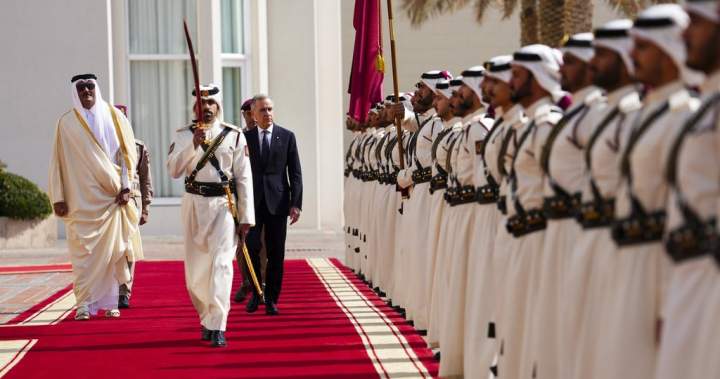
Prime Minister Mark Carney says Qatar has committed to “significant” investments for Canada’s major building projects, calling it a “new chapter” in bilateral relations.
Carney made the announcement Sunday following his meeting with Sheikh Tamim bin Hamad Al Thani, the Emir of Qatar.
The new measures will include the finalization of the Investment Promotion and Protection Agreement with Qatar, a deal that has seen years of stalled negotiations, Carney said.
“We are raising our relationship and our level of alignment by making friends with strategic partners,” Carney said. “To launch this new chapter in our relationship, I’m pleased to announce that Qatar has committed to make significant strategic investments in Canada’s nation-building projects.
“This capital will help the projects get built faster and supercharge our energy industries, while helping to create thousands of high-paying careers for Canadians.”
He also said the new agreement will help Canadian businesses to “more easily” expand operations in Qatar as well as attract investment from the country.
Get daily National news
Get the day’s top news, political, economic, and current affairs headlines, delivered to your inbox once a day.
According to a readout from the Prime Minister’s Office, air services between Canada and Qatar will also be expanded and a defence attache from Canada will be posted in the country.

According to the PMO, the two countries have agreed to launch negotiations on a new framework focused on military, security and defence matters, and expand investment opportunities on areas such as AI.
The PMO said the two leaders agreed to stay in touch and Carney noted Sunday he had invited the Emir to visit Canada later this year and attend the World Cup match between their two countries with him.

The plans with Qatar are Carney’s latest in a slew of agreements and travel to other countries to discuss trade deals since his election last year.
Asked about his ongoing efforts to meet with countries interested in trade, Carney told reporters that multilateral relationships are “being eroded.”
“The consequence of that is there is a reduction in freer trade, much more trade is tariff-based or otherwise restricted and there is virtually no, with all due respect to those who are trying, virtually no multilateral progress,” Carney said.
“Where there is progress, and where Canada and like-minded countries are looking to make progress, is through pluriality deals… which is multiple countries but not all countries.”
On Friday, Canada announced that 49,000 Chinese-made electric vehicles (EVs) would soon be imported each year with a lowered 6.1 per cent tariff after Carney struck a deal with Chinese President Xi Jinping.
Carney added on Sunday that Xi showed interest in expanding China’s trade relations with other countries, and that’s why Canada is establishing trade deals with other countries, such as Qatar.
“In this more uncertain and dangerous world, we’ve chosen to create greater stability, security and prosperity together,” Carney said.
© 2026 Global News, a division of Corus Entertainment Inc.


Wildfires raging across Chile kill at least 18, force thousands to flee – National TenX News

Carney agrees ‘in principle’ to Trump’s Gaza peace board – National TenX News

Qatar to invest in Canada’s major building projects, Carney says – National TenX News


-

 Fashion10 months ago
These ’90s fashion trends are making a comeback in 2017
-

 Entertainment10 months ago
The final 6 ‘Game of Thrones’ episodes might feel like a full season
-

 TenX Exclusive10 months ago
अमर योद्धा: राइफलमैन जसवंत सिंह रावत की वीरगाथा
-
 Politics9 months ago
Before being named Pope Leo XIV, he was Cardinal Robert Prevost. Who is he? – National TenX News
-

 Politics9 months ago
Puerto Rico faces island-wide blackout, sparking anger from officials – National TenX News
-

 Fashion10 months ago
According to Dior Couture, this taboo fashion accessory is back
-

 Tech10 months ago
Indian-AI-software-which-caught-30-thousand-criminals-and-busted-18-terrorist-modules-its-demand-is-increasing-in-foreign-countries-also – News18 हिंदी
-

 Politics9 months ago
Scientists detect possible signs of life on another planet — but it’s not aliens – National TenX News