
Politics
Trump’s Aug. 7 tariff start date for some countries brings new uncertainty – National TenX News

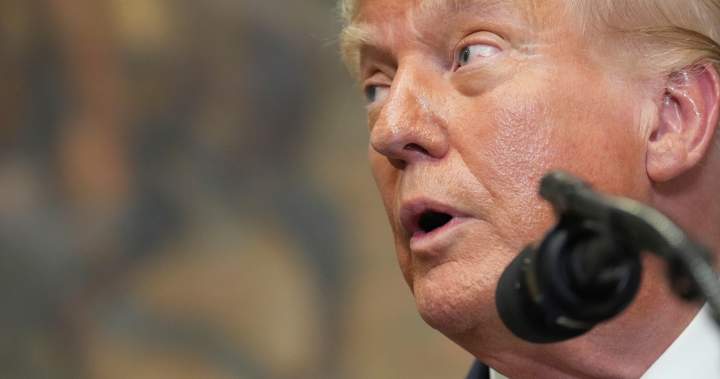
For weeks, President Donald Trump was promising the world economy would change on Friday with his new tariffs in place. It was an ironclad deadline, administration officials assured the public.
But when Trump signed the order Thursday night imposing new tariffs on 66 countries, the European Union, Taiwan and the Falkland Islands, the start date of the punishing import taxes was pushed back seven days so that the tariff schedule could be updated. The change — while potentially welcome news to countries that had not yet reached a deal with the U.S. — injected a new dose of uncertainty for consumers and businesses still wondering what’s going to happen and when.
Trump told NBC News in a Thursday night interview the tariffs process was going “very well, very smooth.” But even as the Republican president insisted these new rates would stay in place, he added: “It doesn’t mean that somebody doesn’t come along in four weeks and say we can make some kind of a deal.”
Trump has promised that his tax hikes on the nearly US$3 trillion in goods imported to the United States will usher in newfound wealth, launch a cavalcade of new factory jobs, reduce the budget deficits and, simply, get other countries to treat America with more respect.
The vast tariffs risk jeopardizing America’s global standing as allies feel forced into unfriendly deals. As taxes on the raw materials used by U.S. factories and basic goods, the tariffs also threaten to create new inflationary pressures and hamper economic growth — concerns the Trump White House has dismissed.
Questions swirl around the tariffs despite Trump’s eagerness
As the clock ticked toward Trump’s self-imposed deadline, few things seemed to be settled other than the president’s determination to levy the taxes he has talked about for decades. The very legality of the tariffs remains an open question as a U.S. appeals court on Thursday heard arguments on whether Trump had exceeded his authority by declaring an “emergency” under a 1977 law to charge the tariffs, allowing him to avoid congressional approval.
Trump was ebullient as much of the world awaited what he would do.
“Tariffs are making America GREAT & RICH Again,” he said Thursday morning on Truth Social.

Others saw a policy carelessly constructed by the U.S. president, one that could impose harms gradually over time that would erode America’s power and prosperity.

Get breaking National news
For news impacting Canada and around the world, sign up for breaking news alerts delivered directly to you when they happen.
“The only things we’ll know for sure on Friday morning are that growth-sapping U.S. import taxes will be historically high and complex, and that, because these deals are so vague and unfinished, policy uncertainty will remain very elevated,” said Scott Lincicome, a vice president of economics at the Cato Institute. “The rest is very much TBD.”
The new tariffs build off ones announced in the spring
Trump initially imposed the Friday deadline after his previous “Liberation Day” tariffs in April resulted in a stock market panic. His unusually high tariff rates unveiled then led to recession fears, prompting Trump to impose a 90-day negotiating period. When he was unable to create enough trade deals with other countries, he extended the timeline and sent out letters to world leaders that simply listed rates, prompting a slew of hasty agreements.
Swiss imports will now be taxed at a higher rate, 39 per cent, than the 31 per cent Trump threatened in April, while Liechtenstein saw its rate slashed from 37 per cent to 15 per cent. Countries not listed in the Thursday night order would be charged a baseline 10 per cent tariff.
Trump negotiated trade frameworks over the past few weeks with the EU, Japan, South Korea, Indonesia and the Philippines — allowing the president to claim victories as other nations sought to limit his threat of charging even higher tariff rates. He said on Thursday there were agreements with other countries, but he declined to name them.
Thursday began with a palpable sense of tension
The EU was awaiting a written agreement on its 15 per cent tariff deal. Switzerland and Norway were among the dozens of countries that did not know what their tariff rate would be, while Trump agreed after a Thursday morning phone call to keep Mexico’s tariffs at 25 per cent for a 90-day negotiating period. The president separately on Thursday amended an order to raise Canada’s fentanyl-related tariffs to 35 per cent.
European leaders face blowback for seeming to cave to Trump, even as they insist that this is merely the start of talks and stress the importance of maintaining America’s support of Ukraine’s fight against Russia. Canadian Prime Minister Mark Carney has already indicated that his country can no longer rely on the U.S. as an ally, and Trump declined to talk to him on Thursday.


India, with its 25 per cent tariff announced Wednesday by Trump, may no longer benefit as much from efforts to pivot manufacturing out of China. While the Trump administration has sought to challenge China’s manufacturing dominance, it is separately in extended trade talks with that country, which faces a 30 per cent tariff and is charging a 10 per cent retaliatory rate on the U.S.
Major companies came into the week warning that tariffs would begin to squeeze them financially. Ford Motor Co. said it anticipated a net $2 billion hit to earnings this year from tariffs. French skincare company Yon-Ka is warning of job freezes, scaled-back investment and rising prices.
It’s unclear whether Trump’s new tariffs will survive a legal challenge
Federal judges sounded skeptical Thursday about Trump’s use of a 1977 law to declare the long-standing U.S. trade deficit a national emergency that justifies tariffs on almost every country on Earth.
“You’re asking for an unbounded authority,” Judge Todd Hughes of the U.S. Court of Appeals for the Federal Circuit told a Justice Department lawyer representing the administration.
The judges didn’t immediately rule, and the case is expected to eventually reach the Supreme Court.
The Trump White House has pointed to the increase in federal revenues as a sign that the tariffs will reduce the budget deficit, with $127 billion in customs and duties collected so far this year — about $70 billion more than last year.
New tariffs threaten to raise inflation rates
There are not yet signs that tariffs will lead to more domestic manufacturing jobs, and the U.S. economy now has 14,000 fewer manufacturing jobs than it did in April.
On Thursday, one crucial measure of inflation, known as the Personal Consumption Expenditures index, showed that prices have climbed 2.6 per cent over the 12 months that ended in June, a sign that inflation may be accelerating as the tariffs flow through the economy.
The prospect of higher inflation from the tariffs has caused the Federal Reserve to hold off on additional cuts to its benchmark rates, a point of frustration for Trump, who on Truth Social, called Fed Chair Jerome Powell a “TOTAL LOSER.”
But ahead of Trump’s tariffs, Powell seemed to suggest that the tariffs had put the U.S. economy and much of the world into a state of unknowns.
“There are many uncertainties left to resolve,” Powell told reporters Wednesday. “So, yes, we are learning more and more. It doesn’t feel like we’re very close to the end of that process. And that’s not for us to judge, but it does — it feels like there’s much more to come.”
—AP writer Paul Wiseman contributed to this report.

Politics
Wildfires raging across Chile kill at least 18, force thousands to flee – National TenX News
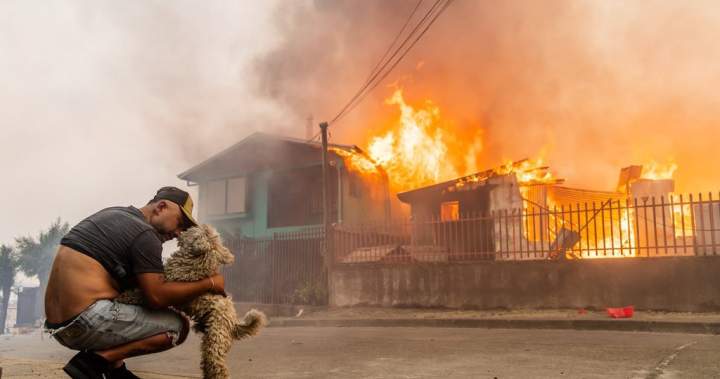
Wildfires raging across central and southern Chile on Sunday left at least 18 people dead, scorched thousands of acres of forest and destroyed hundreds of homes, authorities said, as the South American country swelters under a heat wave.
Chilean President Gabriel Boric declared a state of catastrophe in the country’s central Biobio region and the neighboring Ñuble region, around 500 kilometers (300 miles) south of Santiago, the capital.
The emergency designation allows the suspension of constitutional rights and greater coordination with the military to rein in over two dozen active wildfires that have so far blazed through 8,500 hectares (21,000 acres), according to the national forestry agency.
In a press conference from the hard-hit city of Concepción in the Biobio region, Boric expressed his support and condolences to the victims and warned that the government’s initial reports of 18 people killed and 300 houses destroyed were expected to rise as the extent of the losses came into focus.
He estimated the total number of affected homes in the Biobio region alone to be “certainly more than a thousand, just so far.”
Get daily National news
Get the day’s top news, political, economic, and current affairs headlines, delivered to your inbox once a day.
“The first priority, as you know, in these emergencies is always to fight and extinguish the fire. But we cannot forget, at any time, that there are human tragedies here, families who are suffering,” he said. “These are difficult times.”
His address followed complaints from local authorities that for hours Sunday as fires ravaged the hillsides and prompted 50,000 people to evacuate, destruction was everywhere and help was nowhere.
“Dear President Boric, from the bottom of my heart, I have been here for four hours, a community is burning and there is no (government) presence,” Rodrigo Vera, the mayor of the small coastal town of Penco in the Biobio region, said on a local radio station earlier Sunday. “How can a minister do nothing but call me to tell me that the military is going to arrive at some point?”
Firefighters struggled to extinguish the flames, with the heat and strong winds hampering their efforts. Temperatures topped 38 C (100 F) on Sunday, and the scorching weather was expected to persist through Monday.
“Weather conditions for coming hours are not good and indicate extreme temperatures,” said Interior Minister Álvaro Elizalde.


Residents said the fires took them by surprise after midnight, trapping them in their homes.
“Many people didn’t evacuate. They stayed in their houses because they thought the fire would stop at the edge of the forest,” said John Guzmán, 55, surveying the scene in Penco, where smoke blanketed the sky in an orange haze. “It was completely out of control. No one expected it.”
“We fled running, with the kids, in the dark,” said Juan Lagos, 52, also in Penco. The fire engulfed most of the city, burning cars, a school and a church.
Charred bodies were found across fields, homes, along roads and in cars.
“From what we can see, there are people who died … and we knew them well,” said Víctor Burboa, 54. “Everyone here knew them.”
Wildfires afflict central and southern Chile every summer, typically reaching a peak in February as temperatures surge and the country continues to reel from a yearslong drought. In 2024, massive fires ripping across Chile’s central coastline killed at least 130 people, becoming the nation’s deadliest natural disaster since a devastating 2010 earthquake.
Neighboring Argentina has also struggled to contain wildfires consuming thousands of acres of forest in recent weeks as the country’s southern Patagonia area experiences a spell of hot, dry weather.
© 2026 The Canadian Press
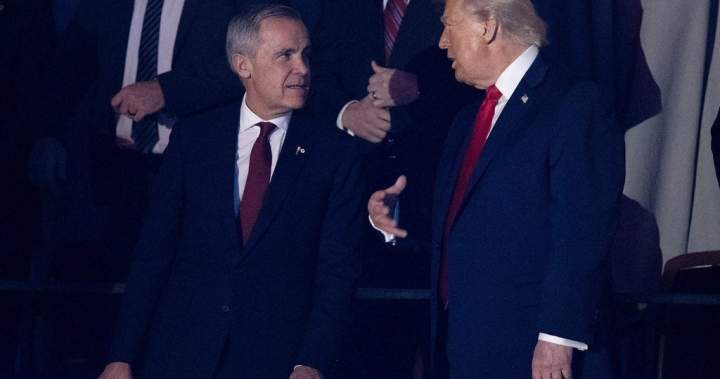
Prime Minister Mark Carney told reporters Sunday he has agreed in principle to join U.S. President Donald Trump’s controversial “Board of Peace,” meant to support the reconstruction of Gaza.
Carney told reporters in Doha that Trump asked him about joining this board “a few weeks ago.”
“There is a humanitarian tragedy in Gaza that is ongoing and Canada will make every effort possible to address this situation,“ he said at a news conference at an Islamic Art museum in the capital of the Gulf country.
He said the president put the question to him a few weeks ago and he said yes and that he and Canada will do everything it can to bring peace to the region.
Carney said there is still not unimpeded humanitarian aid flowing into help the people of Gaza and that is a “precondition for moving forward.”

The prime minister said details still need to be worked out on how exactly the board and the financing will work.
Get daily National news
Get the day’s top news, political, economic, and current affairs headlines, delivered to your inbox once a day.
The Board of Peace is part of the Trump-brokered peace plan that saw a ceasefire take hold between Israel and Hamas in Gaza.

The creation of new organization has raised concerns that it could deal a blow to the United Nations system of international cooperation that Trump has long argued is ineffective and dysfunctional, and place Trump in control of how the money is distributed.
The text of the charter, published by various international media outlets, states there is a “need for a more nimble and effective international peace-building body” than the UN.
The board will be chaired by Trump himself, and its executive makeup includes Secretary of State Marco Rubio, Trump’s Middle East special envoy Steve Witkoff, Trump’s son-in-law Jared Kushner, and former U.K. prime minister Tony Blair.
Earlier in the month Trump withdrew from dozens of international organizations, many of which are related to the UN.
Carney said working through the peace board is “consistent” with Canadian goals to ensure “unimpeded” humanitarian aid can enter the territory and work toward a two-state solution.
“We will explore every avenue in order to do that,” he said.
© 2026 The Canadian Press
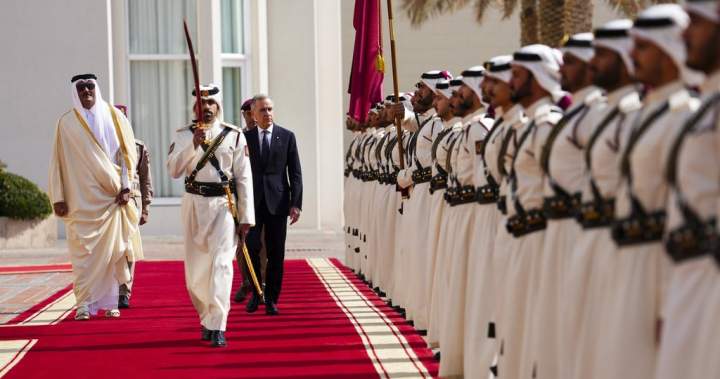
Prime Minister Mark Carney says Qatar has committed to “significant” investments for Canada’s major building projects, calling it a “new chapter” in bilateral relations.
Carney made the announcement Sunday following his meeting with Sheikh Tamim bin Hamad Al Thani, the Emir of Qatar.
The new measures will include the finalization of the Investment Promotion and Protection Agreement with Qatar, a deal that has seen years of stalled negotiations, Carney said.
“We are raising our relationship and our level of alignment by making friends with strategic partners,” Carney said. “To launch this new chapter in our relationship, I’m pleased to announce that Qatar has committed to make significant strategic investments in Canada’s nation-building projects.
“This capital will help the projects get built faster and supercharge our energy industries, while helping to create thousands of high-paying careers for Canadians.”
He also said the new agreement will help Canadian businesses to “more easily” expand operations in Qatar as well as attract investment from the country.
Get daily National news
Get the day’s top news, political, economic, and current affairs headlines, delivered to your inbox once a day.
According to a readout from the Prime Minister’s Office, air services between Canada and Qatar will also be expanded and a defence attache from Canada will be posted in the country.

According to the PMO, the two countries have agreed to launch negotiations on a new framework focused on military, security and defence matters, and expand investment opportunities on areas such as AI.
The PMO said the two leaders agreed to stay in touch and Carney noted Sunday he had invited the Emir to visit Canada later this year and attend the World Cup match between their two countries with him.

The plans with Qatar are Carney’s latest in a slew of agreements and travel to other countries to discuss trade deals since his election last year.
Asked about his ongoing efforts to meet with countries interested in trade, Carney told reporters that multilateral relationships are “being eroded.”
“The consequence of that is there is a reduction in freer trade, much more trade is tariff-based or otherwise restricted and there is virtually no, with all due respect to those who are trying, virtually no multilateral progress,” Carney said.
“Where there is progress, and where Canada and like-minded countries are looking to make progress, is through pluriality deals… which is multiple countries but not all countries.”
On Friday, Canada announced that 49,000 Chinese-made electric vehicles (EVs) would soon be imported each year with a lowered 6.1 per cent tariff after Carney struck a deal with Chinese President Xi Jinping.
Carney added on Sunday that Xi showed interest in expanding China’s trade relations with other countries, and that’s why Canada is establishing trade deals with other countries, such as Qatar.
“In this more uncertain and dangerous world, we’ve chosen to create greater stability, security and prosperity together,” Carney said.
© 2026 Global News, a division of Corus Entertainment Inc.


Wildfires raging across Chile kill at least 18, force thousands to flee – National TenX News

Carney agrees ‘in principle’ to Trump’s Gaza peace board – National TenX News

Qatar to invest in Canada’s major building projects, Carney says – National TenX News


-

 Fashion10 months ago
These ’90s fashion trends are making a comeback in 2017
-

 Entertainment10 months ago
The final 6 ‘Game of Thrones’ episodes might feel like a full season
-

 TenX Exclusive10 months ago
अमर योद्धा: राइफलमैन जसवंत सिंह रावत की वीरगाथा
-
 Politics9 months ago
Before being named Pope Leo XIV, he was Cardinal Robert Prevost. Who is he? – National TenX News
-

 Politics9 months ago
Puerto Rico faces island-wide blackout, sparking anger from officials – National TenX News
-

 Fashion10 months ago
According to Dior Couture, this taboo fashion accessory is back
-

 Tech10 months ago
Indian-AI-software-which-caught-30-thousand-criminals-and-busted-18-terrorist-modules-its-demand-is-increasing-in-foreign-countries-also – News18 हिंदी
-

 Politics9 months ago
Scientists detect possible signs of life on another planet — but it’s not aliens – National TenX News