
Politics
Russian jets violating Estonia airspace ignored NATO warning, officials say – National TenX News

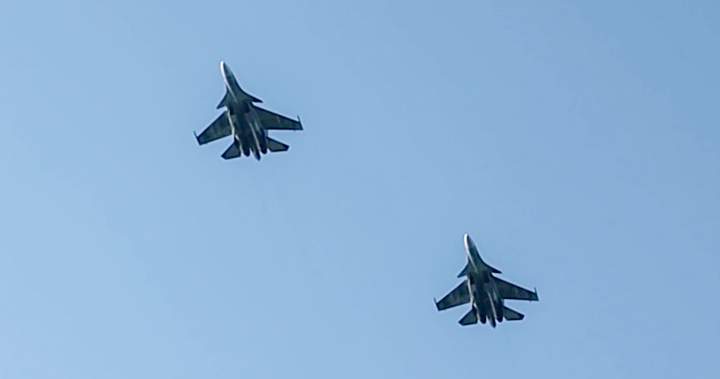
Russian pilots ignored signals from Italian jets responding from NATO’s Baltic Air Policing Mission when they violated Estonian airspace, a senior Estonian military official said Saturday.
The 12-minute incursion was the latest test of the alliance’s ability to respond to Russian airborne threats after around 20 Russian drones entered Polish airspace on Sept. 10.
Russia’s Defense Ministry on Saturday denied its aircraft flew into Estonia’s airspace, after Tallinn reported three fighter jets crossed into its territory on Friday without permission.
Estonian officials dismissed the denial, saying the violation was confirmed by radar and visual contact and suggested it could be a tactic to draw Western resources away from Ukraine.
The Russian MIG-31 fighters entered Estonian airspace between 9:58 a.m. and 10:10 a.m. local time Friday in the area of Vaindloo, a small island located in the Gulf of Finland in the Baltic Sea, the Estonian military said. A ministry statement said it was the fourth airspace violation by Russia this year.
It still “needs to be confirmed,” if the border violation was deliberate or not, Col. Ants Kiviselg, the commander of Estonia’s Military Intelligence Center, told The Associated Press. Regardless, he said, the Russian jets “must have known that they are in (Estonian) airspace.”
The Russian pilots didn’t pose a “military threat,” Kiviselg said.
But although they acknowledged communication from the Italian pilots flying F-35 fighter jets, they apparently ignored it and “didn’t actually follow the signs,” which is partly why they were in Estonian airspace for so long, he added.
“Why they didn’t do it, that’s a question for the Russian pilots,” Kiviselg said.

‘It could be big trouble’
The Russian jets came from an airfield near the city of Petrozavodsk, in northwestern Russia, and were heading to Kaliningrad, the Russian exclave on the Baltic Sea sandwiched between Lithuania and Poland. They were tracked by two Finnish fighter jets before being escorted by the two Italian jets, which took off from Estonia’s Ämari Air Base and followed them into international skies, Kiviselg said.
U.S. President Donald Trump responded Friday by telling reporters he will be briefed by aides on the incursion. “I don’t love it,” he said, adding: “I don’t like when that happens. It could be big trouble, but I’ll let you know later.”

Get daily National news
Get the day’s top news, political, economic, and current affairs headlines, delivered to your inbox once a day.
Margus Tsahkna, Estonia’s foreign minister, told AP the incident was “a very serious violation of NATO airspace.” The last time Estonian airspace was violated for so long was in 2003, he said, “just before Estonia joined NATO.”
Estonia’s government responded by saying it would request consultations under Article 4 of NATO’s treaty which allows a member to formally consult with allies whenever their territorial integrity, political independence or security is threatened. Poland also used the mechanism after its airspace was violated by Russian drones and, after that, NATO launched its Eastern Sentry mission to boost defenses along it’s eastern flank.
Posting on X, Lithuania’s Defense Minister Dovilė Šakalienė suggested NATO member “Turkey set an example” of how to respond to such incidents in 2015 when it shot down a Russian fighter jet which violated its airspace for around 17 seconds.
But that situation was “totally different,” Hanno Pevkur, Estonia’s defense minister said, adding that the “Russians actually killed Turks,” when Moscow used fighter jets to target what they said were militant groups near the Syrian border with Turkey.


During Friday’s incident, Estonia and its allies observed the Russian jets’ route, communication and reaction from the pilots as well as the weapons systems they were carrying and were “very confident that there is no need to shoot them down,” Pevkur said.
Czech President Petr Pavel said Saturday that NATO must respond adequately to Russian violations, including potentially by shooting down Russian jets, the Czech News Agency reported. “Russia will realize very quickly that they have made a mistake and crossed the acceptable boundaries. Unfortunately, this is teetering on the edge of conflict, but giving in to evil is simply not an option,” Pavel said.
Estonian officials maintained Saturday that there was no need to trigger Article 5, NATO’s collective defense clause, despite the repeated violations by Russian jets and drones as well as allegations from Western officials that Moscow is waging a hybrid war against the West including a sabotage campaign, cyberattacks and influence operations.

Radars and visual identification
In an online statement published Saturday, Russia’s Defense Ministry said its fighter jets had kept to neutral Baltic Sea waters more than three kilometers (1.8 miles) from Vaindloo Island.
It said the three MiG-31 jets “completed a scheduled flight from Karelia to an airfield in the Kaliningrad region” and “did not violate the borders of other states.”
Pevkur dismissed the statement, saying Estonia and its NATO allies have “multiple” radars and visual identification which confirm the Russian jets entered the country’s airspace.
He suggested the “root cause” for the air violations, hybrid war and cyberattacks was to distract Western attention from Ukraine.
Moscow, Pevkur said, may be trying to provoke NATO nations into sending additional air defense assets to Estonia in the hope that Kyiv’s allies do more “about our own defense,” and less to support Kyiv.
© 2025 The Canadian Press

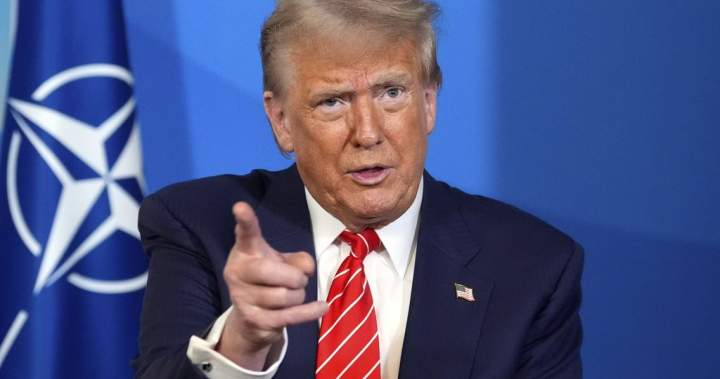
The possibility of a forceful U.S. takeover of Greenland is raising many unprecedented questions — including how Canada, the European Union and NATO could respond or even retaliate against an ostensible ally.
A high-level meeting between Greenlandic, Danish and U.S. officials this week did not resolve the “fundamental disagreement” over the territory’s sovereignty but did set the stage for more talks. The White House made clear Thursday that U.S. President Donald Trump’s desire to control Greenland has not changed after the meeting.
“He wants the United States to acquire Greenland. He thinks it’s in our best national security to do that,” White House press secretary Karoline Leavitt said.
Denmark and European allies are sending more troops to the territory in a show of force and to display a commitment to Arctic security.

Experts say there are other, non-military measures available in the event of a U.S. annexation or invasion of Greenland, or which could at least be threatened to try and get Trump to back down.
Whether those economic measures are actually used is another matter, those experts say.
“I think it remains highly unlikely that we’ll get to that point where we have to seriously discuss consequences for a U.S. move on Greenland,” said Otto Svendsen, an associate fellow with the Europe, Russia, and Eurasia Program at the Center for Strategic and International Studies.
“So it remains contingency planning for a highly unlikely event. That being said … Denmark would certainly do everything in its power to rally a very robust European response.”
Here’s what that could entail.
EU trade, tech disruptions?
Experts agree the biggest pressure points that can be used in the U.S. surround trade and technology.
The European Parliament’s trade committee is currently debating whether to postpone implementing the trade deal signed between Trump and the EU last summer to protest the threats against Greenland, Reuters reported Wednesday.
Many lawmakers have complained that the deal is lopsided, with the EU required to cut most import duties while the U.S. sticks to a broad 15 per cent tariff for European goods.
Get daily National news
Get the day’s top news, political, economic, and current affairs headlines, delivered to your inbox once a day.
An even bolder move would be triggering the EU’s anti-coercion instrument — known as the “trade bazooka” — that would allow the bloc to hit non-member nations with tariffs, trade restrictions, foreign investment bans, and other penalties if that country is found to be using coercive economic measures.
Although the regulation defines coercion as “measures affecting trade and investment,” Svendsen said it could feasibly be used in a diplomatic or territorial dispute as well.
“EU lawyers have proven themselves to be very creative in recent years,” he said.
However, David Perry, president of the Canadian Global Affairs Institute, said in an email that economic measures against the U.S. are unlikely “given the massive asymmetry in the defence and economic relationship between the U.S.” and other western nations.
“Any kind of sanction against the U.S. doesn’t make sense for the same reason they can impose tariffs on others: they have the power,” Perry added.

Target U.S. tech companies?
The likeliest — and potentially least harmful — scenario for retaliation in the event of an attack on Greenland, Svendsen said, would be fines or bans against U.S. tech companies like Google, Meta and X operating in Europe.
That’s because the Trump administration has taken particular focus on preventing what they call “attacks” on American companies by foreign governments seeking to regulate their online content or tax their revenues, which has led to calls on Canada, Britain and the EU to repeal laws like digital services taxes.
“I think that would be a really smart and targeted way to get to economic interests very close to the president, while minimizing the direct impact on the on the European economy,” Svendsen said, calling such a move “low-hanging fruit.”


He also compared a future U.S. tech platform ban to how Europe moved to wean itself off Russian gas after the full-scale invasion of Ukraine in 2022.
“If you told anyone back then that Europe would basically rid itself of its dependence on Russian gas basically within a two-year period … that would have been considered completely impossible,” he said.
“Weaning the European economy off of U.S. tech would certainly be painful in the short term, but they’ve proven that they can get off those dependencies quickly if there is political will behind it in the past.”
A U.S. hostile takeover of Greenland would mean the “end” of the NATO alliance, experts and European leaders have said.
Trump himself has acknowledged it could be a “choice” between preserving the alliance or acquiring Greenland.
There is no provision within the NATO founding treaty that addresses the possibility of a NATO member taking territory from another, and how the alliance should respond to such an act.
A NATO spokesperson told Global News it wouldn’t “speculate on hypothetical scenarios” when asked how it could potentially act.

“None of this would be actionable in a NATO sense,” Perry said. “It’s an alliance that’s organized to bind the U.S. to European security, and revolves around the U.S. So there’s no scenario of NATO doing that to the U.S.”
Denmark and other European nations could move to reduce or close U.S. military bases in their countries as a possible response, experts say.
Balkan Devlen, a a senior fellow at the Macdonald-Laurier Institute and director of its Transatlantic Program, said in an interview that a U.S. annexation of Greenland would force Canada to focus entirely on boosting its defences in the Arctic.
That may include trying to decouple from NORAD, the joint northern defence network with the U.S., in favour of a purely domestic Arctic command, he said — although that process would take years and require Canada to increase defence spending even further.
“Never mind five per cent (of GDP) — we will probably need to go like seven, eight, nine per cent on defence spending to be able to do anything of that sort,” he said. “It’s not even clear that we’ll be able to have enough people to do that.”
Devlen added that any retaliatory action, whether military or financial, needs to be targeted and proportionate to what the U.S. does.
“The problem with nuclear options is that once you use it, it’s gone,” he said. “And if it doesn’t do the damage or make the change of behaviour on the other party, you’ve basically lost a lot of leverage and you might actually sustain a lot more loss yourself.”

A trip to the world’s most-visited museum is about to cost Canadians significantly more.
France has hiked ticket prices at the Louvre by 45 per cent for visitors from outside the European Union, a move that is fuelling debate over so-called dual pricing and the growing backlash against overtourism.
Starting this week, adult visitors from non-EU countries, including Canada, must pay €32 to enter the Paris landmark, up from €22. That’s an increase from about $35 to $52 Canadian.

Visitors from EU countries, as well as Iceland, Liechtenstein and Norway, will continue to pay the lower rate.
The price hike comes as the Louvre grapples with repeated labour strikes, a high-profile daylight jewel heist last October that prompted a costly security overhaul, and years of chronic overcrowding. The museum attracts roughly nine million visitors annually.
Get breaking National news
For news impacting Canada and around the world, sign up for breaking news alerts delivered directly to you when they happen.
Some Canadian tourists told Global News they feel unfairly targeted.
“We didn’t cause the robberies or some of the other issues that happened and we are paying the consequences,” said Allison Moore, visiting Paris from Newfoundland with her daughter. “[In] Canada we don’t discriminate over pricing like that.”
Others argue tourists already shoulder higher costs simply by travelling long distances.
“In general for tourists, I think things should be a little cheaper than for local people, because we have to travel to come all the way here,” said Darla Daniela Quiroz, another Canadian visitor. “It should be equal pricing, or a little bit cheaper.”


Even some Europeans question the two-tiered system. A French tourist interviewed outside the museum said there was “no reason” to charge non-Europeans more and that the fee should be the same for everyone.
Tourism experts say the Louvre’s financial pressures help explain the decision.
“The Louvre is really cash-strapped right now and needs to do something,” said Marion Joppe, a professor at the University of Guelph. “It can’t really look to the government, which is already struggling with its own budget.”
The move also reflects a broader global pushback against mass tourism. Anti-tourism protests have spread across parts of Spain, New Zealand has increased its entry tax, and the United States recently raised national park fees for foreign visitors.
“You take Paris — it gets about 50 million tourists a year,” said Julian Karaguesian, an economist at McGill University. “That’s roughly a million a week. The city simply wasn’t built for those kinds of numbers.”
Despite the higher price, many visitors say they will still line up to see the Mona Lisa and other of the museum’s famous artworks.
“It’s one of the main attractions. It’s on everybody’s list,” Moore said. “We’re still going to go, and hopefully it will be worth it in the end.”
© 2026 Global News, a division of Corus Entertainment Inc.
Politics
Trump calls Canada-China deal ‘good thing’ as U.S. officials voice concern – National TenX News
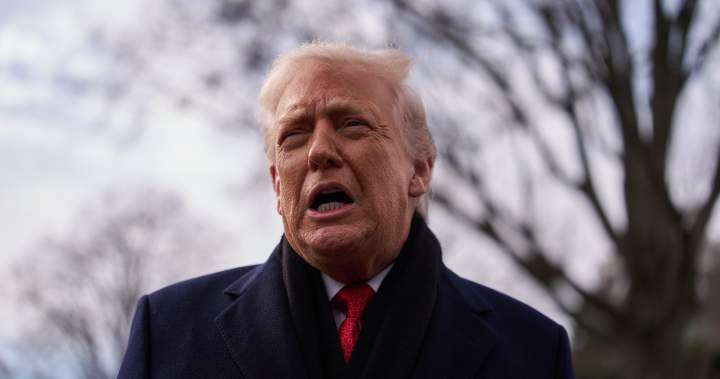
Canada’s new trade deal with China is getting a mixed reaction in Washington, with U.S. President Donald Trump voicing support as administration officials warned Ottawa could regret allowing Chinese EVs into the Canadian market.
The deal signed with Beijing on Friday reverses course on 100 per cent tariffs Canada slapped on Chinese electric vehicles in 2024, which aligned with similar U.S. duties. Canada and China also agreed to reduce tariffs on canola and other products.
Asked about the deal by reporters at the White House, Trump said Prime Minister Mark Carney was doing the right thing.
“That’s what he should be doing. It’s a good thing for him to sign a trade deal. If you can get a deal with China, you should do that,” Trump said.
However, members of Trump’s cabinet expressed concern.
“I think they’ll look back at this decision and surely regret it to bring Chinese cars into their market,” U.S. Transportation Secretary Sean Duffy said at an event with other U.S. government officials at a Ford factory in Ohio to tout efforts to make vehicles more affordable.
U.S. Trade Representative Jamieson Greer told reporters the limited number of vehicles would not impact American car companies exporting cars to Canada.
“I don’t expect that to disrupt American supply into Canada,” he said.
“Canada is so dependent on the United States for their GDP. Their entire population is crowded around our border for that reason. I’ll tell you one thing: if those cars are coming into Canada, they’re not coming here. That’s for sure.”
Get daily National news
Get the day’s top news, political, economic, and current affairs headlines, delivered to your inbox once a day.
Carney has said it’s necessary for Canada to improve trade ties and cooperation with China in light of Trump’s trade war and threats to let the Canada-U.S.-Mexico Agreement on free trade expire.

The trade pact is up for review this summer, and Greer reiterated that the Trump administration wants to bring more auto manufacturing back to the U.S. and incentivize companies to do so.
Under the new deal with Beijing, Carney said he expects China will lower tariffs on its canola seed by March 1 to a combined rate of about 15 per cent.
Greer questioned that agreement in a separate CNBC interview.
“I think in the long run, they’re not going to like having made that deal,” he said.
He called the decision to allow Chinese EVs into Canada “problematic” and added: “There’s a reason why we don’t sell a lot of Chinese cars in the United States. It’s because we have tariffs to protect American auto workers and Americans from those vehicles.”
Greer said rules adopted last January on vehicles that are connected to the internet and navigation systems are a significant impediment to Chinese vehicles in the U.S. market.

“I think it would be hard for them to operate here,” Greer said. “There are rules and regulations in place in America about the cybersecurity of our vehicles and the systems that go into those, so I think it might be hard for the Chinese to comply with those kind of rules.”

Trump and officials like Greer have taken aim at Chinese attempts to enter the North American car market through Mexico by bypassing rules of origin under CUSMA.
The CUSMA review set for July is expected to address those loopholes that American and Canadian officials have said are being exploited by China.
Those concerns, which were also raised by the Biden administration, in part helped spur the steep tariffs on Chinese EVs, which are heavily subsidized by Beijing.
Trump, however, has also said he would like Chinese automakers to come to the United States to build vehicles.
Both Democrat and Republican lawmakers in the U.S. have expressed strong opposition to Chinese vehicles as major U.S. automakers warn China poses a threat to the U.S. auto sector.
Ohio Senator Bernie Moreno, a Republican, said at Friday’s event at the Ford plant that he was opposed to Chinese vehicles coming into the United States, and drew applause from the other government officials.
“As long as I have air in my body, there will not be Chinese vehicles sold the United States of America — period,” Moreno said.
—with files from Reuters
© 2026 Global News, a division of Corus Entertainment Inc.


How could Canada, EU, NATO respond to a U.S. takeover of Greenland? – National TenX News

Louvre raises ticket prices for non-Europeans, hitting Canadian visitors TenX News

Trump calls Canada-China deal ‘good thing’ as U.S. officials voice concern – National TenX News


-

 Fashion10 months ago
These ’90s fashion trends are making a comeback in 2017
-

 Entertainment10 months ago
The final 6 ‘Game of Thrones’ episodes might feel like a full season
-

 TenX Exclusive10 months ago
अमर योद्धा: राइफलमैन जसवंत सिंह रावत की वीरगाथा
-

 Politics8 months ago
Before being named Pope Leo XIV, he was Cardinal Robert Prevost. Who is he? – National TenX News
-

 Politics9 months ago
Puerto Rico faces island-wide blackout, sparking anger from officials – National TenX News
-

 Fashion10 months ago
According to Dior Couture, this taboo fashion accessory is back
-

 Tech10 months ago
Indian-AI-software-which-caught-30-thousand-criminals-and-busted-18-terrorist-modules-its-demand-is-increasing-in-foreign-countries-also – News18 हिंदी
-

 Politics9 months ago
Scientists detect possible signs of life on another planet — but it’s not aliens – National TenX News