
Politics
Putin warns Europe not to ‘wage a war’ as he meets with U.S. on Ukraine – National TenX News

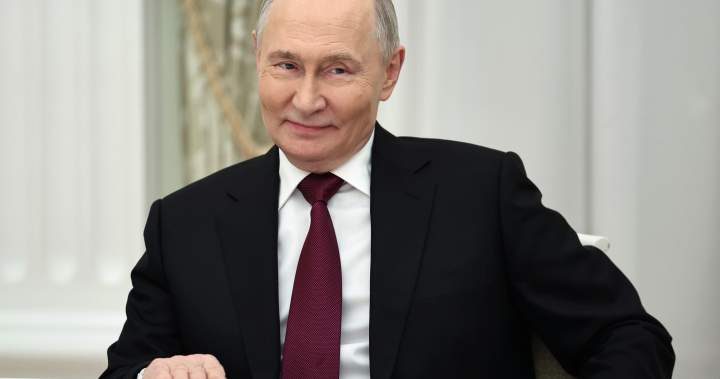
Talks between Russia and the U.S. on ending the nearly four-year war in Ukraine were productive, but much work remains, Yuri Ushakov, a senior adviser to President Vladimir Putin, told reporters on Wednesday.
Putin met U.S. President Donald Trump’s envoy Steve Witkoff and son-in-law Jared Kushner in the Kremlin in talks that began late Tuesday as part of a renewed push by the Trump administration to broker a peace deal. Both sides agreed not to disclose the substance of the talks.
The meeting came days after U.S. officials held talks with a Ukrainian team in Florida and which U.S. Secretary of State Marco Rubio described in cautiously optimistic terms.
At the center of the effort is Trump’s peace plan that became public last month and raised concerns about being tilted heavily toward Moscow. The proposal granted some of the Kremlin’s core demands that Kyiv has rejected as nonstarters, such as Ukraine ceding the entire eastern region of the Donbas to Russia and renouncing its bid to join NATO. Negotiators have indicated the framework has changed, but it’s not clear how.
On Tuesday, Putin accused Kyiv’s European allies of sabotaging U.S.-led efforts to end the war in Ukraine.
“They don’t have a peace agenda, they’re on the side of the war,” Putin said of the Europeans.
Putin ‘s accusations appeared to be his latest attempt to sow dissension between Trump and European countries and set the stage for exempting Moscow from blame for any lack of progress.
He accused Europe of amending peace proposals with “demands that are absolutely unacceptable to Russia,” thus “blocking the entire peace process” and blaming Moscow for it. He also reiterated his long-held position that Russia has no plans to attack Europe — a concern regularly voiced by some European countries.
“But if Europe suddenly wants to wage a war with us and starts it, we are ready right away. There can be no doubt about that,” Putin said.

Russia started the war in 2022 with its full-scale invasion of a sovereign European country, and European governments have since spent billions of dollars to support Ukraine financially and militarily, to wean themselves from energy dependence on Russia, and to strengthen their own militaries to deter Moscow from seizing more territory by force.
They worry that if Russia gets what it wants in Ukraine, it will have free rein to threaten or disrupt other European countries, which already have faced incursions from Russian drones and fighter jets, and an alleged widespread Russian sabotage campaign.
Trump’s peace plan relies on Europe to provide the bulk of the financing and security guarantees for a postwar Ukraine, even though no Europeans appear to have been consulted on the original plan. That’s why European governments have pushed to ensure that peace efforts address their concerns, too.

Get daily National news
Get the day’s top news, political, economic, and current affairs headlines, delivered to your inbox once a day.
Coinciding with Witkoff’s trip, Ukrainian President Volodymyr Zelenskyy went to Ireland, continuing his visits to European countries that have helped sustain his country’s fight against Russia’s invasion.
Zelenskyy said Tuesday he was expecting swift reports from the U.S. envoys in Moscow on whether talks could move forward, after Trump’s initial 28-point plan was whittled down to 20 items in Sunday’s talks between U.S. and Ukrainian officials in Florida.
“The future and the next steps depend on these signals. Such steps will change throughout today, even hour by hour, I believe,” Zelenskyy said at a news conference in Dublin with Irish Prime Minister Micheál Martin.
“If the signals show fair play with our partners, we then might meet very soon, meet with the American delegation,” he said.
“There is a lot of dialogue, but we need results. Our people are dying every day,” Zelenskyy said. “I am ready … to meet with President Trump. It all depends on today’s talks.”

Building on progress in Florida
After months of frustration in trying to stop the fighting, Trump deployed officials to get traction for his peace proposals. The talks have followed parallel lines so far, with Rubio sitting down with Ukrainian officials.
Zelenskyy said he met Tuesday with the Ukrainian delegation that returned from the negotiations with U.S. representatives in Florida. Rubio said those talks made progress, but added that “there’s more work to be done.”


Zelenskyy said the Florida talks took as their cue a document that both sides drafted at an earlier meeting in Geneva. The Ukrainian leader said that document was now “finalized,” although he didn’t explain what that meant.
Ukrainian diplomats are working to ensure that European partners are “substantially involved” in decision-making, Zelenskyy said on the Telegram messaging app, and warned about what he said were Russian disinformation campaigns aimed at steering the negotiations.
European leaders want a say
Zelenskyy met with political leaders and lawmakers in Dublin on his first official visit. Ireland is officially neutral and isn’t a member of NATO but has sent nonlethal military support to Ukraine. More than 100,000 Ukrainians have moved to Ireland since Russia launched its war on Feb. 24, 2022.
Although this week’s consultations could move the process forward, few details have become public. It remains unclear how envoys are going to bridge the gap between the two sides on such basic differences as who keeps what territory. European officials say the road to peace will be long.

European leaders want to make their voices heard after being largely sidelined by Washington. They are also working on future security guarantees for Ukraine.
Zelenskyy was in Paris on Monday, and French President Emmanuel Macron said they spoke by phone with Witkoff. They also spoke to leaders of eight other European countries as well as top European Union officials and NATO Secretary-General Mark Rutte.
Diplomats face a hard time trying to bridge Russian and Ukrainian differences and persuading them to strike compromises. The key obstacles — over whether Kyiv should cede land to Moscow and how to ensure Ukraine’s future security — appear unresolved.
Zelenskyy is under severe pressure in one of the darkest periods of the war for his country. As well as managing diplomatic pressure, he must find money to keep Ukraine afloat, address a corruption scandal that has reached the top echelons of his government, and keep Russia at bay on the battlefield.
The Kremlin late Monday claimed that Russian forces have captured the key city of Pokrovsk in the Donetsk region of eastern Ukraine. Zelenskyy, however, said in Paris that fighting was still ongoing in Pokrovsk on Monday.
Ukraine’s general staff on Tuesday also denied Russia’s claims to have captured Pokrovsk, saying it was a propaganda stunt. The Ukrainian army is readying additional logistic routes to deliver supplies to troops in the area, the Facebook post said.

World leaders are raising alarm after U.S. President Donald Trump threatened to impose sweeping tariffs on European allies in an effort to pressure Denmark into negotiations over Greenland.
The move is sparking protests across the Arctic and sharp rebukes from Europe and Canada.
On Saturday, thousands of people marched through snow and ice in Greenland’s capital, Nuuk, chanting “Greenland is not for sale,” waving national flags.
Police described the demonstration as the largest they have ever seen in the city.
About 825 kilometres away, dozens of people rallied in Iqaluit, Nunavut, in a show of solidarity with Greenlanders.
“Greenland is owned by the Greenlandic people,” protesters chanted in Inuktut as they marched for an hour in freezing, windy conditions.
The protests came as Trump announced he would impose a 10 per cent import tax starting next month on goods from eight European countries.
These nations include Denmark, Norway, Sweden, France, Germany, the United Kingdom, the Netherlands and Finland, because of their opposition to U.S. control of Greenland.
Get breaking National news
For news impacting Canada and around the world, sign up for breaking news alerts delivered directly to you when they happen.
The tariff would rise to 25 per cent on June 1 if no deal was reached for what Trump called the “Complete and Total purchase of Greenland.”
The president suggested the tariffs were leveraged to force talks over Greenland, a semi-autonomous territory of NATO ally Denmark that Trump says is vital to U.S. national security.
French President Emmanuel Macron said France stands firmly behind Greenland’s sovereignty and rejected the use of trade threats.
“Tariff threats are unacceptable and have no place in this context,” Macron wrote on social media, adding that Europeans would respond “in a united and coordinated manner” if the measures are confirmed.
British Prime Minister Keir Starmer said Greenland’s future is for Greenlanders and Denmark to decide.
“Applying tariffs on allies for pursuing the collective security of NATO allies is completely wrong,” Starmer said, adding the issue would be raised directly with the U.S. administration.


Bob Rae, former Canadian ambassador to the United Nations, also chimed in on Trump’s announcement.
The tariff threat could mark a significant rupture between the U.S. and its NATO allies.
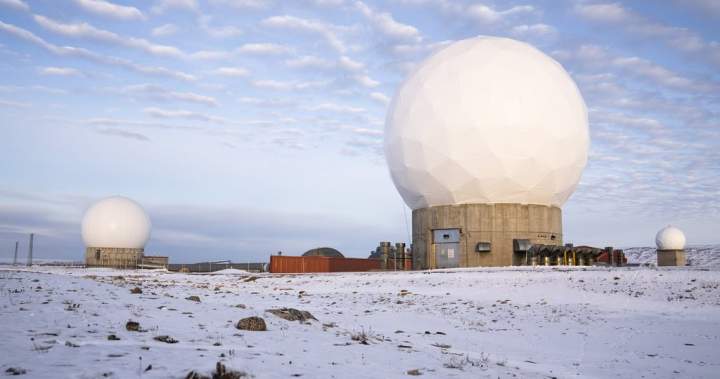
Greenland already hosts the U.S.-run Pituffik Space Base under a 1951 defence agreement with Denmark, supporting missile warning, missile defence and space surveillance for the U.S. and NATO.
“There is no sign of the Trump war of aggression against Greenland and Denmark letting up. It is not about ‘security’ any more than Venezuela was about ‘narco-terrorism.’ They are both about seizing control and plunder.”
He further added, “No country, including my own, Canada, is safe or secure.”
The tariff threat could mark a significant rupture between the U.S. and its NATO allies.
Trump is expected to face questions about the proposed tariffs and Greenland later this week.
He is scheduled to attend the World Economic Forum in Davos, alongside several European leaders he has threatened with tariffs.
— With files from The Canadian Press
© 2026 Global News, a division of Corus Entertainment Inc.
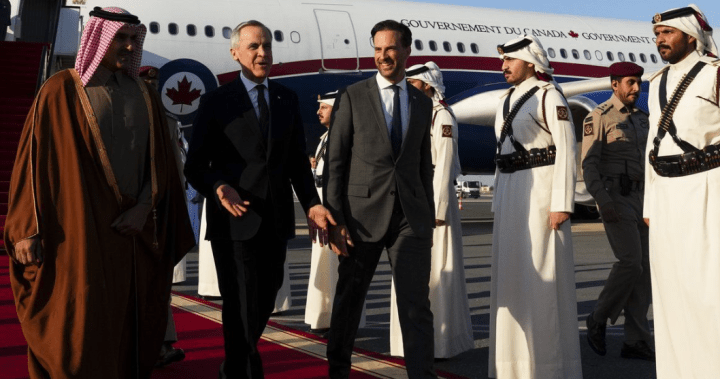
Prime Minister Mark Carney arrived in Doha on Saturday as part of a push to attract foreign investment and deepen Canada’s economic partnerships beyond its traditional allies.
Carney’s visit comes on the heels of his visit to China and follows the recent presentation of a new federal investment budget aimed at positioning Canada as a stable, attractive destination for global capital.
In a news conference on Saturday, Finance Minister François-Philippe Champagne said Canada is working to broaden its economic relationships as global trade patterns shift.
Qatar is viewed by Ottawa as a strategic partner, with officials pointing to the country’s significant investment capacity and growing influence on the global stage.
Get breaking National news
For news impacting Canada and around the world, sign up for breaking news alerts delivered directly to you when they happen.
“We need to reduce our dependence and increase our self-reliance to find a strategic path forward,” Champagne said.
“Engaging with the Middle East and China is necessary for Canada, just like our European partners have done,” Champagne added. “We buy more from the U.S.A. than anywhere else, but the trading climate right now is different.”
The conference highlighted Canada’s industrial capacity and trade advantages as key selling points for potential investors.
Champagne also said international engagement is critical as Canada works to raise its profile among global investors.


“We are one of the G7s with very big industries. We build cars, planes, ships, we have an abundance of energy, and we are the only one with free trade with all G7,” Champagne said. “With the way the world is changing, you better diversify, supply chain is changing and we need to adapt.”
Prime Minister Carney is expected to meet with senior Qatari officials, including Emir Sheikh Tamim bin Hamad Al Thani, as well as representatives of the Qatar Investment Authority.
His office says the talks will focus on expanding trade access and forging partnerships in artificial intelligence, infrastructure, energy and defence.
The visit comes amid heightened geopolitical tensions in the region, though officials say the schedule remains unchanged.
© 2026 Global News, a division of Corus Entertainment Inc.
The possibility of a forceful U.S. takeover of Greenland is raising many unprecedented questions — including how Canada, the European Union and NATO could respond or even retaliate against an ostensible ally.
A high-level meeting between Greenlandic, Danish and U.S. officials this week did not resolve the “fundamental disagreement” over the territory’s sovereignty but did set the stage for more talks. The White House made clear Thursday that U.S. President Donald Trump’s desire to control Greenland has not changed after the meeting.
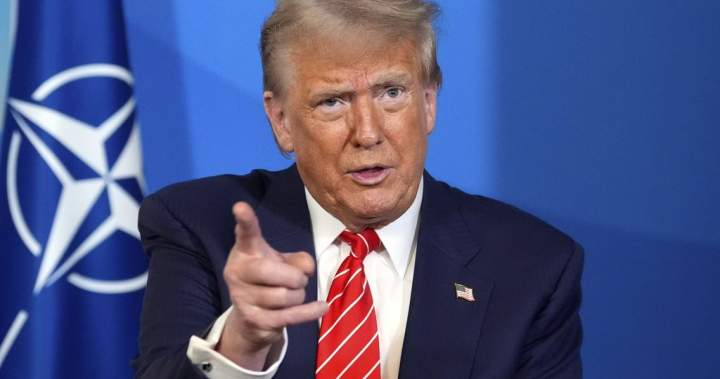
“He wants the United States to acquire Greenland. He thinks it’s in our best national security to do that,” White House press secretary Karoline Leavitt said.
Denmark and European allies are sending more troops to the territory in a show of force and to display a commitment to Arctic security.

Experts say there are other, non-military measures available in the event of a U.S. annexation or invasion of Greenland, or which could at least be threatened to try and get Trump to back down.
Whether those economic measures are actually used is another matter, those experts say.
“I think it remains highly unlikely that we’ll get to that point where we have to seriously discuss consequences for a U.S. move on Greenland,” said Otto Svendsen, an associate fellow with the Europe, Russia, and Eurasia Program at the Center for Strategic and International Studies.
“So it remains contingency planning for a highly unlikely event. That being said … Denmark would certainly do everything in its power to rally a very robust European response.”
Here’s what that could entail.
EU trade, tech disruptions?
Experts agree the biggest pressure points that can be used in the U.S. surround trade and technology.
The European Parliament’s trade committee is currently debating whether to postpone implementing the trade deal signed between Trump and the EU last summer to protest the threats against Greenland, Reuters reported Wednesday.
Many lawmakers have complained that the deal is lopsided, with the EU required to cut most import duties while the U.S. sticks to a broad 15 per cent tariff for European goods.
Get daily National news
Get the day’s top news, political, economic, and current affairs headlines, delivered to your inbox once a day.
An even bolder move would be triggering the EU’s anti-coercion instrument — known as the “trade bazooka” — that would allow the bloc to hit non-member nations with tariffs, trade restrictions, foreign investment bans, and other penalties if that country is found to be using coercive economic measures.
Although the regulation defines coercion as “measures affecting trade and investment,” Svendsen said it could feasibly be used in a diplomatic or territorial dispute as well.
“EU lawyers have proven themselves to be very creative in recent years,” he said.
However, David Perry, president of the Canadian Global Affairs Institute, said in an email that economic measures against the U.S. are unlikely “given the massive asymmetry in the defence and economic relationship between the U.S.” and other western nations.
“Any kind of sanction against the U.S. doesn’t make sense for the same reason they can impose tariffs on others: they have the power,” Perry added.

Target U.S. tech companies?
The likeliest — and potentially least harmful — scenario for retaliation in the event of an attack on Greenland, Svendsen said, would be fines or bans against U.S. tech companies like Google, Meta and X operating in Europe.
That’s because the Trump administration has taken particular focus on preventing what they call “attacks” on American companies by foreign governments seeking to regulate their online content or tax their revenues, which has led to calls on Canada, Britain and the EU to repeal laws like digital services taxes.
“I think that would be a really smart and targeted way to get to economic interests very close to the president, while minimizing the direct impact on the on the European economy,” Svendsen said, calling such a move “low-hanging fruit.”


He also compared a future U.S. tech platform ban to how Europe moved to wean itself off Russian gas after the full-scale invasion of Ukraine in 2022.
“If you told anyone back then that Europe would basically rid itself of its dependence on Russian gas basically within a two-year period … that would have been considered completely impossible,” he said.
“Weaning the European economy off of U.S. tech would certainly be painful in the short term, but they’ve proven that they can get off those dependencies quickly if there is political will behind it in the past.”
A U.S. hostile takeover of Greenland would mean the “end” of the NATO alliance, experts and European leaders have said.
Trump himself has acknowledged it could be a “choice” between preserving the alliance or acquiring Greenland.
There is no provision within the NATO founding treaty that addresses the possibility of a NATO member taking territory from another, and how the alliance should respond to such an act.
A NATO spokesperson told Global News it wouldn’t “speculate on hypothetical scenarios” when asked how it could potentially act.

“None of this would be actionable in a NATO sense,” Perry said. “It’s an alliance that’s organized to bind the U.S. to European security, and revolves around the U.S. So there’s no scenario of NATO doing that to the U.S.”
Denmark and other European nations could move to reduce or close U.S. military bases in their countries as a possible response, experts say.
Balkan Devlen, a a senior fellow at the Macdonald-Laurier Institute and director of its Transatlantic Program, said in an interview that a U.S. annexation of Greenland would force Canada to focus entirely on boosting its defences in the Arctic.
That may include trying to decouple from NORAD, the joint northern defence network with the U.S., in favour of a purely domestic Arctic command, he said — although that process would take years and require Canada to increase defence spending even further.
“Never mind five per cent (of GDP) — we will probably need to go like seven, eight, nine per cent on defence spending to be able to do anything of that sort,” he said. “It’s not even clear that we’ll be able to have enough people to do that.”
Devlen added that any retaliatory action, whether military or financial, needs to be targeted and proportionate to what the U.S. does.
“The problem with nuclear options is that once you use it, it’s gone,” he said. “And if it doesn’t do the damage or make the change of behaviour on the other party, you’ve basically lost a lot of leverage and you might actually sustain a lot more loss yourself.”


“Unacceptable’: Allies react to Trump Greenland tariff threats – National TenX News

Canada talks trade with Qatar as Carney touches down in Doha – National TenX News

How could Canada, EU, NATO respond to a U.S. takeover of Greenland? – National TenX News


-

 Fashion10 months ago
These ’90s fashion trends are making a comeback in 2017
-

 Entertainment10 months ago
The final 6 ‘Game of Thrones’ episodes might feel like a full season
-

 TenX Exclusive10 months ago
अमर योद्धा: राइफलमैन जसवंत सिंह रावत की वीरगाथा
-

 Politics8 months ago
Before being named Pope Leo XIV, he was Cardinal Robert Prevost. Who is he? – National TenX News
-

 Politics9 months ago
Puerto Rico faces island-wide blackout, sparking anger from officials – National TenX News
-

 Fashion10 months ago
According to Dior Couture, this taboo fashion accessory is back
-

 Tech10 months ago
Indian-AI-software-which-caught-30-thousand-criminals-and-busted-18-terrorist-modules-its-demand-is-increasing-in-foreign-countries-also – News18 हिंदी
-

 Politics9 months ago
Scientists detect possible signs of life on another planet — but it’s not aliens – National TenX News