
Politics
Israeli strikes kill more top Iranian officials in 3rd day of open conflict – National TenX News

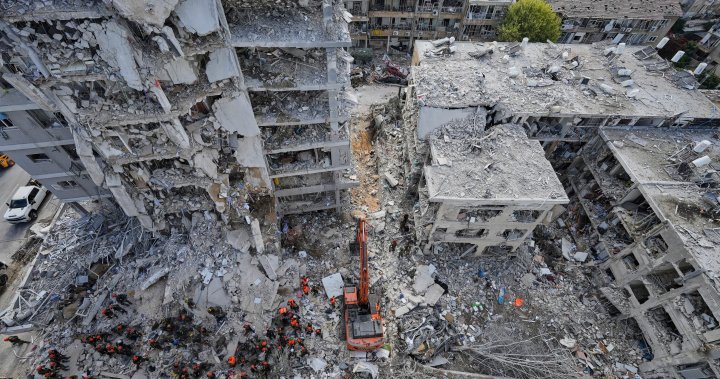
Israel claimed to operate almost freely in the skies over Iran during a third day of airstrikes Sunday and killed more high-ranking security figures, while some Iranian missiles slipped through Israel’s air defenses. Both sides threatened to launch more attacks.
In an indication of how far Israel was prepared to go amid fears of all-out war, a U.S. official told The Associated Press that President Donald Trump in recent days vetoed an Israeli plan to kill Iran’s Supreme Leader Ayatollah Ali Khamenei.
The Iranian Health Ministry said late Sunday that 224 people have been killed since Israel’s attack began Friday. Spokesman Hossein Kermanpour said on social media that 1,277 other people were hospitalized. He asserted that more than 90% of the casualties were civilians.
The paramilitary Revolutionary Guard, which controls Iran’s arsenal of ballistic missiles, said intelligence chief Gen. Mohammad Kazemi and two other generals were the latest killed, Iran’s state TV reported Sunday night. Israel’s attacks have killed several top generals and nuclear scientists.
Iran also said Israel struck two oil refineries, raising the prospect of a broader assault on Iran’s heavily sanctioned energy industry that could affect global markets. Israel’s military warned Iranians to evacuate arms factories, signaling a further widening of the campaign. Iran’s military, on state TV, warned Israelis to stay away from “occupied” areas.

Israel, the sole though undeclared nuclear-armed state in the Middle East, has said it launched the attack — its most powerful ever against Iran — to prevent Iran from developing a nuclear weapon. The two countries have been adversaries for decades. The latest U.S.-Iran talks on its nuclear program were canceled.
Explosions shook the Iranian capital of Tehran. Sirens went off in Israel. The Israeli military noted “several hit sites” Sunday night, including in Haifa in the north, and the Magen David Adom emergency service said it treated nine injured people.
Israel said 14 people have been killed there since Friday and 390 wounded. Iran has fired over 270 missiles, 22 of which got through the country’s sophisticated multi-tiered air defenses, according to Israeli figures. Israel’s main international airport and airspace was closed for a third day.
Iranian Foreign Minister Abbas Araghchi said if Israel’s strikes on Iran stop, then “our responses will also stop.” Iran’s president, Masoud Pezeshkian, criticized the United States for supporting Israel and said “the responses will be more decisive and severe” if Israel keeps attacking, state TV reported.
Trump said the U.S. “had nothing to do with the attack” and that Iran can avoid further destruction only by agreeing to a new nuclear deal.
Photos shared by Iran’s ISNA News Agency showed bloodied people being helped from the scene of Israeli strikes in downtown Tehran. One man carried a blood-spattered girl.

Get daily National news
Get the day’s top news, political, economic, and current affairs headlines, delivered to your inbox once a day.
Deputy Foreign Minister Saeed Khatibzadeh said Israel hit a Foreign Ministry building in the north of Tehran, with several civilians injured “including a number of my colleagues,” Iran’s state-run IRNA news agency reported.

Israeli strikes also targeted Iran’s Defense Ministry after hitting air defenses, military bases and sites associated with its nuclear program. On Sunday night, Israel said it struck “numerous” sites across Iran that produce missile and air defense components.
Israel also claimed it attacked an Iranian refueling aircraft in Mashhad in the northeast, calling it the farthest strike the military had carried out. Iran did not immediately acknowledge any attack. Video obtained and verified by the AP showed smoke rising from the city.
Iran’s foreign minister said Israel targeted an oil refinery near Tehran and another in a province on the Persian Gulf.
State television reported that metro stations and mosques would be made available as bomb shelters beginning Sunday night.
Death toll rises in Israel
Earlier Sunday in Israel, at least six people, including a 10-year-old and a 9-year-old, were killed when a missile hit an apartment building in Bat Yam, near Tel Aviv. Daniel Hadad, a local police commander, said 180 people were wounded and seven were missing.
Another four people, including a 13-year-old, were killed and 24 wounded when a missile struck a building in the Arab town of Tamra in northern Israel. A strike on the central city of Rehovot wounded 42. The Weizmann Institute of Science, an important center for military and other research in Rehovot, reported “a number of hits to buildings on the campus” and said no one was harmed.
An oil refinery was damaged in the northern Israeli city of Haifa, according to the firm operating it, which said no one was wounded.


Netanyahu says regime change in Iran could be a result
Israeli Prime Minister Benjamin Netanyahu has brushed off urgent calls by world leaders to deescalate.
In an interview with Fox News on Sunday, he said regime change in Iran “could certainly be the result” of the conflict. He also claimed, without giving evidence, that Israeli intelligence indicated Iran intended to give nuclear weapons to Iranian-backed Houthi rebels in Yemen.
Iran has always said its nuclear program was peaceful, and the U.S. and others have assessed that it has not pursued a weapon since 2003. But Iran has enriched ever larger stockpiles of uranium to near weapons-grade levels in recent years and was believed to have the capacity to develop multiple weapons within months if it chose to do so.
The U.N.’s atomic watchdog issued a rare censure of Iran last week.

A senior U.S. official, speaking on condition of anonymity to discuss the sensitive nuclear talks, said Washington remained committed to them and hoped the Iranians would return to the table.
The region is already on edge as Israel seeks to annihilate Hamas, an Iranian ally, in the Gaza Strip, where war still rages after Hamas’ Oct. 7, 2023, attack.
In a social media post, Trump warned Iran that any retaliation directed against it would bring an American response “at levels never seen before.”
‘More than a few weeks’ to repair nuclear facilities
In Iran, satellite photos analyzed by AP show extensive damage at Iran’s main nuclear enrichment facility in Natanz. The images shot Saturday by Planet Labs PBC show multiple buildings damaged or destroyed. The structures hit include buildings identified by experts as supplying power to the facility.

U.N. nuclear chief Rafael Grossi told the Security Council that the above-ground section of the Natanz facility was destroyed. The main centrifuge facility underground did not appear to be hit, but the loss of power could have damaged infrastructure there, he said.
Israel also struck a nuclear research facility in Isfahan. The International Atomic Energy Agency, the U.N. nuclear watchdog, said four “critical buildings” were damaged, including Isfahan’s uranium-conversion facility. The IAEA said there was no sign of increased radiation at Natanz or Isfahan.
An Israeli military official, speaking on condition of anonymity Sunday in line with official procedures, said it would take “many months, maybe more” to restore the two sites.
Melzer reported from Nahariya, Israel, and Goldenberg from Tel Aviv, Israel. Associated Press writers Nasser Karimi and Amir Vahdat in Tehran, Iran; Sam Mednick and Melanie Lidman in Tel Aviv, Israel, and Julia Frankel in Jerusalem contributed to this report.

World leaders are raising alarm after U.S. President Donald Trump threatened to impose sweeping tariffs on European allies in an effort to pressure Denmark into negotiations over Greenland.
The move is sparking protests across the Arctic and sharp rebukes from Europe and Canada.
On Saturday, thousands of people marched through snow and ice in Greenland’s capital, Nuuk, chanting “Greenland is not for sale,” waving national flags.
Police described the demonstration as the largest they have ever seen in the city.
About 825 kilometres away, dozens of people rallied in Iqaluit, Nunavut, in a show of solidarity with Greenlanders.
“Greenland is owned by the Greenlandic people,” protesters chanted in Inuktut as they marched for an hour in freezing, windy conditions.
The protests came as Trump announced he would impose a 10 per cent import tax starting next month on goods from eight European countries.
These nations include Denmark, Norway, Sweden, France, Germany, the United Kingdom, the Netherlands and Finland, because of their opposition to U.S. control of Greenland.
Get breaking National news
For news impacting Canada and around the world, sign up for breaking news alerts delivered directly to you when they happen.
The tariff would rise to 25 per cent on June 1 if no deal was reached for what Trump called the “Complete and Total purchase of Greenland.”
The president suggested the tariffs were leveraged to force talks over Greenland, a semi-autonomous territory of NATO ally Denmark that Trump says is vital to U.S. national security.
French President Emmanuel Macron said France stands firmly behind Greenland’s sovereignty and rejected the use of trade threats.
“Tariff threats are unacceptable and have no place in this context,” Macron wrote on social media, adding that Europeans would respond “in a united and coordinated manner” if the measures are confirmed.
British Prime Minister Keir Starmer said Greenland’s future is for Greenlanders and Denmark to decide.
“Applying tariffs on allies for pursuing the collective security of NATO allies is completely wrong,” Starmer said, adding the issue would be raised directly with the U.S. administration.


Bob Rae, former Canadian ambassador to the United Nations, also chimed in on Trump’s announcement.
The tariff threat could mark a significant rupture between the U.S. and its NATO allies.
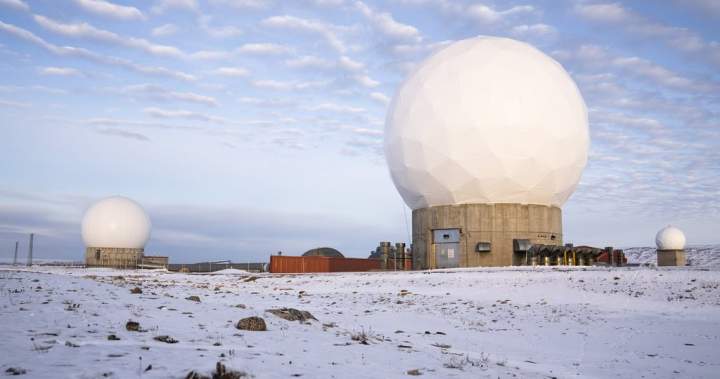
Greenland already hosts the U.S.-run Pituffik Space Base under a 1951 defence agreement with Denmark, supporting missile warning, missile defence and space surveillance for the U.S. and NATO.
“There is no sign of the Trump war of aggression against Greenland and Denmark letting up. It is not about ‘security’ any more than Venezuela was about ‘narco-terrorism.’ They are both about seizing control and plunder.”
He further added, “No country, including my own, Canada, is safe or secure.”
The tariff threat could mark a significant rupture between the U.S. and its NATO allies.
Trump is expected to face questions about the proposed tariffs and Greenland later this week.
He is scheduled to attend the World Economic Forum in Davos, alongside several European leaders he has threatened with tariffs.
— With files from The Canadian Press
© 2026 Global News, a division of Corus Entertainment Inc.
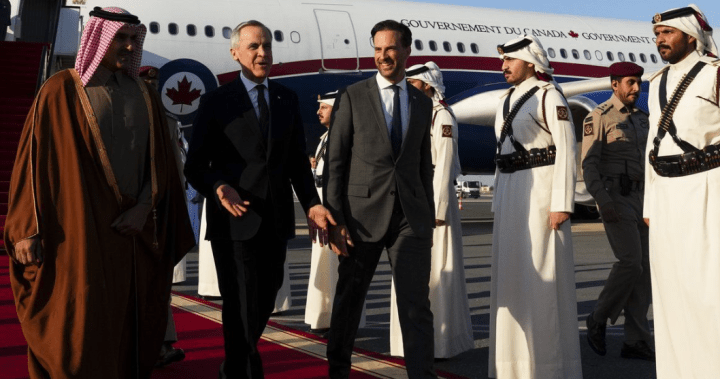
Prime Minister Mark Carney arrived in Doha on Saturday as part of a push to attract foreign investment and deepen Canada’s economic partnerships beyond its traditional allies.
Carney’s visit comes on the heels of his visit to China and follows the recent presentation of a new federal investment budget aimed at positioning Canada as a stable, attractive destination for global capital.
In a news conference on Saturday, Finance Minister François-Philippe Champagne said Canada is working to broaden its economic relationships as global trade patterns shift.
Qatar is viewed by Ottawa as a strategic partner, with officials pointing to the country’s significant investment capacity and growing influence on the global stage.
Get breaking National news
For news impacting Canada and around the world, sign up for breaking news alerts delivered directly to you when they happen.
“We need to reduce our dependence and increase our self-reliance to find a strategic path forward,” Champagne said.
“Engaging with the Middle East and China is necessary for Canada, just like our European partners have done,” Champagne added. “We buy more from the U.S.A. than anywhere else, but the trading climate right now is different.”
The conference highlighted Canada’s industrial capacity and trade advantages as key selling points for potential investors.
Champagne also said international engagement is critical as Canada works to raise its profile among global investors.


“We are one of the G7s with very big industries. We build cars, planes, ships, we have an abundance of energy, and we are the only one with free trade with all G7,” Champagne said. “With the way the world is changing, you better diversify, supply chain is changing and we need to adapt.”
Prime Minister Carney is expected to meet with senior Qatari officials, including Emir Sheikh Tamim bin Hamad Al Thani, as well as representatives of the Qatar Investment Authority.
His office says the talks will focus on expanding trade access and forging partnerships in artificial intelligence, infrastructure, energy and defence.
The visit comes amid heightened geopolitical tensions in the region, though officials say the schedule remains unchanged.
© 2026 Global News, a division of Corus Entertainment Inc.
The possibility of a forceful U.S. takeover of Greenland is raising many unprecedented questions — including how Canada, the European Union and NATO could respond or even retaliate against an ostensible ally.
A high-level meeting between Greenlandic, Danish and U.S. officials this week did not resolve the “fundamental disagreement” over the territory’s sovereignty but did set the stage for more talks. The White House made clear Thursday that U.S. President Donald Trump’s desire to control Greenland has not changed after the meeting.
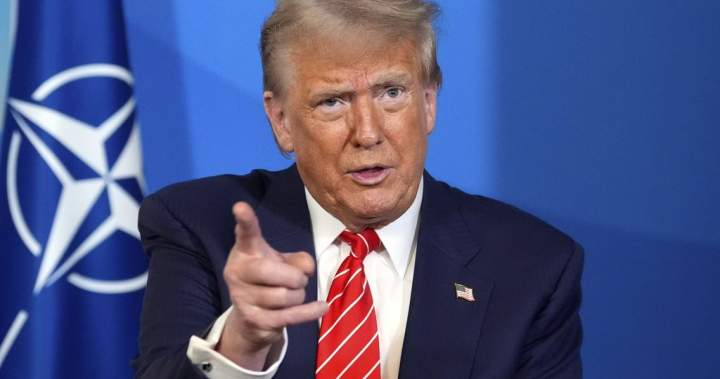
“He wants the United States to acquire Greenland. He thinks it’s in our best national security to do that,” White House press secretary Karoline Leavitt said.
Denmark and European allies are sending more troops to the territory in a show of force and to display a commitment to Arctic security.

Experts say there are other, non-military measures available in the event of a U.S. annexation or invasion of Greenland, or which could at least be threatened to try and get Trump to back down.
Whether those economic measures are actually used is another matter, those experts say.
“I think it remains highly unlikely that we’ll get to that point where we have to seriously discuss consequences for a U.S. move on Greenland,” said Otto Svendsen, an associate fellow with the Europe, Russia, and Eurasia Program at the Center for Strategic and International Studies.
“So it remains contingency planning for a highly unlikely event. That being said … Denmark would certainly do everything in its power to rally a very robust European response.”
Here’s what that could entail.
EU trade, tech disruptions?
Experts agree the biggest pressure points that can be used in the U.S. surround trade and technology.
The European Parliament’s trade committee is currently debating whether to postpone implementing the trade deal signed between Trump and the EU last summer to protest the threats against Greenland, Reuters reported Wednesday.
Many lawmakers have complained that the deal is lopsided, with the EU required to cut most import duties while the U.S. sticks to a broad 15 per cent tariff for European goods.
Get daily National news
Get the day’s top news, political, economic, and current affairs headlines, delivered to your inbox once a day.
An even bolder move would be triggering the EU’s anti-coercion instrument — known as the “trade bazooka” — that would allow the bloc to hit non-member nations with tariffs, trade restrictions, foreign investment bans, and other penalties if that country is found to be using coercive economic measures.
Although the regulation defines coercion as “measures affecting trade and investment,” Svendsen said it could feasibly be used in a diplomatic or territorial dispute as well.
“EU lawyers have proven themselves to be very creative in recent years,” he said.
However, David Perry, president of the Canadian Global Affairs Institute, said in an email that economic measures against the U.S. are unlikely “given the massive asymmetry in the defence and economic relationship between the U.S.” and other western nations.
“Any kind of sanction against the U.S. doesn’t make sense for the same reason they can impose tariffs on others: they have the power,” Perry added.

Target U.S. tech companies?
The likeliest — and potentially least harmful — scenario for retaliation in the event of an attack on Greenland, Svendsen said, would be fines or bans against U.S. tech companies like Google, Meta and X operating in Europe.
That’s because the Trump administration has taken particular focus on preventing what they call “attacks” on American companies by foreign governments seeking to regulate their online content or tax their revenues, which has led to calls on Canada, Britain and the EU to repeal laws like digital services taxes.
“I think that would be a really smart and targeted way to get to economic interests very close to the president, while minimizing the direct impact on the on the European economy,” Svendsen said, calling such a move “low-hanging fruit.”


He also compared a future U.S. tech platform ban to how Europe moved to wean itself off Russian gas after the full-scale invasion of Ukraine in 2022.
“If you told anyone back then that Europe would basically rid itself of its dependence on Russian gas basically within a two-year period … that would have been considered completely impossible,” he said.
“Weaning the European economy off of U.S. tech would certainly be painful in the short term, but they’ve proven that they can get off those dependencies quickly if there is political will behind it in the past.”
A U.S. hostile takeover of Greenland would mean the “end” of the NATO alliance, experts and European leaders have said.
Trump himself has acknowledged it could be a “choice” between preserving the alliance or acquiring Greenland.
There is no provision within the NATO founding treaty that addresses the possibility of a NATO member taking territory from another, and how the alliance should respond to such an act.
A NATO spokesperson told Global News it wouldn’t “speculate on hypothetical scenarios” when asked how it could potentially act.

“None of this would be actionable in a NATO sense,” Perry said. “It’s an alliance that’s organized to bind the U.S. to European security, and revolves around the U.S. So there’s no scenario of NATO doing that to the U.S.”
Denmark and other European nations could move to reduce or close U.S. military bases in their countries as a possible response, experts say.
Balkan Devlen, a a senior fellow at the Macdonald-Laurier Institute and director of its Transatlantic Program, said in an interview that a U.S. annexation of Greenland would force Canada to focus entirely on boosting its defences in the Arctic.
That may include trying to decouple from NORAD, the joint northern defence network with the U.S., in favour of a purely domestic Arctic command, he said — although that process would take years and require Canada to increase defence spending even further.
“Never mind five per cent (of GDP) — we will probably need to go like seven, eight, nine per cent on defence spending to be able to do anything of that sort,” he said. “It’s not even clear that we’ll be able to have enough people to do that.”
Devlen added that any retaliatory action, whether military or financial, needs to be targeted and proportionate to what the U.S. does.
“The problem with nuclear options is that once you use it, it’s gone,” he said. “And if it doesn’t do the damage or make the change of behaviour on the other party, you’ve basically lost a lot of leverage and you might actually sustain a lot more loss yourself.”


“Unacceptable’: Allies react to Trump Greenland tariff threats – National TenX News

Canada talks trade with Qatar as Carney touches down in Doha – National TenX News

How could Canada, EU, NATO respond to a U.S. takeover of Greenland? – National TenX News


-

 Fashion10 months ago
These ’90s fashion trends are making a comeback in 2017
-

 Entertainment10 months ago
The final 6 ‘Game of Thrones’ episodes might feel like a full season
-

 TenX Exclusive10 months ago
अमर योद्धा: राइफलमैन जसवंत सिंह रावत की वीरगाथा
-

 Politics8 months ago
Before being named Pope Leo XIV, he was Cardinal Robert Prevost. Who is he? – National TenX News
-

 Politics9 months ago
Puerto Rico faces island-wide blackout, sparking anger from officials – National TenX News
-

 Fashion10 months ago
According to Dior Couture, this taboo fashion accessory is back
-

 Tech10 months ago
Indian-AI-software-which-caught-30-thousand-criminals-and-busted-18-terrorist-modules-its-demand-is-increasing-in-foreign-countries-also – News18 हिंदी
-

 Politics9 months ago
Scientists detect possible signs of life on another planet — but it’s not aliens – National TenX News