Former Greenlandic politician and past president of the Inuit Circumpolar Council at his home in Nuuk, Greenland.
Braden Latam/Global News

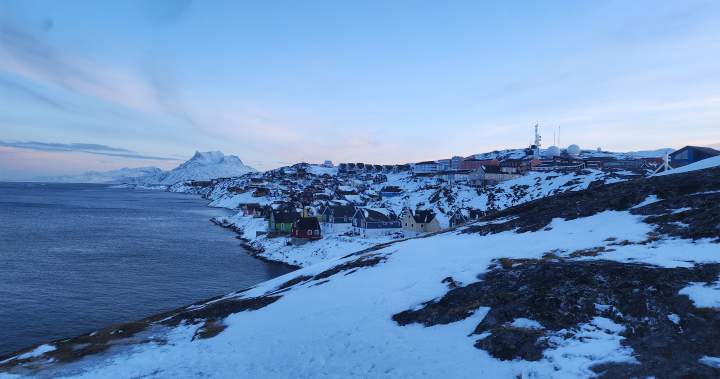
Aqqaluk Lynge pores over a map showing the ice surrounding the island of Greenland and scoffs at U.S. President Donald Trump’s claims America should “own” the territory.
“So, if you dream of a golf course, oh, you’re welcome,” he taunts, “You can do that in the middle of the ice cap. It’s three kilometres thick. We can help you and bring you there by dog sled, and I’m sure that you will survive.”
One of the founders of the pro-Greenlandic independence party Inuit Ataqatigiit, Lynge is also the former president of the Inuit Circumpolar Council.
He’s keenly aware that the U.S. threats have thrust the debate over Greenland’s sovereignty into the global spotlight.
“We’re in the middle of generational change,” says Lynge, an influential leader on the island, during a recent interview at his home at the edge of the capital.
“What you see today is something that we, our generation, built up. And now the young people have Greenland for themselves,” he says.
Lynge was once a fierce advocate for separation from Denmark but now believes the governance structure developed over the years offers the best of both worlds.
In 2008, Kalaallisut, an Inuit language on the island, was made the territory’s official language. Greenland has its own parliament and prime minister and controls its own education, environment and fisheries sectors, as well as mineral and oil revenue.
“We have got the best possible agreement between a former colonized people and our colonizer,” says Lynge.
“Within that, there’s much possibility to expand our political and economic future. We have a right to speak our own language. Also, we have a right to all living and non-living resources,” he explains.
Braden Latam/Global News
Trump may have dropped his threats to take the island “by force,” but his threats have reignited the debate around Greenland’s independence.
Roughly 90 per cent of Greenland’s population is Inuit.
Just how many want the nation to become independent of Denmark appears to be shifting since Trump’s threats first began last year.
A new poll conducted last month for The Copenhagen Post found that 62 per cent percent of Greenlanders don’t want to leave, compared to a survey last year that found 56 per cent Greenlanders polled supported independence.
A 2009 law allows the island to declare independence from Denmark through a referendum. Such a referendum has never been held.
“Over 40 years and we are not closer to being independent,” says Nuuk resident Arnanguak Stork, sitting in the apartment she shares with her husband and adult daughter. Artwork by her grandchildren and old family photos cover the walls.
Stork worries that Greenland and Denmark’s united response to Trump’s annexation threats is overshadowing the Inuit push for sovereignty.
“They [politicians] just speak to the whole world like they are Greenland, saying, ‘Yes, we agree on everything that happens from outside,’” she says.
“We do not agree,” she adds, “And the Danish TV, they always talk about Donald Trump. We are tired of hearing about him. And we’re tired of listening to Danish people.”
With a population of only 57,000, the territory relies on the Kingdom of Denmark for financial support, particularly to fund social programs. In Greenland, the risk of poverty is higher than in Denmark.
Heidi Petracek/Global News
Single mother Dorthe Qvist says life in Nuuk is expensive and that affordable housing is hard to find.
But she still firmly believes that her people would benefit from an independent government.
“My dream is for Greenland to be independent because I’m really proud of my land and my people in Greenland. I know we could do that,” she says. “It’s good working with Denmark now, but in future … I want to be independent.”
The relationship between the Greenlandic Inuit and Denmark has historically been complicated and remains so.
Denmark’s colonial legacy of forced relocations and sterilizations, cultural assimilation, and family separations has caused long-lasting trauma.
A 2023 report from the UN Special Rapporteur on the Rights of Indigenous Peoples urged the Danish and Greenlandic governments to address the harms of colonialism and racism.
It also called for more inclusive consultation with Inuit when developing laws and policies.
Heidi Petracek/Global News
Stork believes life for her people won’t improve until they have full independence.
She says her adult daughter, who lives with her, can’t afford an apartment, and says Inuit, particularly in Nuuk, face racism when trying to find employment.
Asked if she believes she will see independence in her time, Stork’s eyes fill with tears.
“I want to feel it when I am alive,” she says, pausing to stop herself from crying.
“We want to feel independent in here,” she adds, putting her hand to her heart.
Greenland’s political parties all support independence, but each differs on how quickly that should happen.
Inuit like Stork, who have already waited decades, now worry it won’t happen at all.
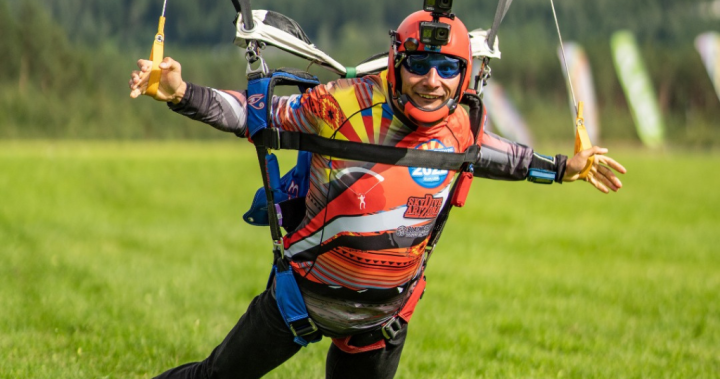
A world champion winged suit skydiver has died after his parachute failed to deploy during a jump in the south of France.
Pierre Wolnik, 37, a two-time French freefly world champion, died after jumping from a helicopter in a wingsuit in the Mont Blanc massif region on Saturday.
After a brief free fall, Wolnik’s parachute did not open, resulting in his death, French outlet Le Figaro reported.
French sporting newspaper Sport Tricolore reported Wolnik’s death on X, describing him as “a world-renowned figure in wingsuit flying.”
Wingsuit flying is an extreme sport in which the diver wears a specialized suit with webbing between the legs and under the arms, allowing the wearer to glide at high speeds and reduce their rate of descent.
His body was found in the village of Les Bossons, in the Chamonix valley. He was pronounced dead at the scene.

For news impacting Canada and around the world, sign up for breaking news alerts delivered directly to you when they happen.
The precise cause of the technical failure that led to the parachute failure is under investigation, Le Figaro reported.
The athlete was a member of the French FAI World Championship team and was a world leader in wingsuit skydiving.
Wolnik was active on social media and a professional videographer who often shared footage of his daredevil dives with his Instagram followers.
Following Wolnik’s death, the Fédération Française de Parachutisme wrote in a translated Facebook statement that he would be “remembered as a teammate whose presence will forever be etched in the memories of those around him.”
“Today, the entire skydiving community mourns and pays tribute to a young man known for his talent and human qualities,” it continued.
“On behalf of the whole of the federation, we send our sincere condolences to his family, his relatives, as well as his teammates, his coach and all the French teams who had the chance to be with him,” the statement concluded.
Fédération Française de Parachutisme/ Facebook
In a separate post, the federation’s president, Yves-Marie Guillaud, honoured Wolnik for his contribution to the sport.
“The entire sport parachuting community mourns a talented young man with such a friendly smile,” he wrote on Facebook, according to Le Parisien. “May the memory of this exceptional parachutist fill our hearts.”
In October, Wolnik shared a video of himself and a fellow diver hovering above a vast mountain range.
“It seems that too many of us take this great mystery of life for granted to a point that they don’t even question the nature of the experience until the very end of it,” the caption reads.
According to Red Bull, wingsuit divers fly at speeds up to 250 km/h. Pilots must have a wealth of skydiving experience before attempting a dive. They often will have completed between 200 and 500 jumps before using a wingsuit.
The first recorded wingsuit jump ended similarly to Wolnik’s. It took place in Paris in 1912 when Franz Reichelt, an Austrian tailor, jumped from the first floor of the Eiffel Tower. His self-designed suit failed, and Reichelt fell 187 feet to his death.
© 2026 Global News, a division of Corus Entertainment Inc.
An artificial intelligence researcher left his job at the U.S. firm Anthropic this week with a cryptic warning about the state of the world, marking the latest resignation in a wave of departures over safety risks and ethical dilemmas.
In a letter posted on X, Mrinank Sharma wrote that he had achieved all he had hoped during his time at the AI safety company and was proud of his efforts, but was leaving over fears that the “world is in peril,” not just because of AI, but from a “whole series of interconnected crises,” ranging from bioterrorism to concerns over the industry’s “sycophancy.”
He said he felt called to writing, to pursue a degree in poetry and to devote himself to “the practice of courageous speech.”
“Throughout my time here, I’ve repeatedly seen how hard it is to truly let our values govern our actions,” he continued.
Anthropic was founded in 2021 by a breakaway group of former OpenAI employees who pledged to design a more safety-centric approach to AI development than its competitors.
For news impacting Canada and around the world, sign up for breaking news alerts delivered directly to you when they happen.
Sharma led the company’s AI safeguards research team.
Anthropic has released reports outlining the safety of its own products, including Claude, its hybrid-reasoning large language model, and markets itself as a company committed to building reliable and understandable AI systems.
The company faced criticism last year after agreeing to pay US$1.5 billion to settle a class-action lawsuit from a group of authors who alleged the company used pirated versions of their work to train its AI models.
Sharma’s resignation comes the same week OpenAI researcher Zoë Hitzig announced her resignation in an essay in the New York Times, citing concerns about the company’s advertising strategy, including placing ads in ChatGPT.
“I once believed I could help the people building A.I. get ahead of the problems it would create. This week confirmed my slow realization that OpenAI seems to have stopped asking the questions I’d joined to help answer,” she wrote.
“People tell chatbots about their medical fears, their relationship problems, their beliefs about God and the afterlife. Advertising built on that archive creates a potential for manipulating users in ways we don’t have the tools to understand, let alone prevent.”
Anthropic and OpenAI recently became embroiled in a public spat after Anthropic released a Super Bowl advertisement criticizing OpenAI’s decision to run ads on ChatGPT.
In 2024, OpenAI CEO Sam Altman said he was not a fan of using ads and would deploy them as a “last resort.”
Last week, he disputed the commercial’s claim that embedding ads was deceptive with a lengthy post criticizing Anthropic.
“I guess it’s on brand for Anthropic doublespeak to use a deceptive ad to critique theoretical deceptive ads that aren’t real, but a Super Bowl ad is not where I would expect it,” he wrote, adding that ads will continue to enable free access, which he said creates “agency.”
Employees at competing companies — Hitzig and Sharma — both expressed grave concern about the erosion of guiding principles established to preserve the integrity of AI and protect its users from manipulation.
Hitzig wrote that a potential “erosion of OpenAI’s own principles to maximise engagement” might already be happening at the firm.
Sharma said he was concerned about AI’s capacity to “distort humanity.”
© 2026 Global News, a division of Corus Entertainment Inc.
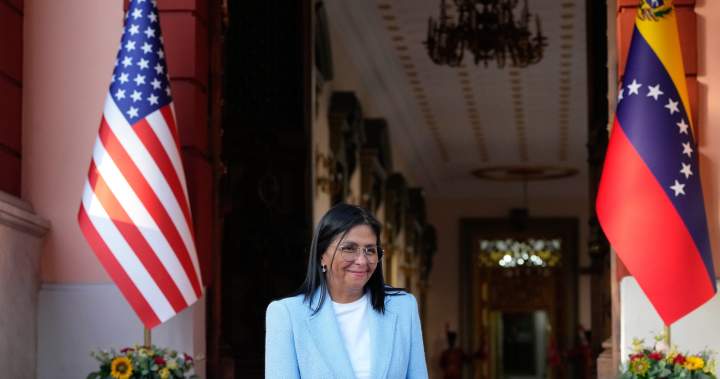
Venezuela’s acting president said Nicolás Maduro remains the country’s ‘legitimate’ leader, despite being held in the U.S. on charges of federal drug trafficking and narco-terrorism.
“I can tell you President Nicolás Maduro is the legitimate president,” Venezuela’s Delcy Rodriguez said in an NBC News interview.
Maduro pleaded not guilty to the charges in January.
With the comments, Rodriguez is continuing to make the case that last month’s U.S. operation to capture Maduro last was a violation of Venezuelan sovereignty even as the Trump administration says she’s cooperating with their effort to overhaul Venezuela’s vast oil industry.
U.S. forces whisked Maduro and his wife to New York to face drug conspiracy charges. Rodriguez in the interview said the Maduros are “innocent.”
Rodriguez met with Energy Secretary Chris Wright on Wednesday in Caracas.
Wright is expected to meet with government officials, oil executives and others during a three-day visit to the South American country.
Wright’s visit comes as the administration of U.S. President Donald Trump continues to lift sanctions to allow foreign companies to operate in Venezuela and help rebuild the nation’s most important industry. It follows last month’s enactment of a Venezuelan law that opened the nation’s oil sector to private investment, reversing a tenet of the self-proclaimed socialist movement that has ruled the country for more than two decades.
For news impacting Canada and around the world, sign up for breaking news alerts delivered directly to you when they happen.
“I bring today a message from President Trump,” Wright told reporters as he stood next to Rodríguez with flags from both countries behind them.
“He is passionately committed to absolutely transforming the relationship between the United States and Venezuela, part of a broader agenda to make the Americas great again, to bring our countries closer together, to bring commerce, peace, prosperity, jobs, opportunity to the people of Venezuela.”
Rodríguez was sworn into her new role after the brazen Jan. 3 seizure of then-President Nicolás Maduro in a U.S. military attack in Caracas. She proposed the overhaul of the country’s energy law after Trump said his administration would take control of Venezuela’s oil exports and revitalize the ailing industry by luring foreign investment.
Rodríguez on Wednesday acknowledged that Venezuela’s relationship with the U.S. has had “highs and lows” but said both countries are now working on a mutually benefiting “energy agenda.”
“Let diplomatic dialogue … and energy dialogue be the appropriate and suitable channels for the U.S. and Venezuela to maturely determine how to move forward,” she said.
© 2026 The Canadian Press





These ’90s fashion trends are making a comeback in 2017


The final 6 ‘Game of Thrones’ episodes might feel like a full season

अमर योद्धा: राइफलमैन जसवंत सिंह रावत की वीरगाथा

Before being named Pope Leo XIV, he was Cardinal Robert Prevost. Who is he? – National TenX News


Puerto Rico faces island-wide blackout, sparking anger from officials – National TenX News


BCCI किस ग्रेड के खिलाड़ी को देती है कितना पैसा? इन 5 क्रिकेटर्स का कटेगा पत्ता! होंगे कई बड़े उलटफेर

According to Dior Couture, this taboo fashion accessory is back


Indian-AI-software-which-caught-30-thousand-criminals-and-busted-18-terrorist-modules-its-demand-is-increasing-in-foreign-countries-also – News18 हिंदी