
Politics
The trade war is rocking economies. Get your ‘houses in order,’ IMF urges – National TenX News


As the International Monetary Fund (IMF) projects slower growth and higher inflation for some countries, the organization’s head has a stark warning to all countries: get your “houses in order.”
The warning by managing director Kristalina Georgieva comes as the IMF is set to release its World Economic Outlook next Tuesday, which she said will show that though there will be “notable markdowns” in growth, there won’t be a recession.
That doesn’t mean, however, that countries won’t face difficulties.
“All countries must redouble efforts to put their own houses in order,” she said in the text of her speech in the U.S on Thursday. “In a world of higher uncertainty and frequent shocks, there is no room for delay in reforms to enhance economic and financial stability and improve growth potential.”
The comments come three months into the second term of U.S. President Donald Trump, whose protectionist policies and widespread tariffs have rocked world markets and spurred concerns of a potential global recession.

Georgieva’s remarks noted the issues that have come in recent months.

Get daily National news
Get the day’s top news, political, economic, and current affairs headlines, delivered to your inbox once a day.
Namely, she said “uncertainty is costly,” saying the cost of one item can be impacted by tariffs in dozens of countries and lead to the postponement of investment decisions, volatility in financial markets, and even questions about which ports ships should sail to.
She went on to say that protectionism “erodes productivity over the long run, especially in smaller economies.”
“Ultimately, trade is like water: when countries put up obstacles in the form of tariff and nontariff barriers, the flow diverts,” she said. “Some sectors in some countries may be flooded by cheap imports; others may see shortages. Trade goes on, but disruptions incur costs.”
Amid the uncertainty, Georgieva urged countries to adjust fiscal policies in order to lower debt levels when necessary, while also keeping their monetary policies “agile and credible.”
In the past weeks since Trump’s latest round of tariffs have come into force, some central banks have appeared to take a wait-and-see approach.
The Bank of Canada on Wednesday did not lower its benchmark rate, keeping it at 2.75 per cent, with the Bank saying in a statement that the major shift in U.S. trade policy and tariff unpredictability prompts increased uncertainty, diminished prospects for economic growth and raised inflation expectations.
U.S. Federal Reserve chair Jerome Powell also said in remarks on Wednesday that it would likely need to pause before lowering interest rates further amid concerns over inflation and tariff impacts.
The Bank of England last week also warned that Trump’s import tariffs have increased the risks of a hit to the global economy.


Georgieva said a second “hugely important priority” is that countries should renew focus on correcting internal and external macroeconomic imbalances, though she acknowledged it can be difficult.
The IMF director went on to recommend that the three “largest actors” — China, the European Union and the U.S. — take their own actions.
With China, the IMF recommended the country dial back its industrial policies and “pervasive state involvement” in industry, while boosting “chronically low” private consumption.
While the IMF notes the U.S. economy has seen strong productivity growth, it must work on putting its federal government debt on a “declining path,” which Georgieva says will require significant reductions to the deficit.
She also said the EU should focus on “assertive fiscal expansion” by Germany to facilitate defence and infrastructure spending, while as a whole the bloc must improve competitiveness by “deepening the single market.”
Georgieva says resilience is being tested by a “reboot” of the global trading system and work must be done on trade policy.
“The goal must be to secure a settlement among the largest players that preserves openness and delivers a more-level playing field — to restart a global trend toward lower tariff rates while also reducing nontariff barriers and distortions,” she said.
“We need a more resilient world economy, not a drift to division.”
— with files from Global News’ Uday Rana and The Associated Press
© 2025 Global News, a division of Corus Entertainment Inc.


Denmark’s prime minister says the country is standing firm in its commitment to “prevent” a threatened U.S. takeover of Greenland, after a meeting with American leaders on Wednesday.
A translation of a statement posted by Danish Prime Minister Mette Frederiksen on social media on Thursday morning described the meeting and what could come next following U.S. President Donald Trump’s rhetoric that Greenland will be acquired by the U.S. “whether they like it or not.”
“Yesterday I received a briefing about the meeting between Greenland, Denmark and the U.S.A. from Foreign Minister Lars Løkke Rasmussen and Greenland Minister for Foreign Affairs Vivian Motzfeldt — it was not an easy meeting,” said Frederiksen in the statement.
Trump has claimed that the United States must acquire Greenland, a Danish territory dating back centuries, because of “national security.”
Get breaking National news
For news impacting Canada and around the world, sign up for breaking news alerts delivered directly to you when they happen.
He has made repeated claims that NATO and Denmark were not doing enough to defend the Arctic from potential threats, including Russia and China.

Frederiksen’s statement describes how NATO forces are working to establish a stronger security presence in the Arctic and that the alliance will not allow the U.S. to take over Greenland.


“Now a working group is being established to discuss how to strengthen security in the Arctic,” she said.
“However, this does not change that there is a fundamental disagreement because the American ambition to take over Greenland is intact. It is, of course, serious, and therefore we continue our efforts to prevent that scenario from becoming a reality.”
Greenland and the U.S. are both members of NATO.
“There is an agreement in the NATO alliance that a strengthened presence in the Arctic is crucial for European and North American security,” said Frederiksen.
“Denmark has invested significantly in new Arctic capacities. And I would like to acknowledge that a number of allies these days are contributing to joint exercise activities in and around Greenland. The defence and protection of Greenland is a common concern for the whole NATO alliance.”
She adds that the Danish government will provide an update on Friday for its own government as well as NATO members about the situation at a meeting in the State Ministry.
© 2026 Global News, a division of Corus Entertainment Inc.
Politics
Sick astronaut returns to Earth with crew in NASA’s 1st medical evacuation – National TenX News
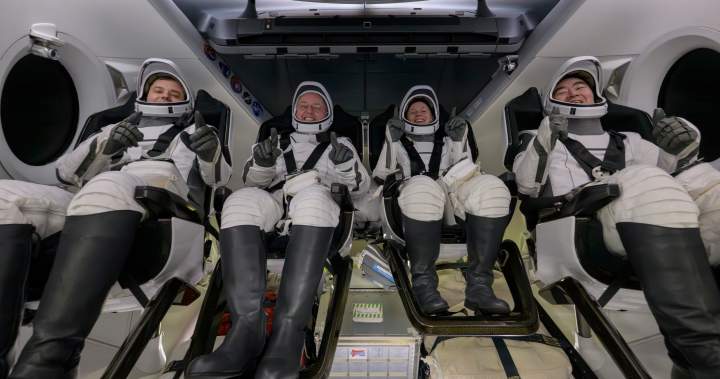
An ailing astronaut returned to Earth with three others on Thursday, ending their space station mission more than a month early in NASA’s first medical evacuation.
SpaceX guided the capsule to a middle-of-the-night splashdown in the Pacific near San Diego, less than 11 hours after the astronauts exited the International Space Station. Their first stop was a hospital for an overnight stay.
“Obviously, we took this action (early return) because it was a serious medical condition,” NASA’s new administrator Jared Isaacman said following splashdown. “The astronaut in question is fine right now, in good spirits and going through the proper medical checks.”
It was an unexpected finish to a mission that began in August and left the orbiting lab with only one American and two Russians on board. NASA and SpaceX said they would try to move up the launch of a fresh crew of four; liftoff is currently targeted for mid-February.
NASA’s Zena Cardman and Mike Fincke were joined on the return by Japan’s Kimiya Yui and Russia’s Oleg Platonov. Officials have refused to identify the astronaut who developed the health problem last week or explain what happened, citing medical privacy.
Support teams onboard the SpaceX recovery ship SHANNON work around the SpaceX Dragon Endeavour spacecraft shortly after it landed off the coast of Long Beach, Calif., Thursday, Jan. 15, 2026.
NASA via AP
While the astronaut was stable in orbit, NASA wanted them back on Earth as soon as possible to receive proper care and diagnostic testing. The entry and splashdown required no special changes or accommodations, officials said, and the recovery ship had its usual allotment of medical experts on board.
Get breaking National news
For news impacting Canada and around the world, sign up for breaking news alerts delivered directly to you when they happen.
The astronauts emerged from the capsule, one by one, within an hour of splashdown. They were helped onto reclining cots and then whisked away for standard medical checks, waving to the cameras. Isaacman monitored the action from Mission Control in Houston, along with the crew’s families.

NASA decided a few days ago to take the entire crew straight to a San Diego-area hospital following splashdown and even practiced helicopter runs there from the recovery ship. The astronaut in question will receive in-depth medical checks before flying with the rest of the crew back to Houston on Friday, assuming everyone is well enough. Platonov’s return to Moscow was unclear.
NASA stressed repeatedly over the past week that this was not an emergency. The astronaut fell sick or was injured on Jan. 7, prompting NASA to call off the next day’s spacewalk by Cardman and Fincke, and ultimately resulting in the early return. It was the first time NASA cut short a spaceflight for medical reasons. The Russians had done so decades ago.

Spacewalk preparations did not lead to the medical situation, Isaacman noted, but for anything else, “it would be very premature to draw any conclusions or close any doors at this point.” It’s unknown whether the same thing could have happened on Earth, he added.
The space station has gotten by with three astronauts before, sometimes even with just two. NASA said it will be unable to perform a spacewalk, even for an emergency, until the arrival of the next crew, which has two Americans, one French and one Russian astronaut.
This screengrab from video provided by NASA shows NASA astronaut Mike Fincke getting helped out of the SpaceX Crew-11 capsule.
NASA via AP
Isaacman said it’s too soon to know whether the launch of station reinforcements will take priority over the agency’s first moonshot with astronauts in more than a half-century. The moon rocket moves to the pad this weekend at Florida’s Kennedy Space Center, with a fueling test to be conducted by early next month. Until all that is completed, a launch date cannot be confirmed; the earliest the moon flyaround could take off is Feb. 6.
For now, NASA is working in parallel on both missions, with limited overlap of personnel, according to Isaacman.
“If it comes down to a point in time to where we have to deconflict between two human spaceflight missions, that is a very good problem to have at NASA,” he told reporters.
© 2026 The Canadian Press

Troops from several European countries, including France, Germany, the UK, Norway and Sweden, are arriving in Greenland in a show of support for Denmark as talks between representatives of Denmark, Greenland and the U.S. on Wednesday highlighted “fundamental disagreement” between the Trump administration and European allies on the future of the Arctic island.
Denmark announced it would increase its military presence in Greenland on Wednesday and several European partners started sending symbolic numbers of troops on that day, just as the Danish and Greenlandic foreign ministers were preparing to meet with White House representatives in Washington.
The troop movements were intended to portray unity among Europeans and send a signal to U.S. President Donald Trump that an American takeover of Greenland is not necessary as NATO together can safeguard the security of the Arctic region amid rising Russian and Chinese interest.
“The first French military elements are already en route” and “others will follow,” French President Emmanuel Macron announced Wednesday, as French authorities said about 15 soldiers from the mountain infantry unit were already in Nuuk for a military exercise.
Germany will deploy a reconnaissance team of 13 personnel to Greenland on Thursday, its Defence Ministry said.
On Thursday, Danish Defence Minister Troels Lund Poulsen said the intention was “to establish a more permanent military presence with a larger Danish contribution,” according to Danish broadcaster DR. He said soldiers from several NATO countries will be in Greenland on a rotation system.
Danish Foreign Minister Lars Løkke Rasmussen, flanked by his Greenlandic counterpart Vivian Motzfeldt, said Wednesday that a “fundamental disagreement” over Greenland remains with Trump after they held highly anticipated talks at the White House with Vice President JD Vance and Secretary of State Marco Rubio.
Rasmussen added that it remains “clear that the president has this wish of conquering over Greenland” but that dialogue with the U.S. would continue at a high level over the following weeks.

Inhabitants of Greenland and Denmark reacted with anxiety but also some relief that negotiations with the U.S. would go on and European support was becoming visible.
In Greenland’s capital, Nuuk, local residents told The Associated Press they were glad the first meeting between Greenlandic, Danish and American officials had taken place but suggested it left more questions than answers.
Get breaking National news
For news impacting Canada and around the world, sign up for breaking news alerts delivered directly to you when they happen.
Several people said they viewed Denmark’s decision to send more troops, and promises of support from other NATO allies, as protection against possible U.S. military action. But European military officials have not suggested the goal is to deter a U.S. move against the island.
Maya Martinsen, 21, agreed and said it was “comforting to know that the Nordic countries are sending reinforcements” because Greenland is a part of Denmark and NATO.
The dispute, she said, is not about “national security” but rather about “the oils and minerals that we have that are untouched.”
On Wednesday, Poulsen had announced a stepped-up military presence in the Arctic “in close cooperation with our allies,” calling it a necessity in a security environment in which “no one can predict what will happen tomorrow.”
“This means that from today and in the coming time there will be an increased military presence in and around Greenland of aircraft, ships and soldiers, including from other NATO allies,” Poulsen said.
Asked whether the European troop movements were coordinated with NATO or what role the U.S.-led military alliance might play in the exercises, NATO referred all questions to the Danish authorities. However, NATO is currently studying ways to bolster security in the Arctic.

Rasmussen, the Danish foreign minister, announced the creation of a working group with the Americans to discuss ways to work through differences.
“The group, in our view, should focus on how to address the American security concerns, while at the same time respecting the red lines of the Kingdom of Denmark,” he said.

Commenting on the outcome of the Washington meeting on Thursday, Poulsen said the working group was “better than no working group” and “a step in the right direction.” He added nevertheless that the dialogue with the U.S. did not mean “the danger has passed.”
“We are really happy that action is being taken to make sure that this discussion is not just ended with that meeting alone,” Greenlandic MP Aki-Matilda Høegh-Dam said on Thursday during a news conference in Copenhagen.
She said Greenlandic people understood they were a “pivotal point” in a broader transformation of the international rules-based order and that they felt responsible not just for themselves but also for the whole world to get it right.
Høegh-Dam said the military operations should not happen “right next to our schools and right next to our kindergartens.”
Line McGee, a 38-year-old from Copenhagen, told AP that she was glad to see some diplomatic progress. “I don’t think the threat has gone away,” she said. “But I feel slightly better than I did yesterday.”
Speaking to FOX News Channel’s Special Report on Wednesday after the White House talks, Rasmussen rejected both a military takeover and the potential purchase of the island by the U.S. Asked whether he thinks the U.S. will invade, he replied: “No, at least I do not hope so, because, I mean, that would be the end of NATO.”
Rasmussen said Greenlanders were unlikely to vote for U.S. rule even if financial incentives were offered, “because I think there’s no way that U.S. will pay for a Scandinavian welfare system in Greenland, honestly speaking.”
“You haven’t introduced a Scandinavian welfare system in your own country,” he added.
Trump, in his Oval Office meeting with reporters, said: “We’ll see how it all works out. I think something will work out.”
© 2026 The Canadian Press


Denmark vows to ‘prevent’ U.S. takeover of Greenland after meeting – National TenX News

Sick astronaut returns to Earth with crew in NASA’s 1st medical evacuation – National TenX News

European troops arrive in Greenland after ‘disagreement’ with U.S. – National TenX News


-

 Fashion10 months ago
These ’90s fashion trends are making a comeback in 2017
-

 Entertainment10 months ago
The final 6 ‘Game of Thrones’ episodes might feel like a full season
-

 TenX Exclusive10 months ago
अमर योद्धा: राइफलमैन जसवंत सिंह रावत की वीरगाथा
-

 Politics8 months ago
Before being named Pope Leo XIV, he was Cardinal Robert Prevost. Who is he? – National TenX News
-

 Politics9 months ago
Puerto Rico faces island-wide blackout, sparking anger from officials – National TenX News
-

 Fashion10 months ago
According to Dior Couture, this taboo fashion accessory is back
-

 Tech10 months ago
Indian-AI-software-which-caught-30-thousand-criminals-and-busted-18-terrorist-modules-its-demand-is-increasing-in-foreign-countries-also – News18 हिंदी
-

 Politics9 months ago
Scientists detect possible signs of life on another planet — but it’s not aliens – National TenX News