
Politics
Hong Kong Canadians reeling after deadly highrise inferno TenX News


Canadians with roots in Hong Kong have been watching in horror at news of the fire that tore through seven highrise towers in the Chinese special administrative region, leaving dozens dead and hundreds missing.
Vancouver resident Albert Wai Yip Chan, a former member of the Legislative Council of Hong Kong, said the fire risk in the city’s tall buildings has always been a concern, especially with many lacking sprinkler systems.
He’s been watching videos online of the blaze in his hometown, which showed large flames and thick smoke engulfing the buildings.
Smoke rises after a fire broke out at Wang Fuk Court, a residential estate in the Tai Po district of Hong Kong’s New Territories on Wednesday, Nov. 26 2025.
AP Photo/Chan Long Hei
“I wish (the) injured people could have a speedy recovery,” said Chan, “It’s a tragedy.”
“We hope the government can improve its property management policy. Otherwise, I believe this type of problem will keep occurring again and again.”
Hundreds of residents were evacuated as the blaze spread across a housing complex in the Tai Po district, with at least 44 people reported dead and about 280 missing.
The blaze, which started mid-afternoon on Wednesday, was upgraded to a level-5 — the highest level of severity locally — and authorities said that conditions remained very challenging for firefighters.
Global Affairs estimates there are about 300,000 Canadian citizens in Hong Kong, making them the biggest Canadian diaspora outside the United States.

Global Affairs Canada has not replied to a request about whether there are any Canadians who have died in the fire.
Derek Armstrong Chan, deputy director of Fire Service operations, said in a news conference that the debris and scaffolding of the affected buildings were falling down, posing additional danger to their front line personnel.

Get daily National news
Get the day’s top news, political, economic, and current affairs headlines, delivered to your inbox once a day.
“Besides, the temperature inside the buildings concerned is very high,” Chan said. “It’s quite difficult for us to enter the building and go upstairs to conduct firefighting and rescue operations.”
Chan said the fire could be one of the deadliest in Hong Kong’s history, bringing back memories of the Garley Building fire in 1996 that killed 41 people and injured about 81.
Aiken Lau, a former Hong Kong banker and now resident of Coquitlam, B.C., said he remembered crying as a teenager about the Garley Building fire, and the same feelings are emerging again 29 years later.
Flames engulf a building after a fire broke out at Wang Fuk Court, a residential estate in the Tai Po district of Hong Kong’s New Territories, Wednesday, Nov. 26 2025.
AP Photo/Chan Long Hei
Firefighters try to extinguish a flames engulfing a building after a fire broke out at Wang Fuk Court, a residential estate in the Tai Po district of Hong Kong’s New Territories, Wednesday, Nov. 26 2025.
AP Photo/Chan Long Hei


“I left very heartbroken when I first saw the news,” Lau said. “Although I have been away from Hong Kong for more than 20 years, I still have strong feelings for the city, and I hate to see people there suffering in pain.
“I hope the missing people could be found as soon as possible.”
Officials have said the Tai Po fire started on Wednesday in external bamboo scaffolding on a 32-storey tower and later spread because of windy conditions.
Lau said there are many questions about the cause and how the deadly flames could have moved so quickly.
Conservative Richmond Centre — Marpole member of Parliament Chak Au also took to social media to express his sadness, saying his heart is with Hong Kong.
Au, who worked as an assistant professor at the Chinese University of Hong Kong before immigrating to Canada in 1988, said in an interview that the news hit home for him.
Au’s son is a firefighter with the City of Richmond, and the former city councillor also said the location of the Hong Kong blaze in the Tai Po district is close to his former workplace.
“Tai Po district is only several stops away from the Chinese University of Hong Kong, my former workplace, and it’s a very population-dense city,” said Au.
“My heartfelt condolences to all who lost loved ones — including the firefighter who died in the line of duty — and my thoughts are with the injured and the many families still waiting for news of the missing,” he added. “I also pray that more survivors can be rescued.”
John Lee, Hong Kong’s chief executive, said that the situation at the scene is gradually getting under control, and a “holistic investigation” has been launched.
Several local media outlets reported that police had arrested three men on suspicion of manslaughter in connection with the fire.
Lau said all he is hoping for is for the death toll to stop climbing.
“When I dug into the history of deadly fires in Hong Kong, the fire that occurred in Sham Shui Po in 1962 is the worst one, which has killed 44 people and left hundreds of people homeless, but I wasn’t born at that time, and I didn’t know much of it,” said Lau.
“I am extremely worried that the latest fire might break the record of 1962. It’s devastating.”
___
with files from The Associated Press
© 2025 The Canadian Press

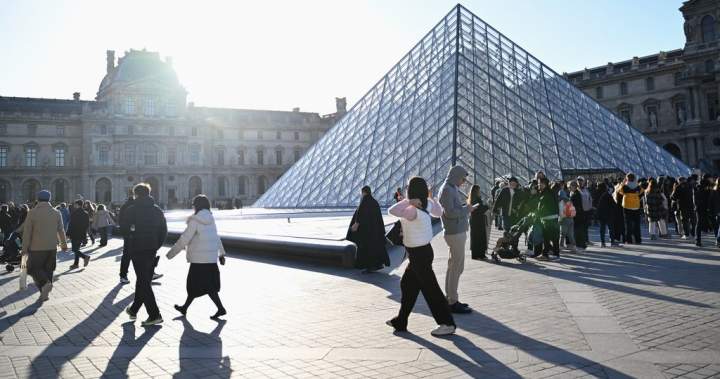
A trip to the world’s most-visited museum is about to cost Canadians significantly more.
France has hiked ticket prices at the Louvre by 45 per cent for visitors from outside the European Union, a move that is fuelling debate over so-called dual pricing and the growing backlash against overtourism.
Starting this week, adult visitors from non-EU countries, including Canada, must pay €32 to enter the Paris landmark, up from €22. That’s an increase from about $35 to $52 Canadian.

Visitors from EU countries, as well as Iceland, Liechtenstein and Norway, will continue to pay the lower rate.
The price hike comes as the Louvre grapples with repeated labour strikes, a high-profile daylight jewel heist last October that prompted a costly security overhaul, and years of chronic overcrowding. The museum attracts roughly nine million visitors annually.
Get breaking National news
For news impacting Canada and around the world, sign up for breaking news alerts delivered directly to you when they happen.
Some Canadian tourists told Global News they feel unfairly targeted.
“We didn’t cause the robberies or some of the other issues that happened and we are paying the consequences,” said Allison Moore, visiting Paris from Newfoundland with her daughter. “[In] Canada we don’t discriminate over pricing like that.”
Others argue tourists already shoulder higher costs simply by travelling long distances.
“In general for tourists, I think things should be a little cheaper than for local people, because we have to travel to come all the way here,” said Darla Daniela Quiroz, another Canadian visitor. “It should be equal pricing, or a little bit cheaper.”


Even some Europeans question the two-tiered system. A French tourist interviewed outside the museum said there was “no reason” to charge non-Europeans more and that the fee should be the same for everyone.
Tourism experts say the Louvre’s financial pressures help explain the decision.
“The Louvre is really cash-strapped right now and needs to do something,” said Marion Joppe, a professor at the University of Guelph. “It can’t really look to the government, which is already struggling with its own budget.”
The move also reflects a broader global pushback against mass tourism. Anti-tourism protests have spread across parts of Spain, New Zealand has increased its entry tax, and the United States recently raised national park fees for foreign visitors.
“You take Paris — it gets about 50 million tourists a year,” said Julian Karaguesian, an economist at McGill University. “That’s roughly a million a week. The city simply wasn’t built for those kinds of numbers.”
Despite the higher price, many visitors say they will still line up to see the Mona Lisa and other of the museum’s famous artworks.
“It’s one of the main attractions. It’s on everybody’s list,” Moore said. “We’re still going to go, and hopefully it will be worth it in the end.”
© 2026 Global News, a division of Corus Entertainment Inc.
Politics
Trump calls Canada-China deal ‘good thing’ as U.S. officials voice concern – National TenX News
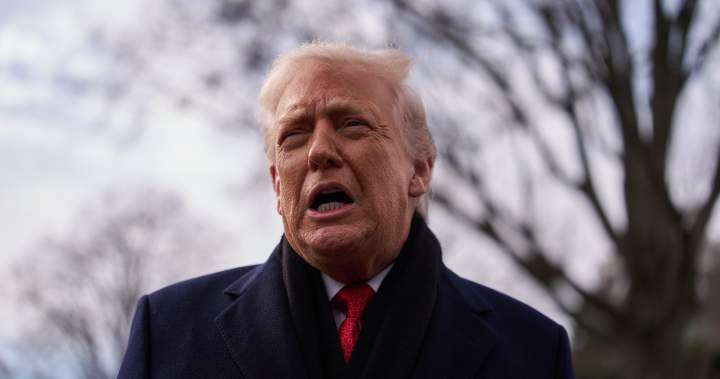
Canada’s new trade deal with China is getting a mixed reaction in Washington, with U.S. President Donald Trump voicing support as administration officials warned Ottawa could regret allowing Chinese EVs into the Canadian market.
The deal signed with Beijing on Friday reverses course on 100 per cent tariffs Canada slapped on Chinese electric vehicles in 2024, which aligned with similar U.S. duties. Canada and China also agreed to reduce tariffs on canola and other products.
Asked about the deal by reporters at the White House, Trump said Prime Minister Mark Carney was doing the right thing.
“That’s what he should be doing. It’s a good thing for him to sign a trade deal. If you can get a deal with China, you should do that,” Trump said.
However, members of Trump’s cabinet expressed concern.
“I think they’ll look back at this decision and surely regret it to bring Chinese cars into their market,” U.S. Transportation Secretary Sean Duffy said at an event with other U.S. government officials at a Ford factory in Ohio to tout efforts to make vehicles more affordable.
U.S. Trade Representative Jamieson Greer told reporters the limited number of vehicles would not impact American car companies exporting cars to Canada.
“I don’t expect that to disrupt American supply into Canada,” he said.
“Canada is so dependent on the United States for their GDP. Their entire population is crowded around our border for that reason. I’ll tell you one thing: if those cars are coming into Canada, they’re not coming here. That’s for sure.”
Get daily National news
Get the day’s top news, political, economic, and current affairs headlines, delivered to your inbox once a day.
Carney has said it’s necessary for Canada to improve trade ties and cooperation with China in light of Trump’s trade war and threats to let the Canada-U.S.-Mexico Agreement on free trade expire.

The trade pact is up for review this summer, and Greer reiterated that the Trump administration wants to bring more auto manufacturing back to the U.S. and incentivize companies to do so.
Under the new deal with Beijing, Carney said he expects China will lower tariffs on its canola seed by March 1 to a combined rate of about 15 per cent.
Greer questioned that agreement in a separate CNBC interview.
“I think in the long run, they’re not going to like having made that deal,” he said.
He called the decision to allow Chinese EVs into Canada “problematic” and added: “There’s a reason why we don’t sell a lot of Chinese cars in the United States. It’s because we have tariffs to protect American auto workers and Americans from those vehicles.”
Greer said rules adopted last January on vehicles that are connected to the internet and navigation systems are a significant impediment to Chinese vehicles in the U.S. market.


“I think it would be hard for them to operate here,” Greer said. “There are rules and regulations in place in America about the cybersecurity of our vehicles and the systems that go into those, so I think it might be hard for the Chinese to comply with those kind of rules.”

Trump and officials like Greer have taken aim at Chinese attempts to enter the North American car market through Mexico by bypassing rules of origin under CUSMA.
The CUSMA review set for July is expected to address those loopholes that American and Canadian officials have said are being exploited by China.
Those concerns, which were also raised by the Biden administration, in part helped spur the steep tariffs on Chinese EVs, which are heavily subsidized by Beijing.
Trump, however, has also said he would like Chinese automakers to come to the United States to build vehicles.
Both Democrat and Republican lawmakers in the U.S. have expressed strong opposition to Chinese vehicles as major U.S. automakers warn China poses a threat to the U.S. auto sector.
Ohio Senator Bernie Moreno, a Republican, said at Friday’s event at the Ford plant that he was opposed to Chinese vehicles coming into the United States, and drew applause from the other government officials.
“As long as I have air in my body, there will not be Chinese vehicles sold the United States of America — period,” Moreno said.
—with files from Reuters
© 2026 Global News, a division of Corus Entertainment Inc.
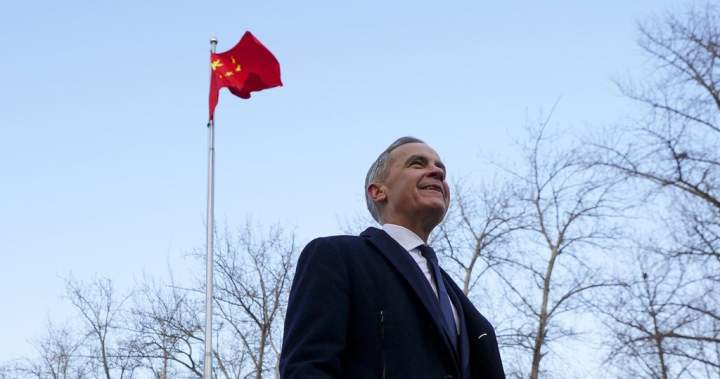
Prime Minister Mark Carney’s trade mission to China is being framed as a win for British Columbia’s economy.
Carney announced a new deal with Beijing on electric vehicles and canola at the end of a high-profile trip on Friday.
“The inroads Canada has made this week are a sign that the government gets it and is showing Canadians and the world that we are open for business,” Alexa Young with the Vancouver Fraser Port Authority said.
The trade deal would allow up to 49,000 Chinese EVs into Canada yearly at a tariff rate of 6.1 per cent.
An expanded auto terminal on Annacis Island will be able to handle the additional volume of cars that could be more affordable than what is currently on the market, with prices expected to be under $40,000.
The New Car Dealers Association said in a statement to Global News that, “We look forward to reviewing the full details of this announcement and engaging constructively with governments to ensure that affordability, competition, and long-term market stability remain central considerations.”


In British Columbia, the overall reaction to the news on Friday is positive.
Get breaking National news
For news impacting Canada and around the world, sign up for breaking news alerts delivered directly to you when they happen.
“China’s economy is important,” Alex McMillan with the B.C. Chamber of Commerce said.
“Having trade deals like this — and diversifying our markets — is important. Providing certainty is important.”
There are concerns with the agreement, including privacy issues and China’s human rights record. But Ottawa’s goal is to double trade with partners outside the United States, which is a goal that would be impossible without China.
“We do want to see more trade and more diversification of our markets and know that China is an important nation and important economy, so having better trade relationships with them, I think overall is going to be good,” McMillan said.
–with files from The Canadian Press
© 2026 Global News, a division of Corus Entertainment Inc.


Louvre raises ticket prices for non-Europeans, hitting Canadian visitors TenX News

Trump calls Canada-China deal ‘good thing’ as U.S. officials voice concern – National TenX News

Canada-China trade deal framed as a win for B.C.’s economy TenX News


-

 Fashion10 months ago
These ’90s fashion trends are making a comeback in 2017
-

 Entertainment10 months ago
The final 6 ‘Game of Thrones’ episodes might feel like a full season
-

 TenX Exclusive10 months ago
अमर योद्धा: राइफलमैन जसवंत सिंह रावत की वीरगाथा
-

 Politics8 months ago
Before being named Pope Leo XIV, he was Cardinal Robert Prevost. Who is he? – National TenX News
-

 Politics9 months ago
Puerto Rico faces island-wide blackout, sparking anger from officials – National TenX News
-

 Fashion10 months ago
According to Dior Couture, this taboo fashion accessory is back
-

 Tech10 months ago
Indian-AI-software-which-caught-30-thousand-criminals-and-busted-18-terrorist-modules-its-demand-is-increasing-in-foreign-countries-also – News18 हिंदी
-

 Politics9 months ago
Scientists detect possible signs of life on another planet — but it’s not aliens – National TenX News