
Politics
History can help us try to understand Donald Trump’s tariffs, professor says – Winnipeg TenX News

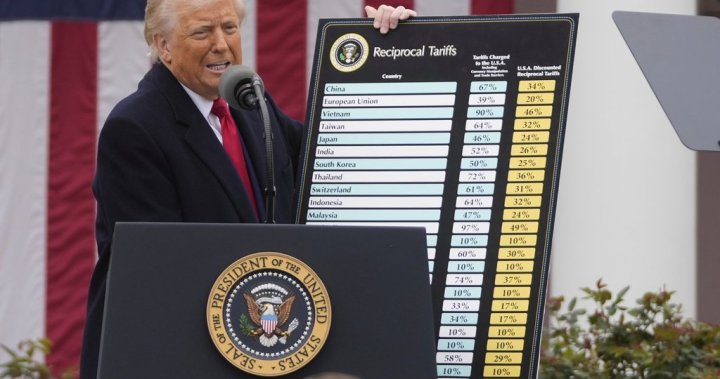
On what U.S. President Donald Trump called “Liberation Day”, the American leader imposed his so-called “reciprocal” tariff policy on dozens of foreign nations.
While making his announcement, Trump also referenced a historic law called the 1930 Smoot Hawley Tariff Act, that he claimed would have saved the United States from the Great Depression if it was not eliminated.
Fact checkers quickly rushed to rule whether or not the law boosted or depressed the U.S. economy, while social media was quickly flooded with clips from the classic film Ferris Bueller’s Day Off, featuring the protagonist in class learning about the act, with his teacher blaming then-U.S. president Herbert Hoover’s act for making the Great Depression worse.
University of Manitoba history professor George Buri disagrees with that assertion, stating its effects were quite insignificant.
Shedding light on the behind-the-scenes of that famous movie scene, Buri reveals that the Ben Stein, the actor that played Buellers teacher, was a free market economist and a conservative before he turned comedian. During the movie’s production, he was actually told to give a boring lesson by the director.
A still from the 1986 film ‘Ferris Bueller’s Day Off’.
GettyImages
Buri finds it interesting that he gave that lecture, because it is a direct reflection of what was being preached during the 1980s in the era of Thatcher and Reagan, a time when Keynesian policies and government intervention was seen as a thing of the past. Buri believed it was a lack of demand that caused the Great Depression, not tariffs.

Get weekly money news
Get expert insights, Q&A on markets, housing, inflation, and personal finance information delivered to you every Saturday.
“So as these politicians are trying to essentially argue in the 1980s the correct economic policies they prefer is a return to open markets, laissez faire and free trade. They’re basically looking to say that tariffs are always bad” he said.
“In the ’80s there’s this new theory that what really caused the depression wasn’t laissez faire, so it must have been the Smoot Hawley tariffs”
New regulations and capital investments from then-president Franklin D. Roosevelt’s administration bailed out banks and establish social welfare systems, helping end the Great Depression.
Meanwhile, Hoover’s tariffs were seen as a failure to improve the economy. Since there was such low demand in a variety of sectors, the tariffs that were meant to encourage Americans to buy cheaper domestic goods was rendered pointless because prices were already so low. From 1928 to 1933, a bushel of wheat’s price dropped from $1.29 to 34 cents.
Although they did create difficult conditions in Canada, the broader effects of the Great Depression were far greater than the Smoot Hawley Tariffs.
Ottawa even attempted to bridge the gap by using reciprocal tariffs in response, but they were ultimately unsuccessful. Buri says it was American recovery that helped the integrated natural resources system get up to speed, while wartime production in the late 1930s quickly increased demand for materials and ended Canada’s financial crisis.


Even though tariffs appeared to play an insignificant role during the depression, they were the spark that ignited the northern nations’ timeline.
After Great Britain ended their preferential exchange with imperial colonies, Upper and Lower Canada, as well as Nova Scotia and New Brunswick, began trading with their southerly neighbours. However, these relationships became complicated when the United States implemented tariffs in 1866 after Britain provided support to the Cotton and sugar rich Confederacy in the American civil war.
“That’s literally what Canada is born out of,” Buri said.
“In 1866 America ends reciprocity, and the very next year in 1867 Upper and Lower Canada, New Brunswick and Nova Scotia decide to form modern-day Canada based on this new notion of ,‘We can’t trade with Britain, we can’t trade with the U.S., so why don’t we trade with each other and form a larger entity?’”
Once the country was formed, Buri points out that east-west expansion was fuelled by tariffs implemented by John A. Macdonald, forcing Canadians to trade above the 49th parallel, and protect the new nation from American influence.
While free trade was the motivator for economic nationalism early on, Buri says the movement re-emerged in the 1980s as American corporations crept north, a side effect of Canada’s much smaller economy being so integrated with their southerly neighbour’s financial system.
Although tariffs have had very different effects for both Canadians and Americans, both nations’ histories are filled with tariff-related stories that illustrate their economic policies and development. Although Buri disagrees with Trump’s methods behind the tariffs, the historian understands his rationale.
“There’s a real problem with the American economy” he said.
“This isn’t completely random. It is an attempt to reverse a several-decades trend of the decline of America’s manufacturing economy and America becoming more and more reliant on Wall Street and the U.S. dollar, which as we saw in 2008 could be a recipe for disaster.”
“I think America is trying to address some very real problems with its economy. Whether or not it’s going to work, I don’t know.”
© 2025 Global News, a division of Corus Entertainment Inc.

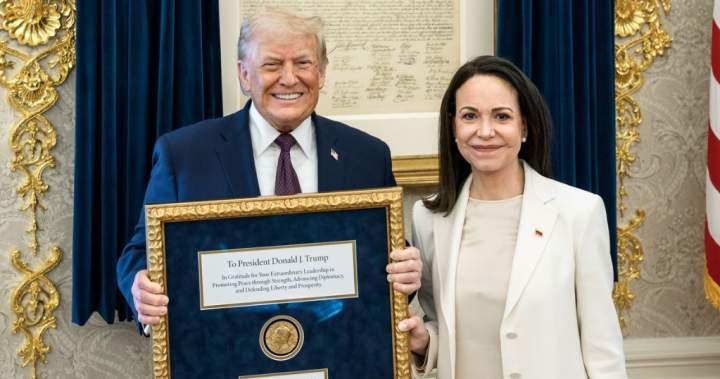
Venezuelan opposition leader María Corina Machado said she presented her Nobel Peace Prize medal to President Donald Trump at the White House on Thursday even as he has questioned her credibility to take over her country after the U.S. ousted then-President Nicolás Maduro.
The Nobel Institute has said Machado could not give her prize to Trump, an honour that he has coveted. Even if the gesture proves to be purely symbolic, it was extraordinary given that Trump has effectively sidelined Machado, who has long been the face of resistance in Venezuela. He has signalled his willingness to work with acting President Delcy Rodríguez, who had been Maduro’s second in command.
“I presented the president of the United States the medal, the Nobel Peace Prize,” Machado told reporters after leaving the White House and heading to Capitol Hill. She said she had done so “as a recognition for his unique commitment with our freedom.”

Trump confirmed later on social media that Machado had left the medal for him to keep, and he said it was an honour to meet her.
“She is a wonderful woman who has been through so much. María presented me with her Nobel Peace Prize for the work I have done,” Trump said in his post. “Such a wonderful gesture of mutual respect. Thank you María!”
The White House later posted a photo of Machado standing next to Trump in the Oval Office as he holds the medal in a large frame. A text in the frame reads, “Presented as a personal symbol of gratitude on behalf of the Venezuelan people in recognition of President Trump’s principled and decisive action to secure a free Venezuela.”
Trump has raised doubts about his stated commitment to backing democratic rule in Venezuela, giving no timetable on when elections might be held. Machado indicated that he had provided few specifics on that front during their discussion.

Get breaking National news
For news impacting Canada and around the world, sign up for breaking news alerts delivered directly to you when they happen.
She did not provide more information on what was said.
‘We can count on President Trump’
After the closed-door meeting, Machado greeted dozens of cheering supporters waiting for her near the White House gates, stopping to hug many.
“We can count on President Trump,” she told them without elaborating, prompting some to briefly chant, “Thank you, Trump.”
Before her visit to Washington, Machado had not been seen in public since she travelled last month to Norway, where her daughter received the peace prize on her behalf. She had spent 11 months in hiding in Venezuela before she appeared in Norway after the ceremony.
The jubilant scene after her meeting with Trump stood in contrast to political realities in Venezuela. Rodríguez remains in charge of day-to-day government operations, along with others in Maduro’s inner circle. In her first state of the union speech Thursday, the interim president promoted the resumption of diplomatic ties between the historic adversaries and advocated for opening the state-run oil industry to more foreign investment after Trump pledged to seize control of Venezuelan crude sales.

Trump has said it would be difficult for Machado to lead because she “doesn’t have the support within or the respect within the country.” Her party is widely believed to have won 2024 elections rejected by Maduro.
White House press secretary Karoline Leavitt called Machado “a remarkable and brave voice” but also said the meeting didn’t mean Trump’s opinion of her changed, calling it “a realistic assessment.”
Leavitt told reporters that Trump supported new Venezuelan elections “when the time is right” but did not say when he thought that might be.
A ‘frank and positive discussion’ about Venezuela
Leavitt said Machado had sought the face-to-face meeting without setting expectations for what would occur. She spent about two and a half hours at the White House.


“I don’t think he needs to hear anything from Ms. Machado,” the press secretary said while the meeting was still going on, other than to have a ”frank and positive discussion about what’s taking place in Venezuela.”
After leaving the White House, Machado went on to a closed-door meeting with a bipartisan group of senators.
Sen. Chris Murphy, D-Conn., said Machado told them that “if there’s not some progress, real progress towards a transition in power, and/or elections in the next several months, we should all be worried.”
“She reminded us that Delcy Rodríguez is, in many ways, worse than Maduro,” he added.
Asked if Machado had heard any commitment from the White House on holding elections in Venezuela, Murphy said, “No, I don’t think she got any commitment from them.”

Sen. Bernie Moreno, an Ohio Republican, was exultant following the meeting, saying Machado “delivered a message that loud and clear: What President Trump did was the most important, significant event in Latin America. That getting rid of Maduro was absolutely essential.”
Machado’s Washington stop coincided with U.S. forces in the Caribbean Sea seizing another sanctioned oil tanker that the Trump administration says had ties to Venezuela. It is part of a broader U.S. effort to take control of the South American country’s oil after U.S. forces captured Maduro and his wife less than two weeks ago at a heavily guarded compound in the Venezuelan capital of Caracas and brought them to New York to stand trial on drug trafficking charges.
Leavitt said Venezuela’s interim authorities have been fully cooperating with the Trump administration and noted that Rodríguez’s government said it planned to release more prisoners detained under Maduro. Among those released were five Americans this week.
Trump said Wednesday that he had a “great conversation” with Rodríguez, their first since Maduro was ousted.
Machado doesn’t get the nod from Trump
Just hours after Maduro’s capture, Trump said of Machado that “it would be very tough for her to be the leader.” Machado had steered a careful course to avoid offending Trump, notably after winning the peace prize, and had sought to cultivate relationships with him and key administration voices like Secretary of State Marco Rubio.
The industrial engineer and daughter of a steel magnate, Machado began challenging the ruling party in 2004, when the nongovernmental organization she co-founded, Súmate, promoted a referendum to recall then-President Hugo Chávez. The initiative failed, and Machado and other Súmate executives were charged with conspiracy.
A year later, she drew the anger of Chávez and his allies again for travelling to Washington to meet President George W. Bush, whom Chávez considered an adversary.
Almost two decades later, she marshalled millions of Venezuelans to reject Chávez’s successor, Maduro, for another term in the 2024 election. But ruling party-loyal electoral authorities declared him the winner despite ample credible evidence to the contrary. Ensuing anti-government protests ended in a brutal crackdown.
Politics
IMF chief backs Jerome Powell, U.S. Fed independence amid Trump pressure – National TenX News
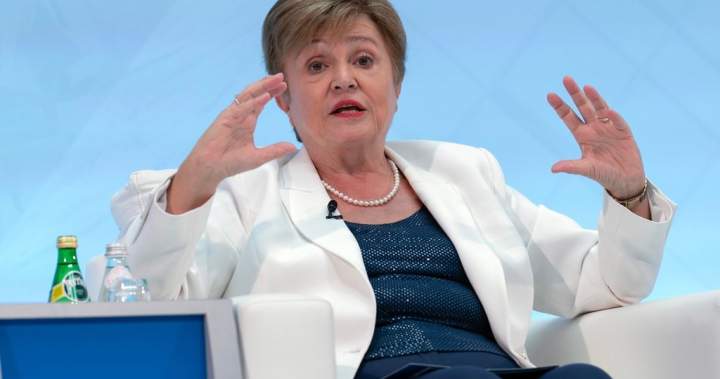
International Monetary Fund chief Kristalina Georgieva on Thursday underscored the importance of keeping central banks independent and threw her support behind beleaguered Federal Reserve Chair Jerome Powell, who is facing a Trump administration investigation for renovation cost overruns.
Georgieva told Reuters in an interview that there was ample evidence that central bank independence worked in the interest of businesses and households, and that evidence-based, data-based decision-making is good for the economy.
The IMF managing director said she had worked with Powell and respected his professionalism.
“I have worked with Jay Powell. He is a very good professional, very decent man, and I think that his standing among his colleagues tells the story,” she said, when asked about a letter of support signed by her predecessor, Christine Lagarde, now head of the European Central Bank, and other large central banks.
Powell on Sunday disclosed that the Trump administration had opened an investigation into him over cost overruns for a $2.5 billion project to renovate two historical buildings at the Fed’s Washington headquarters complex.
Get daily National news
Get the day’s top news, political, economic, and current affairs headlines, delivered to your inbox once a day.
Powell denies wrongdoing and has called the unprecedented actions a pretext to put pressure on him for not bowing to U.S. President Donald Trump’s long-running demands for sharply lower interest rates.


The probe has sparked widespread criticism from some key members of Trump’s Republican Party in the U.S. Senate, which must confirm his nominee to succeed Powell, along with foreign economic officials, investors and former U.S. government officials from both political parties.
Trump has repeatedly derided Powell’s leadership of the Fed and attacked him, often personally, over what he sees as the Fed chair’s slow moves to cut interest rates. On Wednesday, he dismissed concerns that eroding central bank independence would undermine the value of the U.S. dollar and spark inflation, telling Reuters, “I don’t care.”
Georgieva said the IMF looked carefully at issues such as monetary and financial stability, as well as the strength of a country’s institutions. It was specifically interested in the Fed, given the role of the U.S. dollar as a reserve currency.
“It would be very good to see that there is a recognition … that the Fed is precious for the Americans. It is very important for the rest of the world,” she said.
Trump has also attempted to fire another Fed official, Governor Lisa Cook, who has challenged her termination in a legal case that will be argued before the Supreme Court next week.
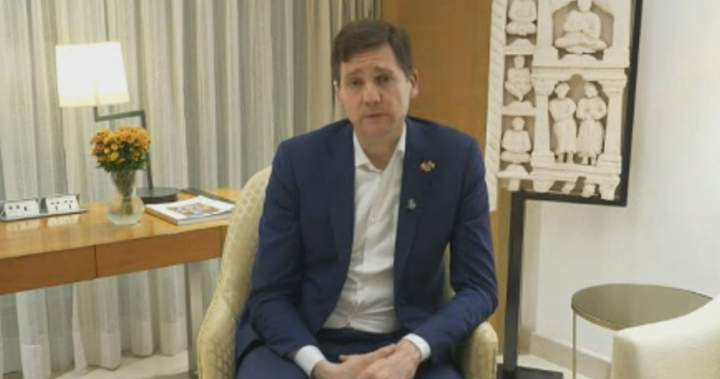
B.C. Premier David Eby spoke to reporters on Thursday morning from Mumbai, India, during his six-day trade mission.
He said that mining and energy companies in India are showing an interest in B.C.
“They are looking strongly to LNG as one of their ways of reducing carbon intensity, as well as reducing smog in the country,” Eby said.
“And so B.C. LNG has been an item of considerable interest, especially the projects that are reaching final investment decision over the next year — LNG Canada Phase 2, KSI Lisims LNG — as well as the projects that are under construction like Woodfibre LNG.”

Eby was also asked about the rise in extortion cases in B.C.
He said the province’s extortion task force will provide an update next week.
Get breaking National news
For news impacting Canada and around the world, sign up for breaking news alerts delivered directly to you when they happen.
“We have assembled a remarkable and historic task force, RCMP, CBSA,” Eby said.

“There are more police in Surrey right now than there have ever been. The RCMP has surged resources into the community.”
Eby said he has not been happy with the fact that there has been no update from the task force and he has asked them to provide one.
“There have been some important developments, people deported, an arrest here in India, cooperation between the Indian government and the Canadian government on this at the law enforcement level,” he added.
“That needs to continue, but, bluntly, we need better results, we need to see more arrests and whatever we can do to support the police to get the job done, we will do so.”
As of Jan. 12, Surrey police said there have been 16 reported extortion incidents in the city since the beginning of the year.
© 2026 Global News, a division of Corus Entertainment Inc.


Trump gifted Nobel Peace Prize by Venezuela’s María Corina Machado – National TenX News

IMF chief backs Jerome Powell, U.S. Fed independence amid Trump pressure – National TenX News

B.C. Premier David Eby says province’s LNG, mining of interest to India TenX News


-

 Fashion10 months ago
These ’90s fashion trends are making a comeback in 2017
-

 Entertainment10 months ago
The final 6 ‘Game of Thrones’ episodes might feel like a full season
-

 TenX Exclusive10 months ago
अमर योद्धा: राइफलमैन जसवंत सिंह रावत की वीरगाथा
-
 Politics8 months ago
Before being named Pope Leo XIV, he was Cardinal Robert Prevost. Who is he? – National TenX News
-

 Politics9 months ago
Puerto Rico faces island-wide blackout, sparking anger from officials – National TenX News
-

 Fashion10 months ago
According to Dior Couture, this taboo fashion accessory is back
-

 Tech10 months ago
Indian-AI-software-which-caught-30-thousand-criminals-and-busted-18-terrorist-modules-its-demand-is-increasing-in-foreign-countries-also – News18 हिंदी
-

 Politics9 months ago
Scientists detect possible signs of life on another planet — but it’s not aliens – National TenX News