
Politics
G7 urges Russia to accept ceasefire, backs Ukraine’s territorial integrity – National TenX News

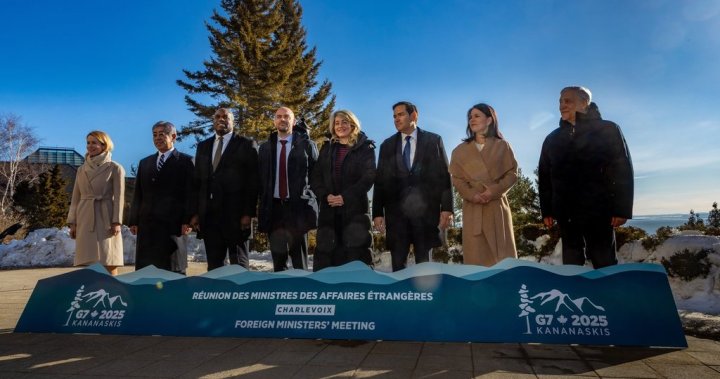
Foreign ministers from the G7 nations overcame their differences on Friday to back Ukraine’s territorial integrity and warned Russia to follow Kyiv in accepting a ceasefire or face possible further sanctions.
Their joint communique followed weeks of tension between U.S. allies and President Donald Trump over his upending of Western trade, security and Ukraine-related policy.
Trump urged Russian President Vladimir Putin on Friday to spare Ukrainian troops being pushed back out of Russia’s Kursk region and said there was a “very good chance” the war could end.
Trump posted on social media after his envoy, Steve Witkoff, held a lengthy meeting with Putin on Thursday night in Moscow that Trump described as “very good and productive.”
The Kremlin said Putin had sent Trump a message about his ceasefire plan, which Kyiv has agreed to, via Witkoff, expressing “cautious optimism” that a deal could be reached to end the three-year-old conflict.

Putin said on Thursday that he supported Trump’s proposal in principle, but that fighting could not be paused until several crucial conditions were worked out, raising the prospect of longer negotiations.
U.S. Secretary of State Marco Rubio told reporters after the G7 meetings that there was reason to be “cautiously optimistic” about a ceasefire and peace negotiations after Putin’s remarks, but would not address his stated conditions.
G7 officials had feared they would not be able to agree on an all-encompassing document touching on geopolitical issues from across the world, divisions that they said could have played into the hands of both Russia and China.

Get daily National news
Get the day’s top news, political, economic, and current affairs headlines, delivered to your inbox once a day.
“When it comes to different issues, Ukraine and the Middle East, we’ve had sessions talking about these different issues, subjects, and the goal was to keep strong G7 unity,” Canadian Foreign Minister Melanie Joly told reporters.
The Group of Seven ministers from Britain, Canada, France, Germany, Italy, Japan and the United States, along with the European Union, convened in the remote tourist town of La Malbaie, nestled in the Quebec hills, for meetings on Thursday and Friday that in the past have been broadly consensual.
But in the run-up to the first G7 meeting of Canada’s presidency, the crafting of an agreed final statement had been difficult with wrangling over the language regarding Ukraine, the Middle East and Washington’s desire for tougher wording on China.
The communique “reaffirmed their unwavering support for Ukraine in defending its territorial integrity and right to exist, and its freedom, sovereignty and independence.”
Ukraine’s territorial integrity has largely been absent from the U.S. narrative since the Trump administration came to power on January 20. The U.S. under Trump has so far not ruled out the possibility that Kyiv might cede territory.

Ukrainian President Volodymyr Zelenskyy said Friday the issue of territory was discussed during a meeting of Ukrainian and U.S. officials in the Saudi city of Jeddah but it would require difficult dialog.
“The territorial integrity is an important element of the communique and the (reference) to the United Nations,” EU’s foreign policy chief Kaja Kallas told Reuters, referring to a call for a “comprehensive, just and lasting peace in line with the Charter of the United Nations.”


An earlier text referring to the need for security guarantees to ensure a truce was replaced by “assurances,” but they did warn Moscow to follow Kyiv in agreeing to a ceasefire or face further sanctions, including oil price caps.
“G7 members called for Russia to reciprocate by agreeing to a ceasefire on equal terms and implementing it fully.
“They emphasized that any ceasefire must be respected and underscored the need for robust and credible security arrangements to ensure that Ukraine can deter and defend against any renewed acts of aggression,” they said in a reference to Ukraine’s territorial integrity.
British Foreign Secretary David Lammy called the statement “very good.”

Washington had sought to impose red lines on language around Ukraine to not harm its talks with Russia and opposed a separate declaration on curbing Russia’s so-called shadow fleet, a murky shipping network that eludes sanctions, while demanding more robust language on China.
In the end the G7 also approved a separate statement on maritime security, including a task force to tackle the shadow fleet, something that Canada had pushed for.
The final communique stated G7 opposition to any unilateral attempts to change the status quo across the Taiwan Strait by force or coercion, language that will likely be encouraging to Taipei.
There had been wrangling over language regarding Gaza and the Middle East, notably the notion of a two-state solution for the Israeli-Palestinian conflict, something the U.S. was resisting.
The final version made no mention of a two-state solution, dropping language that had stressed its importance in earlier drafts of the text.
“They underscored the imperative of a political horizon for the Palestinian people, achieved through a negotiated solution to the Israeli-Palestinian conflict that meets the legitimate needs and aspirations of both peoples and advances comprehensive Middle East peace, stability and prosperity,” the draft read.
—With additional files from Global News and Reuters

Politics
IMF chief backs Jerome Powell, U.S. Fed independence amid Trump pressure – National TenX News
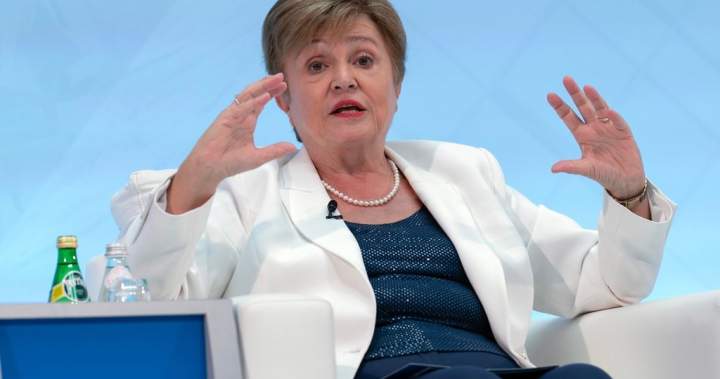
International Monetary Fund chief Kristalina Georgieva on Thursday underscored the importance of keeping central banks independent and threw her support behind beleaguered Federal Reserve Chair Jerome Powell, who is facing a Trump administration investigation for renovation cost overruns.
Georgieva told Reuters in an interview that there was ample evidence that central bank independence worked in the interest of businesses and households, and that evidence-based, data-based decision-making is good for the economy.
The IMF managing director said she had worked with Powell and respected his professionalism.
“I have worked with Jay Powell. He is a very good professional, very decent man, and I think that his standing among his colleagues tells the story,” she said, when asked about a letter of support signed by her predecessor, Christine Lagarde, now head of the European Central Bank, and other large central banks.
Powell on Sunday disclosed that the Trump administration had opened an investigation into him over cost overruns for a $2.5 billion project to renovate two historical buildings at the Fed’s Washington headquarters complex.
Get daily National news
Get the day’s top news, political, economic, and current affairs headlines, delivered to your inbox once a day.
Powell denies wrongdoing and has called the unprecedented actions a pretext to put pressure on him for not bowing to U.S. President Donald Trump’s long-running demands for sharply lower interest rates.


The probe has sparked widespread criticism from some key members of Trump’s Republican Party in the U.S. Senate, which must confirm his nominee to succeed Powell, along with foreign economic officials, investors and former U.S. government officials from both political parties.
Trump has repeatedly derided Powell’s leadership of the Fed and attacked him, often personally, over what he sees as the Fed chair’s slow moves to cut interest rates. On Wednesday, he dismissed concerns that eroding central bank independence would undermine the value of the U.S. dollar and spark inflation, telling Reuters, “I don’t care.”
Georgieva said the IMF looked carefully at issues such as monetary and financial stability, as well as the strength of a country’s institutions. It was specifically interested in the Fed, given the role of the U.S. dollar as a reserve currency.
“It would be very good to see that there is a recognition … that the Fed is precious for the Americans. It is very important for the rest of the world,” she said.
Trump has also attempted to fire another Fed official, Governor Lisa Cook, who has challenged her termination in a legal case that will be argued before the Supreme Court next week.
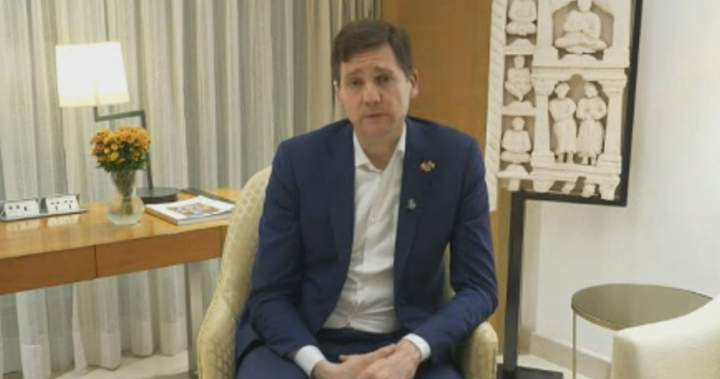
B.C. Premier David Eby spoke to reporters on Thursday morning from Mumbai, India, during his six-day trade mission.
He said that mining and energy companies in India are showing an interest in B.C.
“They are looking strongly to LNG as one of their ways of reducing carbon intensity, as well as reducing smog in the country,” Eby said.
“And so B.C. LNG has been an item of considerable interest, especially the projects that are reaching final investment decision over the next year — LNG Canada Phase 2, KSI Lisims LNG — as well as the projects that are under construction like Woodfibre LNG.”

Eby was also asked about the rise in extortion cases in B.C.
He said the province’s extortion task force will provide an update next week.
Get breaking National news
For news impacting Canada and around the world, sign up for breaking news alerts delivered directly to you when they happen.
“We have assembled a remarkable and historic task force, RCMP, CBSA,” Eby said.


“There are more police in Surrey right now than there have ever been. The RCMP has surged resources into the community.”
Eby said he has not been happy with the fact that there has been no update from the task force and he has asked them to provide one.
“There have been some important developments, people deported, an arrest here in India, cooperation between the Indian government and the Canadian government on this at the law enforcement level,” he added.
“That needs to continue, but, bluntly, we need better results, we need to see more arrests and whatever we can do to support the police to get the job done, we will do so.”
As of Jan. 12, Surrey police said there have been 16 reported extortion incidents in the city since the beginning of the year.
© 2026 Global News, a division of Corus Entertainment Inc.
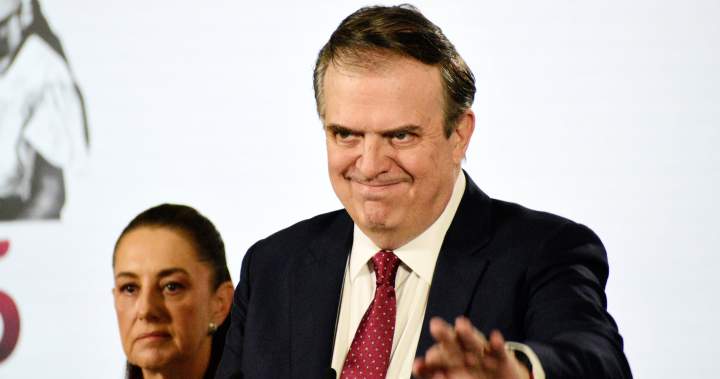
Amid persistent doubts over the future of the Canada-United States-Mexico trade agreement (CUSMA), Mexico’s Economy Minister Marcelo Ebrard insisted on Thursday that the agreement remains firmly intact and that the three countries will close a deal to extend it.
“We’re already in the treaty review phase, and we have to finish by July 1; that’s our deadline,” Ebrard said during Mexican President Claudia Sheinbaum’s daily morning press conference.
“We have made good progress on all the points that concern each of the parties.”
Ebrard’s comments were his first on the topic since U.S. President Donald Trump again cast doubt on the treaty’s future earlier this week.
“There’s no real advantage to it, it’s irrelevant,” Trump said on Tuesday, as he toured a Ford factory in Dearborn, Michigan.
The trilateral trade agreement, known as USMCA, replaced the North American Free Trade Agreement in 2020 and is a backbone of Mexico’s economy.
The treaty, which was negotiated during Trump’s first term, requires the three countries to hold a joint review this year to extend the pact.
Get breaking National news
For news impacting Canada and around the world, sign up for breaking news alerts delivered directly to you when they happen.
If extended, the treaty will remain in place another 16 years. If not, it is subject to annual reviews.

Technically, July 1 is a key date in the treaty’s review process, but many analysts expect negotiations to extend late into 2026 and said Trump will likely avoid extending the treaty before the U.S. midterm elections in November.

Trump’s recent threats to pursue military action against cartels have also added a new layer of uncertainty to U.S.-Mexico relations.
“I think Ebrard is betting on a best-case scenario, but the window for a July successful review is closing fast,” said Alexia Bautista, a former Mexican diplomat and lead Mexico analyst at the political risk consultancy firm Horizon Engage.
“Given recent events and statements, the risk is that Trump injects security into the process, turning the trade review into a far more political negotiation.”
Pedro Casas, chief executive of the American Chamber of Commerce of Mexico, said he expects the U.S. will continue imposing tariffs on a wide spectrum of Mexican exports, regardless of the treaty’s future.
The Trump administration has imposed sweeping 50 per cent duties on steel and aluminum exports to the U.S., along with a 25 per cent tariff on cars shipped from Mexico, even when those vehicles comply with the terms of the trade deal.
“I think the most likely scenario is a positive review process where we agree to extend the treaty for another 16 years, but steep tariffs still remain on Mexican exports that undermine the strength of the agreement,” Casas said.


IMF chief backs Jerome Powell, U.S. Fed independence amid Trump pressure – National TenX News

B.C. Premier David Eby says province’s LNG, mining of interest to India TenX News

Mexico confident CUSMA will remain as Trump suggests it could expire – National TenX News


-

 Fashion10 months ago
These ’90s fashion trends are making a comeback in 2017
-

 Entertainment10 months ago
The final 6 ‘Game of Thrones’ episodes might feel like a full season
-

 TenX Exclusive10 months ago
अमर योद्धा: राइफलमैन जसवंत सिंह रावत की वीरगाथा
-

 Politics8 months ago
Before being named Pope Leo XIV, he was Cardinal Robert Prevost. Who is he? – National TenX News
-

 Politics9 months ago
Puerto Rico faces island-wide blackout, sparking anger from officials – National TenX News
-

 Fashion10 months ago
According to Dior Couture, this taboo fashion accessory is back
-

 Tech10 months ago
Indian-AI-software-which-caught-30-thousand-criminals-and-busted-18-terrorist-modules-its-demand-is-increasing-in-foreign-countries-also – News18 हिंदी
-

 Politics9 months ago
Scientists detect possible signs of life on another planet — but it’s not aliens – National TenX News