
Politics
As Russia threats worsen, all Canadians can help security: Latvian envoy – National TenX News

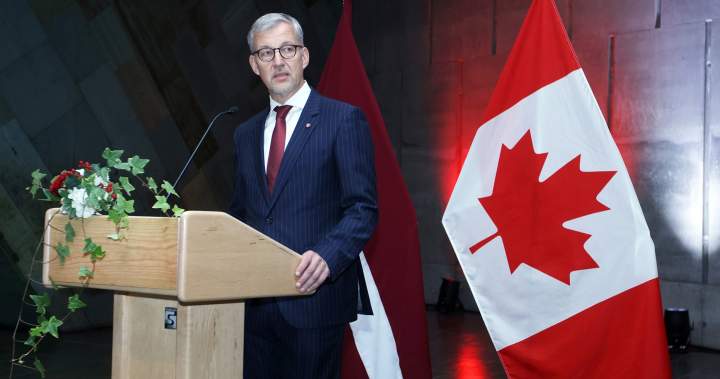
Canada is taking “positive” steps to boost its defence spending and military presence in Europe, but Canadians themselves need to take collective responsibility toward national security to counter growing threats from nations like Russia, Latvia’s envoy says.
In an interview with Global News in Vancouver, Kaspars Ozoliņš, Latvia’s ambassador to Canada, said “unfriendly countries” are not limited to geography as a means to influence or attack other nations, using everything from cyberattacks to disinformation. That requires businesses and civil society to defend critical infrastructure alongside government and military forces, he stressed.
“It’s not just about whether you spend two per cent or five per cent (of GDP on defence),” he said.
“There is an increased understanding (in Latvia) that it has to be a whole-of-society approach. So we do a lot of planning and training and exercise (with) businesses and institutions every year that has led to that growing acceptance and understanding.”
“I guess this is a relatively new concept for Canadians, and something that needs to be understood a little bit better.”
As a former Soviet republic-turned-NATO ally on the front lines of Europe’s defence from an increasingly hostile Russia, Ozoliņš said Latvia knows the risks posed to democratic allies like Canada firsthand.
“I’ve lived under the Soviet regime,” he said, describing the “influence of terror” that preceded Latvia’s independence in 1991.
“The Soviet regime was much milder than it is right now in Russia. And that scares me.”
Canada leading NATO brigade in Latvia
The Canada-Latvia relationship is a valuable one within the NATO alliance. The Baltic nation is home to Canada’s largest overseas military mission, Operation Reassurance, a multinational battle brigade led by Canadian troops since 2017.
Prime Minister Mark Carney announced in August while visiting Riga that Canada would extend the mission for another three years, keeping more than 2,000 Canadian soldiers at the border with Russia until 2029.

The Latvian ambassador said that, while the announcement was welcome, the government wants Canada to join the multinational division command structure alongside Latvia and Denmark in order to streamline the chain of command with the brigade.

Get daily National news
Get the day’s top news, political, economic, and current affairs headlines, delivered to your inbox once a day.
That would require high-level Canadian staffing at the divisional headquarters in Denmark.
“We certainly want Canada to join as a Framework Nation” that leads the overall division, not just the brigade, he said.
Ozoliņš’s comments come just over a week after Carney’s government released its first federal budget, which would allocate $2.7 billion toward that three-year extension of Operation Reassurance.
The budget overall proposes nearly $82 billion over the next five years toward modernizing and strengthening the Canadian Armed Forces, a massive influx in defence spending that Carney says will finally get Canada to meet its NATO commitments.
That money also includes more than $10 billion for digital infrastructure upgrades for military and Communications Security Establishment systems used in “modern warfare,” including cyber defence.
The new budget commits $28 million over the next two years to Canada’s updated cybersecurity strategy, which calls for a “whole-of-society engagement” to confront cyber threats. That means engaging with all levels of government along with law enforcement, the private sector, civil society, academia and Indigenous groups, in addition to partnering with international allies.

Ozoliņš noted Latvia is on track to spend 4.9 per cent of its GDP on defence by next year — more than twice the level Ottawa says it’s on track to hit.
Half of that spending in Latvia will go to defence procurement alone, he said.
“We are fortifying the border line between Russia and our country, as well as with Belarus,” which borders Latvia to the southeast and whose President Alexander Lukashenko is an ally of Russian President Vladimir Putin.
Russia causing more ‘mischief’, envoy says
Ozoliņš noted the war in Ukraine has further underscored the danger Latvia faces as a bulwark for the wider European continent against Moscow — as well as the continued need for collective defence.
In recent months, Russian drones and fighter jets have been reported in the airspace of several NATO countries in Europe, increasing concerns in the region of a broader conflict.


Ozoliņš said such incursions are nothing new for Latvia, while also pointing to Moscow’s continued attempts to sow distrust in elections and democracy around the globe.
“When Russia is lowering the threshold of doing mischief, using force or anything … it’s very worrying,” he said.
Canada’s recent commitments are helping to achieve that deterrence, the ambassador added.
Ottawa aims to have a full cadre of 2,200 persistently deployed Canadian troops in Latvia sometime in 2026, a timeline Ozoliņš said is on track and may be achieved earlier than anticipated.
“Defence investment is very serious and takes a lot of years, but in that sense I think Canada is progressing really well on upscaling the brigade headquarters to full operational capacity,” he said.
“If we look at the pace from decisions made to implementation, it has been very good.”

The military modernization commitments in the budget, if achieved, will be reflected in the NATO Latvia brigade itself as well as in domestic military operations like Arctic security, Ozoliņš added.
Asked if another multinational brigade similar to the one in Latvia would make sense in the Arctic as well, Ozoliņš deferred to the Arctic Council of nations to make that decision, but didn’t dismiss the idea.
“What we like to see is the willingness of countries to work together,” he said.
“You cannot just slice up the Arctic pie and say you only control your slice. The best way to deal with the increasing threats is to work collectively.”
Public understanding of security necessary
Overall, the ambassador said there has been an increased urgency and commitment to defence out of Ottawa. He pointed to Carney’s Remembrance Day statement, which called for continued “vigilance” in an increasingly dangerous world, as proof of a shift in priorities.
He said all levels of government must continue to underscore the need for a collective approach to national defence across industry and civil society in order to gain support for continued investments.
“We don’t have the luxury of spending endless amounts of money,” Ozoliņš said. “We need support from society to confront these threats, and that requires more understanding.”
While defence spending was far outpaced by affordability concerns in an Ipsos poll on budget priorities conducted last month for Global News, the survey found support for investments in the military has risen since last year.
Ozoliņš said there’s a growing awareness of the need for a “societal resiliency” among young people he speaks to at universities across Canada.
“I tell them that history is not static, and that the speed of change is so fast that we can’t be thinking, ‘well it doesn’t concern us,’” he said.
“If you think you’ll be acting when the threat comes, then that would be too late.”

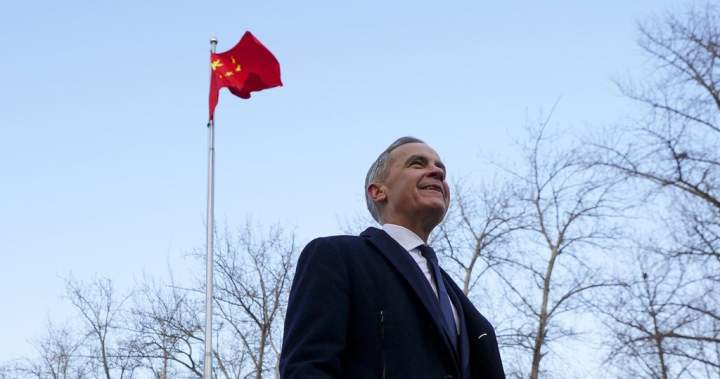
Prime Minister Mark Carney’s trade mission to China is being framed as a win for British Columbia’s economy.
Carney announced a new deal with Beijing on electric vehicles and canola at the end of a high-profile trip on Friday.
“The inroads Canada has made this week are a sign that the government gets it and is showing Canadians and the world that we are open for business,” Alexa Young with the Vancouver Fraser Port Authority said.
The trade deal would allow up to 49,000 Chinese EVs into Canada yearly at a tariff rate of 6.1 per cent.
An expanded auto terminal on Annacis Island will be able to handle the additional volume of cars that could be more affordable than what is currently on the market, with prices expected to be under $40,000.
The New Car Dealers Association said in a statement to Global News that, “We look forward to reviewing the full details of this announcement and engaging constructively with governments to ensure that affordability, competition, and long-term market stability remain central considerations.”


In British Columbia, the overall reaction to the news on Friday is positive.
Get breaking National news
For news impacting Canada and around the world, sign up for breaking news alerts delivered directly to you when they happen.
“China’s economy is important,” Alex McMillan with the B.C. Chamber of Commerce said.
“Having trade deals like this — and diversifying our markets — is important. Providing certainty is important.”
There are concerns with the agreement, including privacy issues and China’s human rights record. But Ottawa’s goal is to double trade with partners outside the United States, which is a goal that would be impossible without China.
“We do want to see more trade and more diversification of our markets and know that China is an important nation and important economy, so having better trade relationships with them, I think overall is going to be good,” McMillan said.
–with files from The Canadian Press
© 2026 Global News, a division of Corus Entertainment Inc.
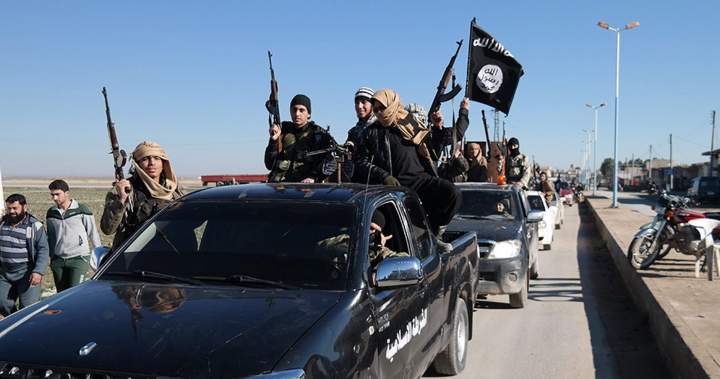
A Crown prosecutor says a Calgary man who willingly joined and worked for an Islamic State terrorist group in the Middle East over a decade ago should spend 16 years in prison, while a defence lawyer has recommended 12 years.
Jamal Borhot, 35, was convicted in December of three counts of participation in a terrorist group for assisting in the terrorist activities of ISIS in Syria in 2013.
Court heard Borhot and his cousin Hussein Borhot illegally entered Syria through Turkey.
Hussein Borhot pleaded guilty in a separate trial and was sentenced in 2022 to 12 years.
In December, Justice Corina Dario found Jamal Borhot participated in violent acts, actively recruited others to join the cause and worked in administration.
He returned to Calgary after one year.
Jamal Borhot travelled to Syria in 2013 with his cousin Hussein Borhot, seen here outside the Calgary Court Centre, after pleading guilty in a separate trial in 2022.
Global News
The judge is scheduled to sentence Borhot on Feb. 4.
Get daily National news
Get the day’s top news, political, economic, and current affairs headlines, delivered to your inbox once a day.
At a sentencing hearing Friday, prosecutor Kent Brown said 16 years is appropriate for Jamal Borhot, as the cousin received less time for his pleas.
“The focus remains deterrence and denunciation and that is largely due to the pernicious nature of terrorism offences. Anyone who engages in those activities should expect a significant sentence as a result,” Brown said.
Borhot planned the trip to Syria and tried to hide his movements, the prosecutor said.
“There was real risk of serious harm caused by the offender’s conduct. I submit that’s without question here, given his involvement in battles in Syria.”
Brown added outside court that the case was difficult to prosecute since it happened so long ago. “It’s a cold case that happened in a country half way around the world.”
Defence lawyer Pawel Milczarek said his client has lived a peaceful life since returning to Canada and should have a sentence that’s proportionate to his cousin’s prison time.
Milczarek said Borhot became radicalized and wanted to help fight the Syrian government, as he believed it was randomly slaughtering civilians.
“Mr. Borhot was motivated by this purpose to travel to Syria. He found the wrong group to fight with,” the lawyer said.
“With 20/20 hindsight, we can all identify that ISIS became a violent terrorist organization after Mr. Borhot left Syria. We should not harshly punish Mr. Borhot for making a mistake with imperfect information.”
Borhot did not address the court.

© 2026 The Canadian Press

As Iran returned to uneasy calm after a wave of protests that drew a bloody crackdown, a senior hard-line cleric called Friday for the death penalty for detained demonstrators and directly threatened U.S. President Donald Trump — evidence of the rage gripping authorities in the Islamic Republic.
Trump, though, struck a conciliatory note, thanking Iran’s leaders for not executing hundreds of detained protesters, in a further sign he may be backing away from a military strike. Executions, as well as the killing of peaceful protesters, are two of the red lines laid down by Trump for possible action against Iran.
Harsh repression that has left several thousand people dead appears to have succeeded in stifling demonstrations that began Dec. 28 over Iran’s ailing economy and morphed into protests directly challenging the country’s theocracy.
There have been no signs of protests for days in Tehran, where shopping and street life have returned to outward normality, though a week-old internet blackout continued. Authorities have not reported any unrest elsewhere in the country.
“Iran canceled the hanging of over 800 people,” Trump told reporters in Washington, adding that “I greatly respect the fact that they canceled.”
Trump did not clarify who he spoke to in Iran to confirm the state of any planned executions.

The U.S.-based Human Rights Activists News Agency on Friday put the death toll at 3,090. The number, which exceeds that of any other round of protest or unrest in Iran in decades and recalls the chaos surrounding the 1979 revolution, continues to rise.
The agency has been accurate throughout the years of demonstrations, relying on a network of activists inside Iran that confirms all reported fatalities.
The AP has been unable to independently confirm the toll. Iran’s government has not provided casualty figures.
Hard-line cleric’s fiery sermon
In contrast, the sermon by Ayatollah Ahmad Khatami carried by Iranian state radio sparked chants from those gathered for prayers, including: “Armed hypocrites should be put to death!”
Get daily National news
Get the day’s top news, political, economic, and current affairs headlines, delivered to your inbox once a day.
Khatami, a member of Iran’s Assembly of Experts and Guardian Council long known for his hard-line views, described the protesters as the “butlers” of Israeli Prime Minister Benjamin Netanyahu and “Trump’s soldiers.” He said Netanyahu and Trump should await “hard revenge from the system.”
“Americans and Zionists should not expect peace,” the cleric said.
FILE – Iranian senior cleric Ahmad Khatami delivers his sermon during Friday prayer ceremony in Tehran, Iran, Friday, Jan. 5, 2018. (AP Photo/Ebrahim Noroozi, File).
EN
His fiery speech came as allies of Iran and the United States alike sought to defuse tensions. Russian President Vladimir Putin spoke Friday to both Iranian President Masoud Pezeshkian and Israel’s Netanyahu, Kremlin spokesman Dmitry Peskov said.
Russia had previously kept largely quiet about the protests. Moscow has watched several key allies suffer blows as its resources and focus are consumed by its 4-year-old war against Ukraine, including the downfall of Syria’s former President Bashar Assad in 2024, last year’s U.S. and Israeli attacks on Iran and the U.S. seizure of Venezuelan leader Nicolas Maduro this month.
Exiled Iranian royal calls for fight to continue
Days after Trump pledged “help is on its way” for the protesters, both the demonstrations and the prospect of imminent U.S. retaliation appeared to have receded. One diplomat told The Associated Press that top officials from Egypt, Oman, Saudi Arabia and Qatar had raised concerns with Trump that a U.S. military intervention would shake the global economy and destabilize an already volatile region.
Iran’s exiled Crown Prince Reza Pahlavi urged the U.S. to make good on its pledge to intervene. Pahlavi, whose father was overthrown by Iran’s 1979 Islamic Revolution, said he still believes the president’s promise of assistance.
“I believe the president is a man of his word,” Pahlavi told reporters in Washington. He added that “regardless of whether action is taken or not, we as Iranians have no choice to carry on the fight.“
“I will return to Iran,” he vowed. Hours later, he urged protesters to take to the streets again from Saturday to Monday.
Despite support by diehard monarchists in the diaspora, Pahlavi has struggled to gain wider appeal within Iran. But that has not stopped him from presenting himself as the transitional leader of Iran if the regime were to fall.


Iran authorities list protest damage
Khatami, the hard-line cleric, also provided the first overall statistics on damage from the protests, claiming 350 mosques, 126 prayer halls and 20 other holy places had sustained damage. Another 80 homes of Friday prayer leaders — an important position within Iran’s theocracy — were also damaged, likely underlining the anger demonstrators felt toward symbols of the government.
He said 400 hospitals, 106 ambulances, 71 fire department vehicles, and another 50 emergency vehicles also sustained damage.
Even as protests appeared to have been smothered inside Iran, thousands of exiled Iranians and their supporters have taken to the streets in cities across Europe to shout out their rage at the government of the Islamic Republic.
Amid the continuing internet shutdown, some Iranians crossed borders to communicate with the outside world. At a border crossing in Turkey’s eastern province of Van, a trickle of Iranians crossing on Friday said they were traveling to get around the communications blackout.
“I will go back to Iran after they open the internet,” said a traveler who gave only his first name, Mehdi, out of security concerns.
Also crossing the border were some Turkish citizens escaping the unrest in Iran.

Mehmet Önder, 47, was in Tehran for his textiles business when the protests erupted. He said he laid low in his hotel until it was shut for security reasons, then stayed with one of his customers until he was able to return to Turkey.
Although he did not venture into the streets, Önder said he heard heavy gunfire.
“I understand guns, because I served in the military in the southeast of Turkey,” he said. “The guns they were firing were not simple weapons. They were machine-guns.”
In a sign of the conflict’s potential to spill over borders, a Kurdish separatist group in Iraq said it has launched attacks on Iran’s paramilitary Revolutionary Guard in recent days in retaliation for Tehran’s crackdown on protests.
A representative of the Kurdistan Freedom Party, or PAK, said its members have “played a role in the protests through both financial support and armed operations to defend protesters when needed.” The group said the attacks were launched by members of its military wing based inside Iran.
Amiri reported from New York. Associated Press journalists Will Weissert and Darlene Superville in Washington and Serra Yedikardes at the Kapikoy Border Crossing, Turkey, contributed.


Canada-China trade deal framed as a win for B.C.’s economy TenX News

Crown says Calgary man who joined ISIS should serve a 16-year terrorism sentence TenX News

Iran protests appear to calm, fate of detained demonstrators unclear – National TenX News


-

 Fashion10 months ago
These ’90s fashion trends are making a comeback in 2017
-

 Entertainment10 months ago
The final 6 ‘Game of Thrones’ episodes might feel like a full season
-
 TenX Exclusive10 months ago
अमर योद्धा: राइफलमैन जसवंत सिंह रावत की वीरगाथा
-
 Politics8 months ago
Before being named Pope Leo XIV, he was Cardinal Robert Prevost. Who is he? – National TenX News
-

 Politics9 months ago
Puerto Rico faces island-wide blackout, sparking anger from officials – National TenX News
-
 Fashion10 months ago
According to Dior Couture, this taboo fashion accessory is back
-

 Tech10 months ago
Indian-AI-software-which-caught-30-thousand-criminals-and-busted-18-terrorist-modules-its-demand-is-increasing-in-foreign-countries-also – News18 हिंदी
-

 Politics9 months ago
Scientists detect possible signs of life on another planet — but it’s not aliens – National TenX News