
Politics
Venezuela frees several opposition members after politically-motivated detentions – National TenX News


Venezuela’s government on Sunday released from prison several prominent opposition members, including one of the closest allies of Nobel Peace Prize laureate Maria Corina Machado, after lengthy politically motivated detentions.
Their releases come as the government of acting President Delcy Rodríguez faces mounting pressure to free hundreds of people whose detentions months or years ago have been linked to their political beliefs. They also follow a visit to Venezuela of representatives of the United Nations High Commissioner for Human Rights.
“Today, we are being released,” Juan Pablo Guanipa, a Machado ally and former governor, said in a video posted on X. “Much to discuss about the present and future of Venezuela, always with the truth at the forefront.”
Guanipa, who spent more than eight months in custody, was released from a detention facility in the capital, Caracas. An armored vehicle and officers appeared behind him in the video he released.
Venezuelan-based prisoners’ rights group Foro Penal confirmed the release of at least 30 people on Sunday.
In addition to Guanipa, Machado’s political organization said several of its members were among the released, including Maria Oropeza, who livestreamed her arrest by military intelligence officers as they broke into her home with a crowbar. Machado’s attorney, Perkins Rocha, was also freed.

Get breaking National news
For news impacting Canada and around the world, sign up for breaking news alerts delivered directly to you when they happen.
“Let’s go for the freedom of Venezuela!” Machado posted on X.

Guanipa was detained in late May and accused by Interior Minister Diosdado Cabello of participating in an alleged “terrorist group” plotting to boycott that month’s legislative election. Guanipa’s brother Tomás rejected the accusation, and said that the arrest was meant to crack down on dissent.
“Thinking differently cannot be criminalized in Venezuela, and today, Juan Pablo Guanipa is a prisoner of conscience of this regime,” Tomás Guanipa said after the arrest. “He has the right to think as he thinks, the right to defend his ideas, and the right to be treated under a constitution that is not being enforced today.”


Rodríguez was sworn in as Venezuela’s acting president after the capture in Caracas of then-President Nicolás Maduro by the U.S. military last month.
Her government announced on Jan. 8 it would free a significant number of prisoners — a central demand of the country’s opposition and human rights organizations with backing from the United States — but families and rights watchdogs have criticized authorities for the slow pace of the releases.
The ruling party-controlled National Assembly this week began debating an amnesty bill that could lead to the release of hundreds of prisoners. The opposition and nongovernmental organizations have reacted with cautious optimism as well as with suggestions and demands for more information on the contents of the proposal.
National Assembly President Jorge Rodríguez on Friday posted a video on Instagram showing him outside a detention center in Caracas and saying that “everyone” would be released no later than next week, once the amnesty bill is approved.
Delcy Rodríguez and Volker Türk, the U.N. High Commissioner for Human Rights, spoke by phone in late January. His spokesperson, Ravina Shamdasani, in a statement said he “offered our support to help Venezuela work on a roadmap for dialogue and reconciliation in which human rights should be at the centre” and then “deployed a team” to the South American country.
—Associated Press writer Jamey Keaten in Geneva contributed to this report.
© 2026 The Canadian Press

Politics
Parents condemn $176 fines for hostel staff after daughters died from tainted alcohol – National TenX News

The families of two Melbourne teenagers who died after drinking tainted alcohol in Laos have criticized the AU$185 (approximately $176 CAD) fines received by staff members who served the deadly drinks.
Holly Bowles and Bianca Jones, 19, died after they were served tainted alcohol laced with methanol at the Nana Backpacker Hostel in November 2024, part of a mass poisoning that also killed two Danish women, a U.S. tourist and a British woman.
The two 19-year-old Australian women fell ill following a night out drinking with a group and failed to check out from the Nana Backpacker Hostel as planned. The women were found sick in their room and then taken to Thailand for emergency treatment, where both died in hospital.
Thai authorities confirmed that Jones had died by “brain swelling due to high levels of methanol found in her system.”

The women’s fathers, Shaun Bowles and Mark Jones, said they were uninformed about the court case involving the hostel staff, which took place at the People’s Court of Vang Vieng in Laos.
They were part of a group chat with the families of the victims that provided them with updates and that’s how they learned 10 people connected to the hostel faced a judge in late January.
Get breaking National news
For news impacting Canada and around the world, sign up for breaking news alerts delivered directly to you when they happen.
Those 10 people were fined the AU$185 each and given a suspended sentence for destroying evidence, 9News reports.
“We were shocked by the absolute injustice for our girls and the others,” Jones said. “We have had no correspondence with anyone from the Laos government. We had no idea the court case was going ahead.
“To think that the Laos authorities believe that those who were involved in killing our daughters is worth $185 is absolutely disgraceful.”
The fathers initially thought the court case was linked to the deaths of their daughters, but the Department of Foreign Affairs and Trade confirmed that the charge for destruction of evidence was linked to the death of the American tourist.

Australian Foreign Minister Penny Wong said the Department of Foreign Affairs has been in communication with the Bowles and Jones families.
“I have made it clear to my Lao counterpart that Australia expects full accountability,” Wong said in a statement. “I have also made it clear that charges should reflect the seriousness of the tragedy which left six people dead, including Holly and Bianca.”
“The Department of Foreign Affairs and Trade is aware that the Vang Vieng District Court sentenced individuals over the destruction of evidence in relation to the death of a US citizen,” Wong said. “We continue to press Lao authorities on the cases relating to Holly and Bianca’s deaths, and we will continue to support Holly and Bianca’s families at this distressing time.”


Bowles and Jones called on the Australian government to step in and help get justice for the death of their daughters.
“As citizens of this country we expect the government to look after their people and get justice for their citizens when they go travelling,” Jones said.
“We can’t get into the country. There’s nothing more we can do. We need the government to do something because we are out of options,” Bowles added.
The Australian prime minister said the federal government would do everything it could to support the families of Bowles and Jones.
“The foreign minister has made it clear to her counterpart in Laos that Australia expects full accountability and the charges should reflect the devastating seriousness of this incident. We will continue to engage Laos authorities on these cases,” Australian Prime Minister Anthony Albanese said during question time in a daily parliamentary session with members of Parliament on Monday.
In November 2024, Canada issued a travel advisory after the six tourists, mostly aged 19 to 20, died from methanol poisoning in the popular backpacker town in northern Laos.
“Several foreigners in Vang Vieng have been victims of suspected methanol-adulterated alcohol poisoning,” the warning read. “Be vigilant if you choose to drink alcohol. Avoid accepting free or extremely low-priced drinks. Only buy alcohol in sealed bottles and cans from reputable shops. Seek medical assistance if you begin to feel sick.”
Methanol is a clear, colourless alcohol used in all kinds of everyday products like industrial cleaners, solvents, paint, cosmetics and anti-freeze. Methanol is toxic and deadly when consumed.
Methanol is sometimes added to mixed drinks at disreputable bars as a cheaper alternative to ethanol, but can cause severe poisoning or death. It is also a byproduct of poorly distilled homebrew liquor and could have found its way into bar drinks inadvertently.
— With files from The Associated Press
© 2026 Global News, a division of Corus Entertainment Inc.
Politics
Cuba is reaching ‘breaking point’ as fuel shortage worsens. What to know – National TenX News
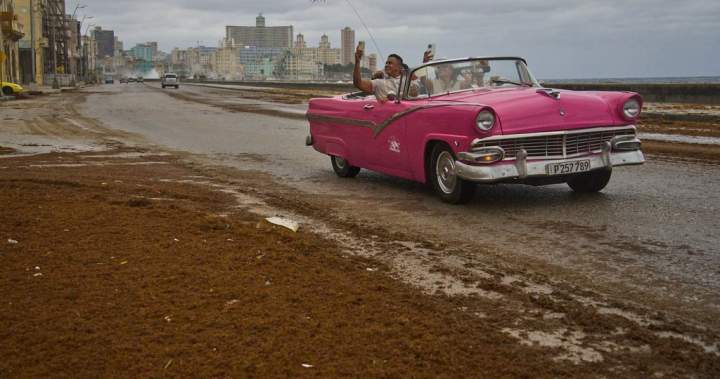
The suspension of Air Canada flights to Cuba after the country warned airlines of a fuel shortage marks the latest blow for the island’s economy amid increased pressure from the Trump administration.
Cuba had been weathering economic hardship before U.S. President Donald Trump effectively cut off oil shipments to the island by blockading its chief supplier, Venezuela, and threatening tariffs on any country that stepped in to fill the void.
After the U.S. captured Venezuelan President Nicolas Maduro in early January, Trump predicted Cuba’s government was “ready to fall” next.
U.S. Secretary of State Marco Rubio told senators at a hearing late last month that “we would love to see a change” in the regime, but added the U.S. wouldn’t “make” that change.

The White House has labelled Cuba “an unusual and extraordinary threat” to the U.S. due to the communist nation’s alliances with Russia, China and Iran.
Last week, Cuban President Miguel Díaz-Canel said his government is willing to enter negotiations with the Trump administration that could ease some of the economic pain. Whether that means the fall of the Cuban government is an open question.
“We may be reaching a breaking point,” said Max Cameron, a political science professor at the University of British Columbia who studies Latin America.
Cuba has been facing fuel shortages for years, and particularly since the outbreak of the COVID-19 pandemic, as Venezuela’s state oil company PDVSA has reduced exports in order to avoid fuel scarcity at home.
Other suppliers like Russia and Mexico have also reduced oil shipments, which the Cuban government has blamed on new U.S. sanctions imposed during Trump’s first term and later by former U.S. president Joe Biden.
The shortages have led to blackouts of the island’s fuel-powered electrical grid. In 2024, the entire population of over 10 million people was plunged into darkness when the grid ran out of fuel.

Cubans have also faced food and medicine shortages in recent years that have been exacerbated by hurricanes disrupting shipments of essential goods.
Get daily National news
Get the day’s top news, political, economic, and current affairs headlines, delivered to your inbox once a day.
Trump’s Venezuelan oil blockade, and his Jan. 29 order that countries will face tariffs if they supply oil to Cuba, has further compounded the pain the country is facing.
Diaz-Canel has imposed emergency measures including shorter workweeks and school days, limited transport between provinces and fuel rationing for essential services.
“I know we are going to live through difficult times. But we will overcome them together, with creative resilience,” he said during a rare press conference on Feb. 5 where he told residents they must “sacrifice” and “resist.”
Mark Entwistle, who served as Canada’s ambassador to Cuba from 1993 to 1997, said Trump’s pressure campaign on Cuba also puts countries like Canada in a “vice grip.”
“The reality is that we need to manage and renegotiate (the Canada-U.S.-Mexico Agreement on free trade),” he said in an interview.
“The Canadian government … needs to manage the U.S. relationship in a smart-minded way, (but at the same time) nobody wants to see a fellow country of the Americas be bullied and crushed and potentially fall into chaos.”
Entwistle said the federal government will also need to ensure the safety and security of thousands of Canadians in Cuba.
Global Affairs Canada says it is aware of more than 7,200 Canadians in Cuba and is providing consular assistance to anyone who requests it.
It also pointed to the government’s travel advisory for Cuba, which was upgraded Feb. 3 to warn travellers to “exercise a high degree of caution,” citing worsening power outages and shortages of basic necessities.

Canadians have long been the top market for Cuba’s lucrative tourism industry, which once generated $3 billion annually but has struggled to return to pre-pandemic levels. Many resorts have been forced to close or reduce their bookings because of the fuel and supply shortages.

Last year, around 754,000 Canadians visited the island, a 12-per cent drop from the year before and well below the 1.3 million pre-pandemic annual average, according to Cuba’s national statistics agency ONEI.
The number still outpaces other top markets like Russia and even Cuban nationals visiting from the U.S., and even exceeds the combined number of visitors from several other countries.
Pedro Monreal, a Cuban economist, said on X this week that Cuba’s tourism industry has become increasingly reliant on Canadian visitors, and that the recent drop-off has created a “pneumonia” across the sector.
The question of who’s to blame for Cuba’s economic crisis has led to finger-pointing between the Cuban government and the United States.
The U.S. has had an economic embargo on Cuba since the early 1960s, shortly after Fidel Castro’s socialist revolution in 1959. That embargo was codified into law in the 1990s, and has been relaxed and strengthened at various points since then.
A period of renewed U.S.-Cuba relations under the Obama administration came to an end when Trump took over the White House in 2017, an approach that continued under Biden.

Díaz-Canel said last week that U.S. sanctions have cost the country over $7.5 billion between March 2024 and February 2025, and called the “energy blockade” enacted by Trump a “psychological war.”
Rubio, the son of Cuban immigrants with deep ties to Miami’s Cuban community, told the U.S. Senate foreign relations committee on Jan. 28 that Cuba’s economic problems are the fault of the government’s decades of mismanagement.
“The suffering in the rural areas of Cuba are acute and they’re deep, and it’s not because of the embargo. It’s because they don’t know how to run an economy,” he said.
“How is it the fault of the U.S. embargo that Cuba, one of the world’s largest sugar producers, now imports sugar? Because no sector of their society works. It’s frozen and it’s broken.”
Entwistle and Cameron said both sides are partially responsible for the current situation. They said Cuba’s investments in health care and social services, while laudable, came at the expense of infrastructure that has been failing for decades.
The U.S. embargo, meanwhile, has blocked foreign investment and made sourcing goods difficult, though countries unfriendly to the U.S. like Russia, China and Venezuela have often stepped in to help.
The embargo has also, in the eyes of many experts and researchers, aimed to provoke regime change and force Cuba away from communism.
Although Entwistle said Cubans are “exhausted” by the worsening economic crisis and “would love to see a change in government,” he added the pressure from the U.S. is fueling Cuban nationalism and “anti-Americanism.”
“If there is a view in Washington that all Cubans on the island are waiting for them to come, or that Cubans will endure all suffering so that there can be a change in government — suffering even provoked by the U.S. government itself — that is an incorrect assessment,” he said.
Cameron added that a fall of the regime in Cuba could spark a power vacuum and civil strife that may create a new security crisis for the U.S. and the wider region.
“You don’t want to turn Cuba into another Haiti,” he said.
Politics
Record snow drought in Western US raises concerns for water shortages and wildfires TenX News
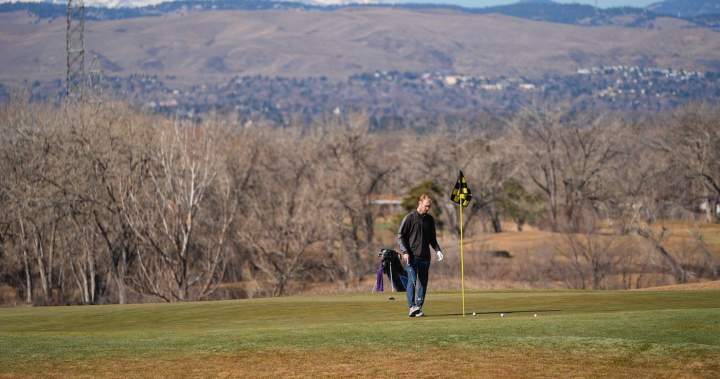
A record snow drought with unprecedented heat is hitting most of the American West, depleting future water supplies, making it more vulnerable to wildfires and hurting winter tourism and recreation.
Scientists say snow cover and snow depth are both at the lowest levels they’ve seen in decades, while at least 67 Western weather stations have measured their warmest December through early February on record.
Normal snow cover this time of year should be about 1.2 million square kilometres (460,000 square miles) — about the size of California, Utah, Idaho and Montana — but this year it’s only about one-third of that, about 401,448 square kilometres (155,000 square miles), according to the National Snow and Ice Data Center.
“I have not seen a winter like this before,” said center director Mark Serreze, who has been in Colorado almost 40 years. “This pattern that we’re in is so darned persistent.”
Taking advantage of daytime temperatures in the mid-to-high teens Celsius, a cyclist wheels through Washington Park, Friday, Feb. 6, 2026, in Denver.
AP Photo/David Zalubowski
The snowpack — measured by how much water is trapped inside — in Oregon is not only record low, but 30 per cent lower than the previous record, said Jason Gerlich, regional drought early warning system coordinator for the National Oceanic and Atmospheric Administration (NOAA).
Much of the U.S. east of the Rockies is snowbound and enduring more than two weeks of bone-chilling abnormal cold, but in West Jordan, Utah, a suburb of Salt Lake City, Trevor Stephens went to the store last week in gym shorts and a T-shirt.
“Right now there’s no snow on the ground,” he said in a video interview, looking out his window and lamenting the lack of snowboarding opportunities. “I’d definitely rather have icy roads and snow than whatever is going on out here right now.”
Concerns over water supply and wildfires
Get breaking National news
For news impacting Canada and around the world, sign up for breaking news alerts delivered directly to you when they happen.
Ski resorts had already been struggling through a difficult season, but the lack of snow has been persistent enough that concerns are growing about wider effects.
Oregon, Colorado and Utah have reported their lowest statewide snowpack since the early 1980s, as far back as records go.
A dry January has meant most states have received half their average precipitation or even less. Along with sunny days and higher-than-average temperatures, that’s meant little snow buildup in a month that historically gets a lot of snow accumulation across much of the Pacific Northwest and Northern Rockies. Because of heavy rains in December, California is in better shape than the other states, scientists said.
As of Monday, it had been 327 days since Salt Lake City International Airport got 2.54 centimeters (1 inch) of snow, making it the longest stretch since 1890-91, according to the National Weather Service.
The meager snow in Colorado and Utah has put the Upper Colorado River Basin at the heart of the snow drought, said Gerlich.
With a backdrop of snowless mountains, a couple walk around the lake in Denver’s Washington Park on Friday, Feb. 6, 2026.
AP Photo/David Zalubowski
A robust mountain snowpack that slowly melts as winter warms to spring provides a steady flow of water into creeks and rivers. That helps ensure there’s enough water later in the year for agriculture, cities, hydropower electric systems and more.
But lack of snow or a too-fast melt means less water will replenish rivers like the Colorado later in the season.
Related News
-
![]()
Record-setting temperatures in Alberta prompt warnings about wildfire danger
-
![]()
Temperatures soar in Western Canada as eastern parts of the country bundle up


“This is a pretty big problem for the Colorado basin,” said Daniel Swain of the University of California’s Water Resources Institute.
Experts said the snow drought could also kick-start an early wildfire season. Snow disappearing earlier than average leaves the ground exposed to warmer weather in the spring and summer, which dries soils and vegetation quicker, said Daniel McEvoy, researcher with the Western Regional Climate Center.
Too warm to snow
While it’s been dry, the record-low snowpack is mostly due to how warm the West has been, which is connected to climate change from the burning of coal, oil and natural gas, several scientists said. Since Dec. 1, there have been more than 8,500 daily high temperature records broken or tied in the West, according to NOAA data.
Much of the precipitation that would normally fall as snow and stay in the mountains for months is instead falling as rain, which runs off quicker, Swain and other scientists said. It’s a problem scientists have warned about with climate change.
Going snowless happens from time to time, but it’s the warmth that has been so extreme, which is easier to tie to climate change, said Russ Schumacher, professor of atmospheric science at Colorado State University and Colorado State Climatologist.
“It was so warm, especially in December, that the snow was only falling at the highest parts of the mountains,” McEvoy said. “And then we moved into January and it got really dry almost everywhere for the last three to four weeks and stayed warm.”
Canada geese sit in a small bank of dirt-covered snow melting in a parking lot in Sheridan, Co., on Feb. 6. 2026.
AP Photo/David Zalubowski
Wetter, cooler weather is coming
Meteorologists expect wetter, cooler weather across the West this week with some snow, so this may be the peak of the snow drought. But it’ll still be warmer than usual in many areas, and scientists aren’t optimistic the snow will be enough.
“I don’t think there’s any way we’re going to go back up to, you know, average or anywhere close to that,” said Schumacher. “But at least we can chip away at those deficits a little bit if it does get more active.”

© 2026 The Canadian Press


Parents condemn $176 fines for hostel staff after daughters died from tainted alcohol – National TenX News

Cuba is reaching ‘breaking point’ as fuel shortage worsens. What to know – National TenX News

Record snow drought in Western US raises concerns for water shortages and wildfires TenX News


-

 Fashion11 months ago
These ’90s fashion trends are making a comeback in 2017
-

 Entertainment11 months ago
The final 6 ‘Game of Thrones’ episodes might feel like a full season
-

 TenX Exclusive11 months ago
अमर योद्धा: राइफलमैन जसवंत सिंह रावत की वीरगाथा
-

 Politics9 months ago
Before being named Pope Leo XIV, he was Cardinal Robert Prevost. Who is he? – National TenX News
-

 Politics10 months ago
Puerto Rico faces island-wide blackout, sparking anger from officials – National TenX News
-

 Sports11 months ago
BCCI किस ग्रेड के खिलाड़ी को देती है कितना पैसा? इन 5 क्रिकेटर्स का कटेगा पत्ता! होंगे कई बड़े उलटफेर
-

 Fashion11 months ago
According to Dior Couture, this taboo fashion accessory is back
-

 Tech11 months ago
Indian-AI-software-which-caught-30-thousand-criminals-and-busted-18-terrorist-modules-its-demand-is-increasing-in-foreign-countries-also – News18 हिंदी