
Politics
Small majority of Canadians want more trade with China: Ipsos poll – National TenX News

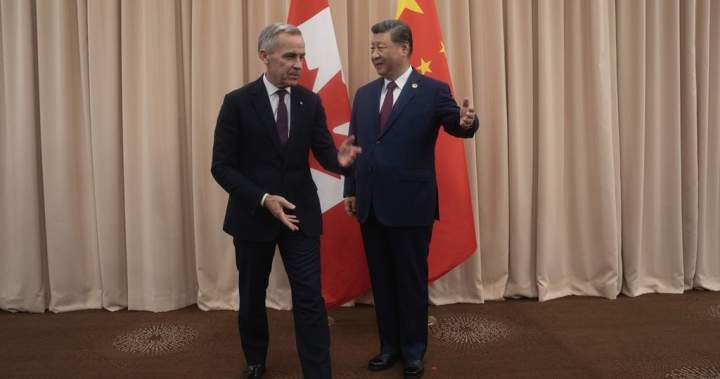
As Prime Minister Mark Carney prepares to travel to China and seeks to restore trade and diplomatic ties, a small majority of Canadians say they support more trade with Beijing, a new poll suggests.
The Ipsos poll conducted exclusively for Global News, released Saturday, found that 54 per cent expressed support for closer trade ties and economic agreements with China.
The results mark a turnaround from 2020, when eight out of 10 Canadians wanted the country to rely less on the Chinese market amid a nadir in relations sparked by foreign interference allegations against Beijing and the arbitrary detention of the “two Michaels.”
Darrell Bricker, CEO of Ipsos Public Affairs, says the new poll’s results “are less about China and more about the United States” and the economic realities of U.S. President Donald Trump’s trade war.
“The reason that it’s bounced back is not all of a sudden people have fallen in love with China, which is why the numbers are soft,” Bricker said in an interview.
“The reason that they’ve bounced back is because people are thinking about who in the world we’re going to trade with. And the second largest population in the world, and the second largest economy, is probably a place that we need to have some sort of a relationship with.”

Ipsos contacted 2,001 Canadian adults in early December 2025 for the poll.
Carney will be in China for five days starting Tuesday, marking the first official trip to the country by a Canadian prime minister since 2017.
He will meet with Chinese President Xi Jinping during the trip, which the Prime Minister’s Office said will build on the two leaders’ first meeting at the Asia-Pacific Economic Cooperation forum in South Korea last October.
Relations with Beijing plunged to new lows in 2018 after China jailed Canadians Michael Kovrig and Michael Spavor for almost three years, in a move widely seen as retaliation over Canada’s arrest of Huawei executive Meng Wanzhou on U.S. fraud charges.
While that source of tension was resolved after the three were released in 2021, trade relations have continued to suffer. Canada has imposed a 100 per cent tariff on Chinese electric vehicles and a 25 per cent import tax on steel and aluminum over the last two years, in moves that matched the U.S.
China responded with a 100 per cent tariff on various Canadian agricultural products last March, including canola and peas, plus a 25 per cent levy on pork and seafood products.
China’s ambassador to Canada has said Chinese tariffs would be removed if Canada dropped its EV tariffs. Political leaders in tariff-hit provinces like Saskatchewan have called on Ottawa to do all it can to get the agricultural tariffs lifted.

Get daily National news
Get the day’s top news, political, economic, and current affairs headlines, delivered to your inbox once a day.
Since becoming prime minister, Carney has said it’s important to re-engage and “reset” with China in the face of Trump’s tariffs. Canada’s foreign policy has subsequently shifted from seeking to isolate China to pursuing a “strategic relationship” that balances co-operation with competition.

Carney said in September 2025 that Ottawa should be “clearer about where we engage” with China — that Canada could collaborate “deeply” with Beijing on energy, climate change and basic manufacturing, while maintaining “guardrails” around national security matters.
“We have to be really careful about our relations with China, to not try to broaden and deepen them, to expose ourselves in the future to even more problems down the road,” said Margaret McCuaig-Johnston, a senior fellow at the University of Ottawa who studies Canada-China relations.
“We have to be concerned about what guardrails are going to be set up for the medium and long term and not find ourselves being used by China as a wedge with the U.S.”
She added that Carney must ensure Canadian businesses aren’t “taken to the cleaners” when entering the Chinese market and that “we can’t let them anywhere near our advanced technologies or artificial intelligence or critical minerals.”
McCuaig-Johnston and Kovrig, now a senior advisor to the International Crisis Group, said Carney must also avoid dropping Canada’s EV tariffs in exchange for Chinese tariff relief.
“If Canada does that, then it would hollow out its automobile manufacturing sector within a decade,” Kovrig said in an interview.
Critics of China and Xi, such as Hong Kong pro-democracy activists, have told Global News that Canada should be careful about deepening economic ties with Beijing. They say the detentions of Kovrig, Spavor and other Canadians in recent years prove China and Hong Kong are “not safe places” for business and trade.
“Are we going to reward China for what they’re doing [by doing business with them]? I don’t think that’s OK,” said Andy Wong, president of the Ontario non-profit Canada-Hong Kong Link.
Economic benefits vs ‘shared values’?


Saturday’s Ipsos poll suggests Canadians are more interested in trade deals that prioritize direct benefits to the Canadian economy and cost of living than issues like national security, the environment and human rights.
Seventy-one per cent of those surveyed said benefits to Canadians are either very or critically important for trading relationships, with 26 per cent considering it a “deal-breaker.”
Two-thirds of poll respondents said economic opportunity for Canadian businesses should be prioritized.
That number falls to 60 per cent who put importance on human rights, 52 per cent for national security and 46 per cent in environmental standards and “shared values” between Canada and its trading partners.

Additionally, the poll found just 25 per cent of Canadians agreed that Canada should only pursue “values-based trade” agreements with countries that share its values on democracy and human rights, “even if it means slower economic growth.”
“The other 75 [per cent] is saying, ‘Look, I know there are issues here, but the most important thing for me is that it pays off for Canada in terms of our economic interests, and it’s going to pay off for people like me personally,’” Bricker said.
“I think in times of plenty, when people don’t feel they’re under threat, the values arguments become more important in the conversation. But … Donald Trump has moved this conversation to a different place that people have become more self-interested.”
Still, Kovrig warned those values shouldn’t be ignored while pursuing trade with China.
“Economic interaction with China now comes with a much higher price tag of measures you have to take to protect democracy, human rights, security and sovereign independence,” he said.
Just under 20 per cent of Canadians surveyed by Ipsos said Canada should trade with countries that have different values in order to use trade as leverage for human rights improvements.
A near-equal number, 18 per cent, said Canada should pursue “pragmatic trade” that disregards the human rights records and domestic politics of trading partners, so long as the agreements offer mutual economic benefits.
Just 16 per cent said they supported protectionist policies that would see Canada focus on domestic production while reducing reliance on international trade.
— with files from Global’s David Akin and The Canadian Press
These are some of the findings of an Ipsos poll conducted between Dec. 5 and 11, 2025 as part of our Trump, Tariffs, and Turmoil syndicated study. For this survey, a sample of n=2,001 Canadians aged 18+ was interviewed online, via the Ipsos I-Say panel and non-panel sources, and respondents earn a nominal incentive for their participation. Quotas and weighting were employed to balance demographics to ensure that the sample’s composition reflects that of the adult population according to Census data and to provide results intended to approximate the sample universe. The precision of Ipsos polls, which include non-probability sampling, is measured using a credibility interval. In this case, the poll is accurate to within ± 2.7 percentage points, 19 times out of 20, had all Canadians been polled. The credibility interval will be wider among subsets of the population. All sample surveys and polls may be subject to other sources of error, including, but not limited to, coverage error and measurement error. Ipsos abides by the disclosure standards established by the CRIC, found here:

Politics
IMF chief backs Jerome Powell, U.S. Fed independence amid Trump pressure – National TenX News
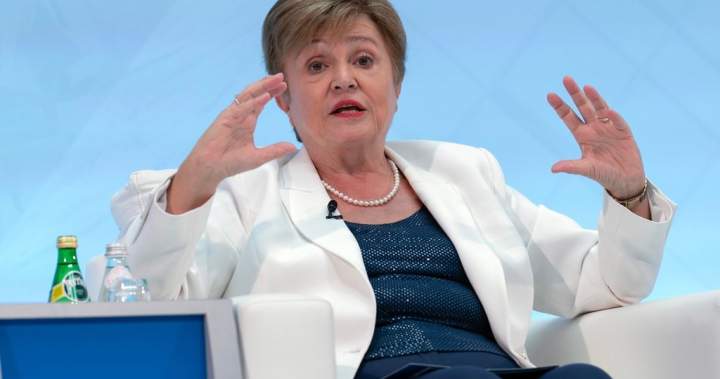
International Monetary Fund chief Kristalina Georgieva on Thursday underscored the importance of keeping central banks independent and threw her support behind beleaguered Federal Reserve Chair Jerome Powell, who is facing a Trump administration investigation for renovation cost overruns.
Georgieva told Reuters in an interview that there was ample evidence that central bank independence worked in the interest of businesses and households, and that evidence-based, data-based decision-making is good for the economy.
The IMF managing director said she had worked with Powell and respected his professionalism.
“I have worked with Jay Powell. He is a very good professional, very decent man, and I think that his standing among his colleagues tells the story,” she said, when asked about a letter of support signed by her predecessor, Christine Lagarde, now head of the European Central Bank, and other large central banks.
Powell on Sunday disclosed that the Trump administration had opened an investigation into him over cost overruns for a $2.5 billion project to renovate two historical buildings at the Fed’s Washington headquarters complex.
Get daily National news
Get the day’s top news, political, economic, and current affairs headlines, delivered to your inbox once a day.
Powell denies wrongdoing and has called the unprecedented actions a pretext to put pressure on him for not bowing to U.S. President Donald Trump’s long-running demands for sharply lower interest rates.


The probe has sparked widespread criticism from some key members of Trump’s Republican Party in the U.S. Senate, which must confirm his nominee to succeed Powell, along with foreign economic officials, investors and former U.S. government officials from both political parties.
Trump has repeatedly derided Powell’s leadership of the Fed and attacked him, often personally, over what he sees as the Fed chair’s slow moves to cut interest rates. On Wednesday, he dismissed concerns that eroding central bank independence would undermine the value of the U.S. dollar and spark inflation, telling Reuters, “I don’t care.”
Georgieva said the IMF looked carefully at issues such as monetary and financial stability, as well as the strength of a country’s institutions. It was specifically interested in the Fed, given the role of the U.S. dollar as a reserve currency.
“It would be very good to see that there is a recognition … that the Fed is precious for the Americans. It is very important for the rest of the world,” she said.
Trump has also attempted to fire another Fed official, Governor Lisa Cook, who has challenged her termination in a legal case that will be argued before the Supreme Court next week.
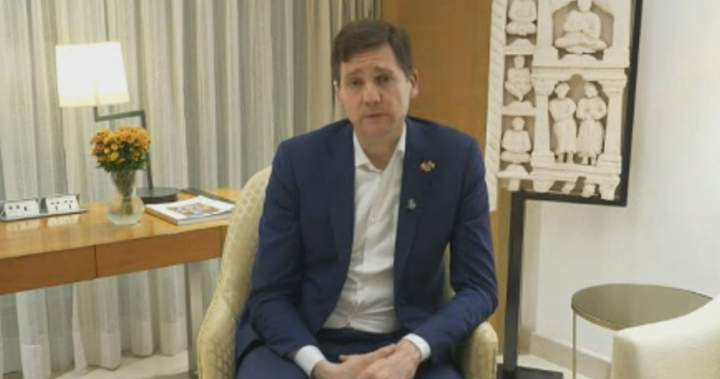
B.C. Premier David Eby spoke to reporters on Thursday morning from Mumbai, India, during his six-day trade mission.
He said that mining and energy companies in India are showing an interest in B.C.
“They are looking strongly to LNG as one of their ways of reducing carbon intensity, as well as reducing smog in the country,” Eby said.
“And so B.C. LNG has been an item of considerable interest, especially the projects that are reaching final investment decision over the next year — LNG Canada Phase 2, KSI Lisims LNG — as well as the projects that are under construction like Woodfibre LNG.”

Eby was also asked about the rise in extortion cases in B.C.
He said the province’s extortion task force will provide an update next week.
Get breaking National news
For news impacting Canada and around the world, sign up for breaking news alerts delivered directly to you when they happen.
“We have assembled a remarkable and historic task force, RCMP, CBSA,” Eby said.


“There are more police in Surrey right now than there have ever been. The RCMP has surged resources into the community.”
Eby said he has not been happy with the fact that there has been no update from the task force and he has asked them to provide one.
“There have been some important developments, people deported, an arrest here in India, cooperation between the Indian government and the Canadian government on this at the law enforcement level,” he added.
“That needs to continue, but, bluntly, we need better results, we need to see more arrests and whatever we can do to support the police to get the job done, we will do so.”
As of Jan. 12, Surrey police said there have been 16 reported extortion incidents in the city since the beginning of the year.
© 2026 Global News, a division of Corus Entertainment Inc.
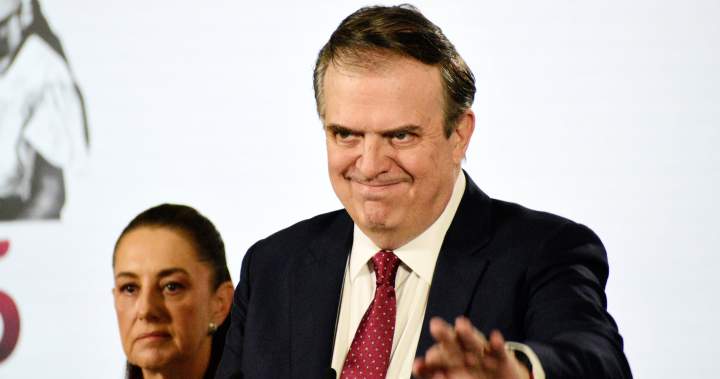
Amid persistent doubts over the future of the Canada-United States-Mexico trade agreement (CUSMA), Mexico’s Economy Minister Marcelo Ebrard insisted on Thursday that the agreement remains firmly intact and that the three countries will close a deal to extend it.
“We’re already in the treaty review phase, and we have to finish by July 1; that’s our deadline,” Ebrard said during Mexican President Claudia Sheinbaum’s daily morning press conference.
“We have made good progress on all the points that concern each of the parties.”
Ebrard’s comments were his first on the topic since U.S. President Donald Trump again cast doubt on the treaty’s future earlier this week.
“There’s no real advantage to it, it’s irrelevant,” Trump said on Tuesday, as he toured a Ford factory in Dearborn, Michigan.
The trilateral trade agreement, known as USMCA, replaced the North American Free Trade Agreement in 2020 and is a backbone of Mexico’s economy.
The treaty, which was negotiated during Trump’s first term, requires the three countries to hold a joint review this year to extend the pact.
Get breaking National news
For news impacting Canada and around the world, sign up for breaking news alerts delivered directly to you when they happen.
If extended, the treaty will remain in place another 16 years. If not, it is subject to annual reviews.

Technically, July 1 is a key date in the treaty’s review process, but many analysts expect negotiations to extend late into 2026 and said Trump will likely avoid extending the treaty before the U.S. midterm elections in November.

Trump’s recent threats to pursue military action against cartels have also added a new layer of uncertainty to U.S.-Mexico relations.
“I think Ebrard is betting on a best-case scenario, but the window for a July successful review is closing fast,” said Alexia Bautista, a former Mexican diplomat and lead Mexico analyst at the political risk consultancy firm Horizon Engage.
“Given recent events and statements, the risk is that Trump injects security into the process, turning the trade review into a far more political negotiation.”
Pedro Casas, chief executive of the American Chamber of Commerce of Mexico, said he expects the U.S. will continue imposing tariffs on a wide spectrum of Mexican exports, regardless of the treaty’s future.
The Trump administration has imposed sweeping 50 per cent duties on steel and aluminum exports to the U.S., along with a 25 per cent tariff on cars shipped from Mexico, even when those vehicles comply with the terms of the trade deal.
“I think the most likely scenario is a positive review process where we agree to extend the treaty for another 16 years, but steep tariffs still remain on Mexican exports that undermine the strength of the agreement,” Casas said.


IMF chief backs Jerome Powell, U.S. Fed independence amid Trump pressure – National TenX News

B.C. Premier David Eby says province’s LNG, mining of interest to India TenX News

Mexico confident CUSMA will remain as Trump suggests it could expire – National TenX News


-

 Fashion10 months ago
These ’90s fashion trends are making a comeback in 2017
-

 Entertainment10 months ago
The final 6 ‘Game of Thrones’ episodes might feel like a full season
-

 TenX Exclusive10 months ago
अमर योद्धा: राइफलमैन जसवंत सिंह रावत की वीरगाथा
-

 Politics8 months ago
Before being named Pope Leo XIV, he was Cardinal Robert Prevost. Who is he? – National TenX News
-

 Politics9 months ago
Puerto Rico faces island-wide blackout, sparking anger from officials – National TenX News
-

 Fashion10 months ago
According to Dior Couture, this taboo fashion accessory is back
-

 Tech10 months ago
Indian-AI-software-which-caught-30-thousand-criminals-and-busted-18-terrorist-modules-its-demand-is-increasing-in-foreign-countries-also – News18 हिंदी
-

 Politics9 months ago
Scientists detect possible signs of life on another planet — but it’s not aliens – National TenX News