
Politics
Trump meets with Zelenskyy, signals he’s not ready to sell Ukraine missiles – National TenX News

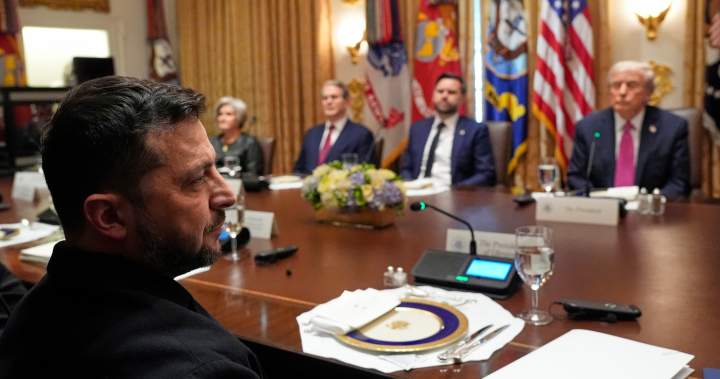
U.S. President Donald Trump is hosting Ukrainian President Volodymyr Zelenskyy for talks at the White House on Friday, with the U.S. leader signaling he’s not ready to agree to sell Kyiv a long-range missile system that the Ukrainians say they desperately need.
Zelenskyy arrived with top aides to discuss the latest developments with Trump over lunch, a day after the U.S. president and Russian President Vladimir Putin held a lengthy phone call to discuss the conflict.
At the start of the talks, Zelenskyy congratulated Trump over landing last week’s ceasefire and hostage deal in Gaza and said Trump now has “momentum” to stop the Russia-Ukraine conflict.
“President Trump now has a big chance to finish this war,” Zelenskyy added.
Zelenskyy also said he had come to Washington with a “proposition” in which Ukraine could provide the United States with its advanced drones, while Washington would sell Kyiv the long-range Tomahawk cruise missiles.
Trump said he believed Ukraine was manufacturing “very good” drones but expressed reluctance about tapping into the U.S. Tomahawk supply.
“I have an obligation also to make sure that we’re completely stocked up as a country, because you never know what’s going to happen in war and peace,” Trump said.

In recent days, Trump had shown an openness to selling Ukraine the Tomahawks, even as Putin warned that such a move would further strain the U.S.-Russian relationship.
But following Thursday’s call with Putin, Trump appeared to downplay the prospects of Ukraine getting the missiles, which have a range of about 995 miles (1,600 kilometers.)

Get breaking National news
For news impacting Canada and around the world, sign up for breaking news alerts delivered directly to you when they happen.
“We need Tomahawks for the United States of America too,” Trump said. “We have a lot of them, but we need them. I mean we can’t deplete for our country.”
Zelenskyy had been seeking the weapons, which would allow Ukrainian forces to strike deep into Russian territory and target key military sites, energy facilities and critical infrastructure. Zelenskyy has argued that the potential for such strikes would help compel Putin to take Trump’s calls for direct negotiations to end the war more seriously.
But Putin warned Trump during the call that supplying Kyiv with the Tomahawks “won’t change the situation on the battlefield, but would cause substantial damage to the relationship between our countries,” according to Yuri Ushakov, Putin’s foreign policy adviser.
Ukrainian Foreign Minister Andrii Sybiha said that talk of providing Tomahawks had already served a purpose by pushing Putin into talks. “The conclusion is that we need to continue with strong steps. Strength can truly create momentum for peace,” Sybiha said on the social platform X late Thursday.
Ukrainian officials have also indicated that Zelenskyy plans to appeal to Trump’s economic interests by aiming to discuss the possibility of energy deals with the U.S.

Zelenskyy is expected to offer to store American liquefied natural gas in Ukraine’s gas storage facilities, which would allow for an American presence in the European energy market.
He previewed the strategy on Thursday in meetings with Energy Secretary Chris Wright and the heads of American energy companies, leading him to post on X that it is important to restore Ukraine’s energy infrastructure after Russian attacks and expand “the presence of American businesses in Ukraine.”


It is the fourth face-to-face meeting for Trump and Zelenskyy since the Republican returned to office in January, and their second in less than a month.
Trump announced following Thursday’s call with Putin that he would soon meet with the Russian leader in Budapest, Hungary, to discuss ways to end the war. The two also agreed that their senior aides, including Secretary of State Marco Rubio, would meet next week at an unspecified location.
The president said Friday it was “to be determined” if Zelenskyy would be involved in the talks in Hungary — suggesting a “double meeting” with the warring countries’ leaders was likely the most workable option for productive talks.
“These two leaders do not like each other, and we want to make it comfortable for everybody,” Trump added.
Ahead of his call with Putin, Trump had shown signs of increased frustration with the Russian leader.
Last month, he announced that he believed Ukraine could win back all territory lost to Russia, a dramatic shift from the U.S. leader’s repeated calls for Kyiv to make concessions to end the war.

Trump, going back to his 2024 campaign, insisted he would quickly end the war, but his peace efforts appeared to stall following a diplomatic blitz in August, when he held a summit with Putin in Alaska and a White House meeting with Zelenskyy and European allies.
Trump emerged from those meetings certain he was on track to arranging direct talks between Zelenskyy and Putin. But the Russian leader hasn’t shown any interest in meeting with Zelenskyy and Moscow has only intensified its bombardment of Ukraine.
Asked if he was concerned that Putin was stringing him along, Trump acknowledged it was a possibility but said he was confident he could handle the Russian leader.
“I’ve been played all my life by the best of them, and I came out pretty well,” Trump said. He added, “I think I’m pretty good at this stuff.”
AP writer Michelle L. Price contributed reporting.
© 2025 The Canadian Press


A trip to the world’s most-visited museum is about to cost Canadians significantly more.
France has hiked ticket prices at the Louvre by 45 per cent for visitors from outside the European Union, a move that is fuelling debate over so-called dual pricing and the growing backlash against overtourism.
Starting this week, adult visitors from non-EU countries, including Canada, must pay €32 to enter the Paris landmark, up from €22. That’s an increase from about $35 to $52 Canadian.

Visitors from EU countries, as well as Iceland, Liechtenstein and Norway, will continue to pay the lower rate.
The price hike comes as the Louvre grapples with repeated labour strikes, a high-profile daylight jewel heist last October that prompted a costly security overhaul, and years of chronic overcrowding. The museum attracts roughly nine million visitors annually.
Get breaking National news
For news impacting Canada and around the world, sign up for breaking news alerts delivered directly to you when they happen.
Some Canadian tourists told Global News they feel unfairly targeted.
“We didn’t cause the robberies or some of the other issues that happened and we are paying the consequences,” said Allison Moore, visiting Paris from Newfoundland with her daughter. “[In] Canada we don’t discriminate over pricing like that.”
Others argue tourists already shoulder higher costs simply by travelling long distances.
“In general for tourists, I think things should be a little cheaper than for local people, because we have to travel to come all the way here,” said Darla Daniela Quiroz, another Canadian visitor. “It should be equal pricing, or a little bit cheaper.”


Even some Europeans question the two-tiered system. A French tourist interviewed outside the museum said there was “no reason” to charge non-Europeans more and that the fee should be the same for everyone.
Tourism experts say the Louvre’s financial pressures help explain the decision.
“The Louvre is really cash-strapped right now and needs to do something,” said Marion Joppe, a professor at the University of Guelph. “It can’t really look to the government, which is already struggling with its own budget.”
The move also reflects a broader global pushback against mass tourism. Anti-tourism protests have spread across parts of Spain, New Zealand has increased its entry tax, and the United States recently raised national park fees for foreign visitors.
“You take Paris — it gets about 50 million tourists a year,” said Julian Karaguesian, an economist at McGill University. “That’s roughly a million a week. The city simply wasn’t built for those kinds of numbers.”
Despite the higher price, many visitors say they will still line up to see the Mona Lisa and other of the museum’s famous artworks.
“It’s one of the main attractions. It’s on everybody’s list,” Moore said. “We’re still going to go, and hopefully it will be worth it in the end.”
© 2026 Global News, a division of Corus Entertainment Inc.
Politics
Trump calls Canada-China deal ‘good thing’ as U.S. officials voice concern – National TenX News
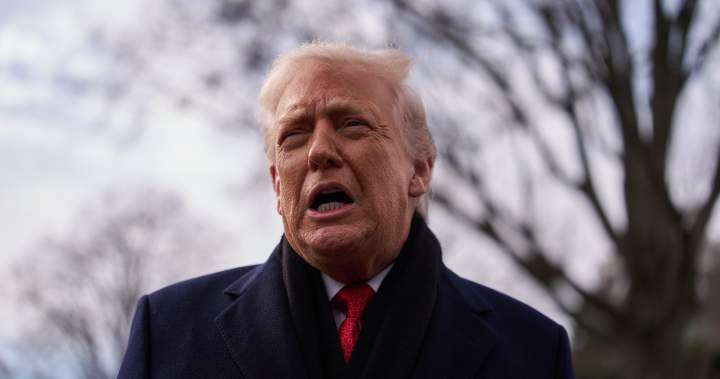
Canada’s new trade deal with China is getting a mixed reaction in Washington, with U.S. President Donald Trump voicing support as administration officials warned Ottawa could regret allowing Chinese EVs into the Canadian market.
The deal signed with Beijing on Friday reverses course on 100 per cent tariffs Canada slapped on Chinese electric vehicles in 2024, which aligned with similar U.S. duties. Canada and China also agreed to reduce tariffs on canola and other products.
Asked about the deal by reporters at the White House, Trump said Prime Minister Mark Carney was doing the right thing.
“That’s what he should be doing. It’s a good thing for him to sign a trade deal. If you can get a deal with China, you should do that,” Trump said.
However, members of Trump’s cabinet expressed concern.
“I think they’ll look back at this decision and surely regret it to bring Chinese cars into their market,” U.S. Transportation Secretary Sean Duffy said at an event with other U.S. government officials at a Ford factory in Ohio to tout efforts to make vehicles more affordable.
U.S. Trade Representative Jamieson Greer told reporters the limited number of vehicles would not impact American car companies exporting cars to Canada.
“I don’t expect that to disrupt American supply into Canada,” he said.
“Canada is so dependent on the United States for their GDP. Their entire population is crowded around our border for that reason. I’ll tell you one thing: if those cars are coming into Canada, they’re not coming here. That’s for sure.”
Get daily National news
Get the day’s top news, political, economic, and current affairs headlines, delivered to your inbox once a day.
Carney has said it’s necessary for Canada to improve trade ties and cooperation with China in light of Trump’s trade war and threats to let the Canada-U.S.-Mexico Agreement on free trade expire.

The trade pact is up for review this summer, and Greer reiterated that the Trump administration wants to bring more auto manufacturing back to the U.S. and incentivize companies to do so.
Under the new deal with Beijing, Carney said he expects China will lower tariffs on its canola seed by March 1 to a combined rate of about 15 per cent.
Greer questioned that agreement in a separate CNBC interview.
“I think in the long run, they’re not going to like having made that deal,” he said.
He called the decision to allow Chinese EVs into Canada “problematic” and added: “There’s a reason why we don’t sell a lot of Chinese cars in the United States. It’s because we have tariffs to protect American auto workers and Americans from those vehicles.”
Greer said rules adopted last January on vehicles that are connected to the internet and navigation systems are a significant impediment to Chinese vehicles in the U.S. market.


“I think it would be hard for them to operate here,” Greer said. “There are rules and regulations in place in America about the cybersecurity of our vehicles and the systems that go into those, so I think it might be hard for the Chinese to comply with those kind of rules.”

Trump and officials like Greer have taken aim at Chinese attempts to enter the North American car market through Mexico by bypassing rules of origin under CUSMA.
The CUSMA review set for July is expected to address those loopholes that American and Canadian officials have said are being exploited by China.
Those concerns, which were also raised by the Biden administration, in part helped spur the steep tariffs on Chinese EVs, which are heavily subsidized by Beijing.
Trump, however, has also said he would like Chinese automakers to come to the United States to build vehicles.
Both Democrat and Republican lawmakers in the U.S. have expressed strong opposition to Chinese vehicles as major U.S. automakers warn China poses a threat to the U.S. auto sector.
Ohio Senator Bernie Moreno, a Republican, said at Friday’s event at the Ford plant that he was opposed to Chinese vehicles coming into the United States, and drew applause from the other government officials.
“As long as I have air in my body, there will not be Chinese vehicles sold the United States of America — period,” Moreno said.
—with files from Reuters
© 2026 Global News, a division of Corus Entertainment Inc.
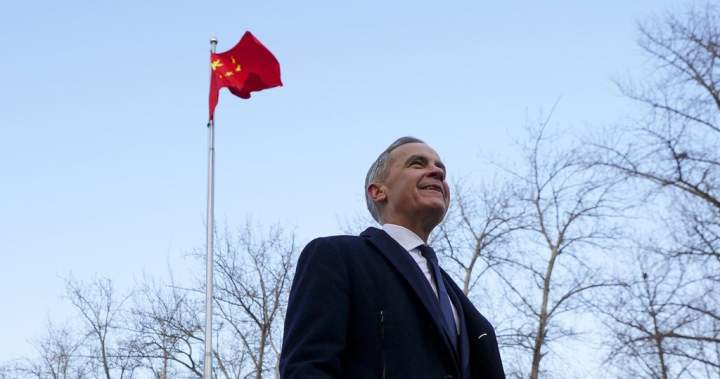
Prime Minister Mark Carney’s trade mission to China is being framed as a win for British Columbia’s economy.
Carney announced a new deal with Beijing on electric vehicles and canola at the end of a high-profile trip on Friday.
“The inroads Canada has made this week are a sign that the government gets it and is showing Canadians and the world that we are open for business,” Alexa Young with the Vancouver Fraser Port Authority said.
The trade deal would allow up to 49,000 Chinese EVs into Canada yearly at a tariff rate of 6.1 per cent.
An expanded auto terminal on Annacis Island will be able to handle the additional volume of cars that could be more affordable than what is currently on the market, with prices expected to be under $40,000.
The New Car Dealers Association said in a statement to Global News that, “We look forward to reviewing the full details of this announcement and engaging constructively with governments to ensure that affordability, competition, and long-term market stability remain central considerations.”


In British Columbia, the overall reaction to the news on Friday is positive.
Get breaking National news
For news impacting Canada and around the world, sign up for breaking news alerts delivered directly to you when they happen.
“China’s economy is important,” Alex McMillan with the B.C. Chamber of Commerce said.
“Having trade deals like this — and diversifying our markets — is important. Providing certainty is important.”
There are concerns with the agreement, including privacy issues and China’s human rights record. But Ottawa’s goal is to double trade with partners outside the United States, which is a goal that would be impossible without China.
“We do want to see more trade and more diversification of our markets and know that China is an important nation and important economy, so having better trade relationships with them, I think overall is going to be good,” McMillan said.
–with files from The Canadian Press
© 2026 Global News, a division of Corus Entertainment Inc.


Louvre raises ticket prices for non-Europeans, hitting Canadian visitors TenX News

Trump calls Canada-China deal ‘good thing’ as U.S. officials voice concern – National TenX News

Canada-China trade deal framed as a win for B.C.’s economy TenX News


-

 Fashion10 months ago
These ’90s fashion trends are making a comeback in 2017
-

 Entertainment10 months ago
The final 6 ‘Game of Thrones’ episodes might feel like a full season
-

 TenX Exclusive10 months ago
अमर योद्धा: राइफलमैन जसवंत सिंह रावत की वीरगाथा
-

 Politics8 months ago
Before being named Pope Leo XIV, he was Cardinal Robert Prevost. Who is he? – National TenX News
-

 Politics9 months ago
Puerto Rico faces island-wide blackout, sparking anger from officials – National TenX News
-

 Fashion10 months ago
According to Dior Couture, this taboo fashion accessory is back
-

 Tech10 months ago
Indian-AI-software-which-caught-30-thousand-criminals-and-busted-18-terrorist-modules-its-demand-is-increasing-in-foreign-countries-also – News18 हिंदी
-

 Politics9 months ago
Scientists detect possible signs of life on another planet — but it’s not aliens – National TenX News