
Politics
Here’s how China agreed to come to the table on Trump’s tariffs – National TenX News

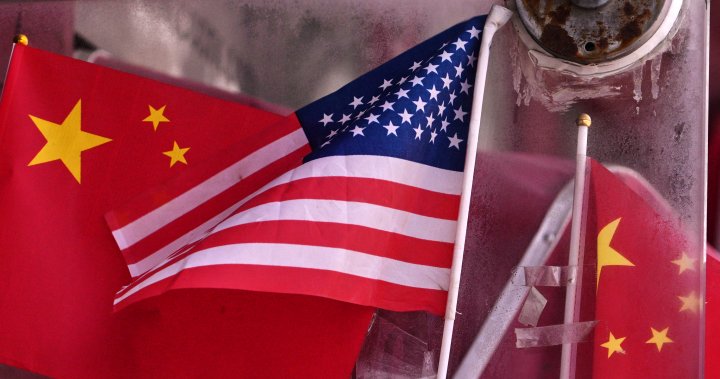
Since U.S. President Donald Trump imposed steep tariffs on China last month, Beijing has responded in kind. On state and social media, it posted images of Mao Zedong, lambasted “imperialists,” and sent a message: capitulation to bullies is dangerous, and it wouldn’t back down.
But behind closed doors, Chinese officials have grown increasingly alarmed about tariffs’ impact on the economy and the risk of isolation as China’s trading partners have started negotiating deals with Washington, according to three officials familiar with Beijing’s thinking.
These factors, along with outreach by the U.S. and an easing of Trump’s rhetoric, persuaded Beijing to send its economic tsar He Lifeng for meetings with U.S. counterparts in Switzerland this weekend, the officials told Reuters.
Re-engagement was complicated by the fractious nature of U.S.-China diplomacy. In particular, Beijing considered a letter the U.S. side sent to Chinese ministries in late April about fentanyl “arrogant,” two officials said. Efforts to arrange talks were further impaired by disagreements over which officials should be involved, said one of these people and another official.
China’s reasons for deciding to negotiate, Washington’s letter on fentanyl, U.S. diplomatic challenges in Beijing, and the early outreach between the two sides are reported by Reuters for the first time, based on interviews with nearly a dozen government officials and experts on both sides. Most of the people were granted anonymity to discuss non-public information.
China’s foreign ministry said in a statement to Reuters that it reiterated that “China’s firm opposition to the U.S. abuse of tariffs is consistent and clear, and there is no change.”
“The U.S. has ignored China’s goodwill and unreasonably imposed tariffs on China under the pretext of fentanyl. This is a typical act of bullying, which seriously undermines dialog and cooperation between the two sides in the field of drug control.”
China’s State Council and ministry of commerce didn’t immediately respond to faxed requests for comment. The White House and State Department also didn’t respond to Reuters questions about the lead-up to the Geneva talks.
China’s Vice Foreign Minister Hua Chunying said on Friday that China has full confidence in its ability to manage U.S. trade issues, adding that the Trump administration’s approach cannot be sustained.
The trade war between the world’s two largest economies, combined with Trump’s decision last month to impose duties on dozens of other countries, has disrupted supply chains, unsettled financial markets and stoked fears of a sharp downturn in global growth.
Chinese export restrictions, meanwhile, have squeezed the supply of critical minerals the U.S. needs for weapons, electronics and consumer goods. Trump’s approval ratings are falling due to his handling of tariffs and the economy.
The volatile run-up to the Geneva talks underscores the deep mistrust and divergent negotiating styles between the Trump team and China, which could make for protracted and fraught discussions.
“Both sides I think are balancing trying to look tough with not wanting to be responsible for sinking the global economy,” said Scott Kennedy, an expert in Chinese business affairs at the Center for Strategic and International Studies in Washington.
“The Chinese set a high bar for these talks, but it became increasingly clear that the Trump administration wanted to talk, and they couldn’t say no forever. So, they’ve accepted what are probably best seen as pre-negotiations in Geneva.”

After Trump’s tariff salvo last month, China took a hard line in its public messaging. Beijing posted footage on its official social media feeds of a Chinese MiG-15 fighter shooting down a U.S. jet in the Korean War, with commentary: “China won’t kneel down, because we know standing up for ourselves keeps the possibility of cooperation alive, while compromise snuffs it out.”
The tone began to shift on April 30, when a state media-affiliated blog said the U.S. had “proactively reached out to China through multiple channels, hoping to discuss tariffs.”

Get daily National news
Get the day’s top news, political, economic, and current affairs headlines, delivered to your inbox once a day.
CSIS’s Kennedy said contacts between Chinese agencies, Beijing’s embassy in Washington and the Trump administration had been increasing in frequency in recent weeks. Some in-person interactions took place at the International Monetary Fund and World Bank meetings in late April, including with Treasury Secretary Scott Bessent, which paved the way for the Swiss meeting, said Kennedy.
After Trump’s “Liberation Day” tariffs, Chinese Commerce Minister Wang Wentao quietly reached out to his U.S. counterpart, Howard Lutnick, but was rebuffed as not senior enough, according to one official familiar with the exchanges.
Trump has been pushing for direct talks with Chinese President Xi Jinping. But China has rejected that idea as not in keeping with its traditional approach of working out the details first before the leaders sign any deal, according to public statements by both sides.
Another significant factor for China was Trump’s public berating of Ukrainian President Volodymyr Zelenskiy in February, said one of the sources, adding that any unscripted hostile interaction between the U.S. and Chinese leaders would represent an unacceptable loss of face for Xi.
As messaging on both sides grew more conciliatory, China decided to put forward its vice premier and Xi confidant He Lifeng, whose direct predecessor struck the “Phase One” trade deal with the U.S. in 2019.
The move satisfied Washington’s demands for substantive talks with a senior official with direct access to Xi, but avoided exposing the Chinese leader to potential embarrassment, said one of the sources.
As for the choice of venue, the Swiss foreign ministry said that “during its recent contacts in Washington and Beijing, Switzerland expressed to the U.S. and Chinese authorities its willingness to organize a meeting between the two parties in Geneva.”

Among the main drivers of Beijing’s climb-down were internal signals that Chinese companies were struggling to avoid bankruptcies and to replace the U.S. market, three people familiar with the Chinese government’s thinking said.
Some areas feeling immediate impact were furniture and toy makers, as well as textiles, said one of the officials.
U.S. diplomats in China have also been closely monitoring factory closures, strikes, and job losses in the industrial heartland in southern China.
Many analysts have downgraded their 2025 economic growth forecasts for China, and investment bank Nomura has warned the trade war could cost it up to 16 million jobs. China’s central bank this week announced fresh monetary stimulus.


One of the officials said Chinese companies were struggling to replace the U.S. market because developing nations cannot buy as many items, and that for many firms this was an existential threat that needed to be resolved in days or weeks.
In addition, Beijing was worried it was left without a place at the negotiating table while its major trading partners, such as Vietnam, India and Japan, began talks with Washington, said two officials familiar with Beijing’s thinking.
In a warning to the countries negotiating with the U.S., China’s commerce ministry said in a statement this week that “appeasement cannot bring peace, compromise cannot be respected, and adhering to principled positions and upholding fairness and justice is the right way to safeguard one’s own interests.”
As part of the push to counter the U.S., China is sending its Premier Li Qiang to Malaysia in late May for a summit with a newly established group of Southeast Asian and Arab nations, two sources told Reuters.
A regional diplomat based in Beijing told Reuters China’s message to Southeast Asia was “We will buy stuff from you.”
In Geneva, Beijing appears to have modest expectations.
Internally, China has downgraded the talks from a higher level to merely a meeting, reflecting its view that the discussions will be mostly about finding out Washington’s demands and red lines after weeks of contradictory messages by Trump and other senior U.S. officials, according to a person familiar with the matter.
Still, one official said China could draw on its extensive toolbox and follow Asian neighbors in offering to buy more American liquefied natural gas.
On the table may also be purchases of agricultural goods, similar to the 2019 “Phase One” deal during Trump’s first term. At the time, Beijing said it would increase purchases of U.S. agricultural products by US$32 billion over two years.
While other matters like the U.S.’s axing of the “de minimis” exemption for packages under US$800 from China and the sale of TikTok are also likely to play a part in the broader talks, Chinese officials said they do not expect them to play a central role this weekend.

Even before triggering the broader trade war, Trump imposed a 20 per cent tariff on Chinese goods, saying Beijing wasn’t doing enough to counter the flow of chemicals used to produce the deadly drug fentanyl.
One of the moves that complicated the rapprochement, according to two officials, was a letter sent by the U.S. to China in late April that outlined the steps Trump wanted Beijing to take on fentanyl.
The document, reviewed by Reuters, caused friction with Beijing because it referenced a congressional report that asserted China, through value-added tax rebates for exporters, directly subsidizes production of fentanyl precursors for sale abroad. China denies it does so.
The letter, sent to the ministries of foreign affairs, commerce, and public security, called on Beijing to publicize the crackdown on fentanyl precursors on the front page of the Communist Party mouthpiece People’s Daily; send a similar message through “internal party channels” to party members; tighten regulation of some specified chemicals; and deepen law-enforcement cooperation.
Two officials familiar with China’s reaction said it found especially the first two points “arrogant” because Beijing saw it as the U.S. dictating what China should do within its ruling apparatus.
One said fentanyl would feature in the Geneva talks and that the U.S. government’s opening position would be to present the four points to China.
A U.S. official familiar with the letter said the Trump administration simply wanted China to curb the flow of fentanyl precursors to drug cartels.
Complicating the negotiations, Trump’s Washington team has frozen out many U.S. embassy officials responsible for earlier contacts with Chinese counterparts, two people familiar with the matter said.
Trump’s new ambassador to China, David Perdue, is slated to arrive in Beijing next week, but Deputy Chief of Mission Sarah Beran, who served as a senior official on China in the Biden administration’s National Security Council, was removed from her post this week, the two officials said.
The turmoil has resulted in lack of internal consultations on demands put forward by the American side, the officials said. An official familiar with Chinese thinking said there had been minimal contact with the U.S. embassy ahead of the Geneva talks.

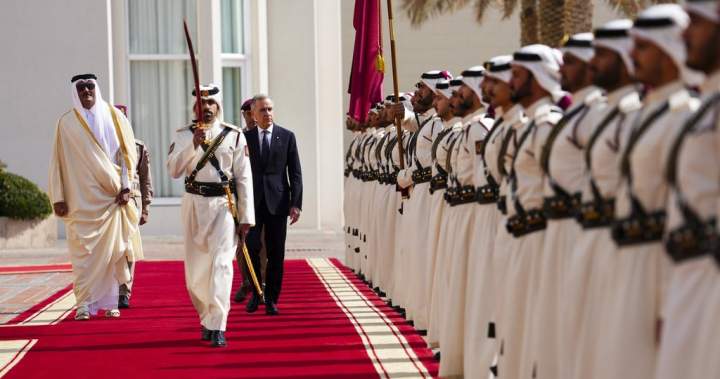
Prime Minister Mark Carney says Qatar has committed to “significant” investments for Canada’s major building projects, calling it a “new chapter” in bilateral relations.
Carney made the announcement Sunday following his meeting with Sheikh Tamim bin Hamad Al Thani, the Emir of Qatar.
The new measures will include the finalization of the Investment Promotion and Protection Agreement with Qatar, a deal that has seen years of stalled negotiations, Carney said.
“We are raising our relationship and our level of alignment by making friends with strategic partners,” Carney said. “To launch this new chapter in our relationship, I’m pleased to announce that Qatar has committed to make significant strategic investments in Canada’s nation-building projects.
“This capital will help the projects get built faster and supercharge our energy industries, while helping to create thousands of high-paying careers for Canadians.”
He also said the new agreement will help Canadian businesses to “more easily” expand operations in Qatar as well as attract investment from the country.
Get daily National news
Get the day’s top news, political, economic, and current affairs headlines, delivered to your inbox once a day.
According to a readout from the Prime Minister’s Office, air services between Canada and Qatar will also be expanded and a defence attache from Canada will be posted in the country.

According to the PMO, the two countries have agreed to launch negotiations on a new framework focused on military, security and defence matters, and expand investment opportunities on areas such as AI.
The PMO said the two leaders agreed to stay in touch and Carney noted Sunday he had invited the Emir to visit Canada later this year and attend the World Cup match between their two countries with him.


The plans with Qatar are Carney’s latest in a slew of agreements and travel to other countries to discuss trade deals since his election last year.
Asked about his ongoing efforts to meet with countries interested in trade, Carney told reporters that multilateral relationships are “being eroded.”
“The consequence of that is there is a reduction in freer trade, much more trade is tariff-based or otherwise restricted and there is virtually no, with all due respect to those who are trying, virtually no multilateral progress,” Carney said.
“Where there is progress, and where Canada and like-minded countries are looking to make progress, is through pluriality deals… which is multiple countries but not all countries.”
On Friday, Canada announced that 49,000 Chinese-made electric vehicles (EVs) would soon be imported each year with a lowered 6.1 per cent tariff after Carney struck a deal with Chinese President Xi Jinping.
Carney added on Sunday that Xi showed interest in expanding China’s trade relations with other countries, and that’s why Canada is establishing trade deals with other countries, such as Qatar.
“In this more uncertain and dangerous world, we’ve chosen to create greater stability, security and prosperity together,” Carney said.
© 2026 Global News, a division of Corus Entertainment Inc.
World leaders are raising alarm after U.S. President Donald Trump threatened to impose sweeping tariffs on European allies in an effort to pressure Denmark into negotiations over Greenland.
The move is sparking protests across the Arctic and sharp rebukes from Europe and Canada.
On Saturday, thousands of people marched through snow and ice in Greenland’s capital, Nuuk, chanting “Greenland is not for sale,” waving national flags.
Police described the demonstration as the largest they have ever seen in the city.
About 825 kilometres away, dozens of people rallied in Iqaluit, Nunavut, in a show of solidarity with Greenlanders.
“Greenland is owned by the Greenlandic people,” protesters chanted in Inuktut as they marched for an hour in freezing, windy conditions.
The protests came as Trump announced he would impose a 10 per cent import tax starting next month on goods from eight European countries.
These nations include Denmark, Norway, Sweden, France, Germany, the United Kingdom, the Netherlands and Finland, because of their opposition to U.S. control of Greenland.
Get breaking National news
For news impacting Canada and around the world, sign up for breaking news alerts delivered directly to you when they happen.
The tariff would rise to 25 per cent on June 1 if no deal was reached for what Trump called the “Complete and Total purchase of Greenland.”
The president suggested the tariffs were leveraged to force talks over Greenland, a semi-autonomous territory of NATO ally Denmark that Trump says is vital to U.S. national security.
French President Emmanuel Macron said France stands firmly behind Greenland’s sovereignty and rejected the use of trade threats.
“Tariff threats are unacceptable and have no place in this context,” Macron wrote on social media, adding that Europeans would respond “in a united and coordinated manner” if the measures are confirmed.
British Prime Minister Keir Starmer said Greenland’s future is for Greenlanders and Denmark to decide.
“Applying tariffs on allies for pursuing the collective security of NATO allies is completely wrong,” Starmer said, adding the issue would be raised directly with the U.S. administration.


Bob Rae, former Canadian ambassador to the United Nations, also chimed in on Trump’s announcement.
The tariff threat could mark a significant rupture between the U.S. and its NATO allies.
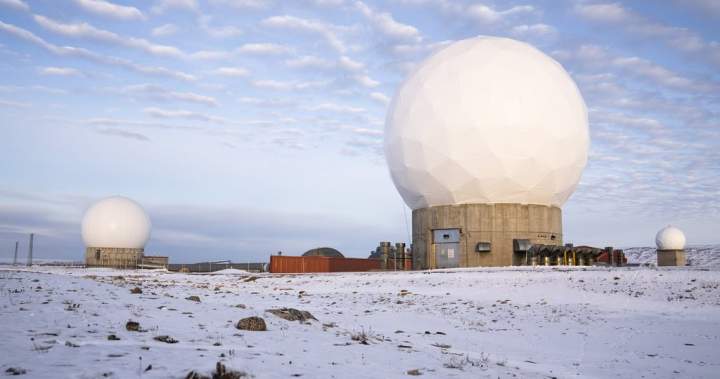
Greenland already hosts the U.S.-run Pituffik Space Base under a 1951 defence agreement with Denmark, supporting missile warning, missile defence and space surveillance for the U.S. and NATO.
“There is no sign of the Trump war of aggression against Greenland and Denmark letting up. It is not about ‘security’ any more than Venezuela was about ‘narco-terrorism.’ They are both about seizing control and plunder.”
He further added, “No country, including my own, Canada, is safe or secure.”
The tariff threat could mark a significant rupture between the U.S. and its NATO allies.
Trump is expected to face questions about the proposed tariffs and Greenland later this week.
He is scheduled to attend the World Economic Forum in Davos, alongside several European leaders he has threatened with tariffs.
— With files from The Canadian Press
© 2026 Global News, a division of Corus Entertainment Inc.
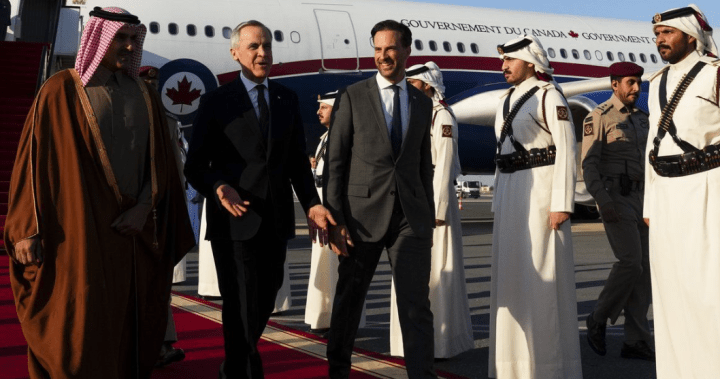
Prime Minister Mark Carney arrived in Doha on Saturday as part of a push to attract foreign investment and deepen Canada’s economic partnerships beyond its traditional allies.
Carney’s visit comes on the heels of his visit to China and follows the recent presentation of a new federal investment budget aimed at positioning Canada as a stable, attractive destination for global capital.
In a news conference on Saturday, Finance Minister François-Philippe Champagne said Canada is working to broaden its economic relationships as global trade patterns shift.
Qatar is viewed by Ottawa as a strategic partner, with officials pointing to the country’s significant investment capacity and growing influence on the global stage.
Get breaking National news
For news impacting Canada and around the world, sign up for breaking news alerts delivered directly to you when they happen.
“We need to reduce our dependence and increase our self-reliance to find a strategic path forward,” Champagne said.
“Engaging with the Middle East and China is necessary for Canada, just like our European partners have done,” Champagne added. “We buy more from the U.S.A. than anywhere else, but the trading climate right now is different.”
The conference highlighted Canada’s industrial capacity and trade advantages as key selling points for potential investors.
Champagne also said international engagement is critical as Canada works to raise its profile among global investors.


“We are one of the G7s with very big industries. We build cars, planes, ships, we have an abundance of energy, and we are the only one with free trade with all G7,” Champagne said. “With the way the world is changing, you better diversify, supply chain is changing and we need to adapt.”
Prime Minister Carney is expected to meet with senior Qatari officials, including Emir Sheikh Tamim bin Hamad Al Thani, as well as representatives of the Qatar Investment Authority.
His office says the talks will focus on expanding trade access and forging partnerships in artificial intelligence, infrastructure, energy and defence.
The visit comes amid heightened geopolitical tensions in the region, though officials say the schedule remains unchanged.
© 2026 Global News, a division of Corus Entertainment Inc.


Qatar to invest in Canada’s major building projects, Carney says – National TenX News

“Unacceptable’: Allies react to Trump Greenland tariff threats – National TenX News

Canada talks trade with Qatar as Carney touches down in Doha – National TenX News


-

 Fashion10 months ago
These ’90s fashion trends are making a comeback in 2017
-

 Entertainment10 months ago
The final 6 ‘Game of Thrones’ episodes might feel like a full season
-

 TenX Exclusive10 months ago
अमर योद्धा: राइफलमैन जसवंत सिंह रावत की वीरगाथा
-
 Politics8 months ago
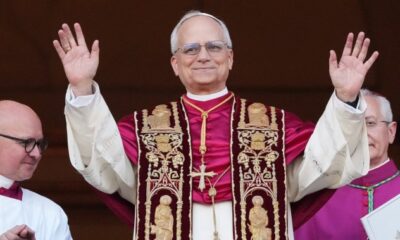
Before being named Pope Leo XIV, he was Cardinal Robert Prevost. Who is he? – National TenX News
-

 Politics9 months ago
Puerto Rico faces island-wide blackout, sparking anger from officials – National TenX News
-

 Fashion10 months ago
According to Dior Couture, this taboo fashion accessory is back
-

 Tech10 months ago
Indian-AI-software-which-caught-30-thousand-criminals-and-busted-18-terrorist-modules-its-demand-is-increasing-in-foreign-countries-also – News18 हिंदी
-

 Politics9 months ago
Scientists detect possible signs of life on another planet — but it’s not aliens – National TenX News