
Politics
India and Pakistan are facing a new conflict. A look at their relationship – National TenX News

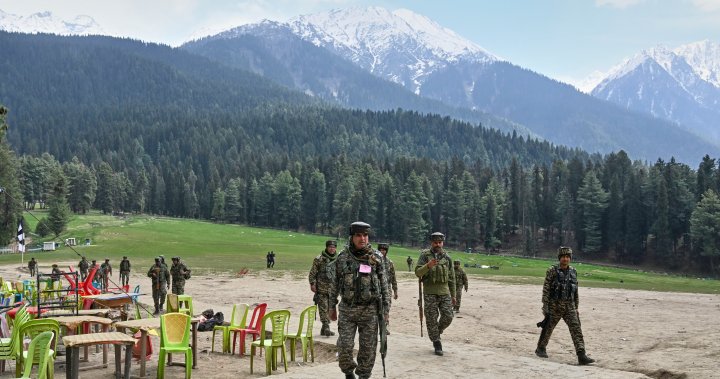
India struck multiple sites inside Pakistani controlled territory early Wednesday, two weeks after a deadly attack on tourists in the disputed Kashmir plunged relations between the neighbours to new lows.
India accused Pakistan of backing the massacre, in which 26 men, mostly Indian Hindus, were killed, a charge Pakistan denies.
Soldiers on each side have exchanged fire along their de facto border since the killings, with each blaming the other for shooting first. Both countries expelled diplomats and citizens, ordered the border shut and closed their airspace for each other.
Here’s a look at multiple conflicts between the two countries since their bloody partition in 1947:
___
1947 — Months after British India is partitioned into a predominantly Hindu India and a Muslim-majority Pakistan, the two young nations fight their first war over control of Muslim-majority Kashmir, then a kingdom ruled by a Hindu monarch. The war killed thousands before ending in 1948.
1949 — A U.N.-brokered ceasefire line leaves Kashmir divided between India and Pakistan, with the promise of a U.N.-sponsored vote that would enable the region’s people to decide whether to be part Pakistan or India. That vote has never been held.

Get daily National news
Get the day’s top news, political, economic, and current affairs headlines, delivered to your inbox once a day.
1965 — The rivals fight their second war over Kashmir. Thousands are killed in inconclusive fighting before a ceasefire is brokered by the Soviet Union and the United States. Negotiations in Tashkent run until January 1966, ending in both sides giving back territories they seized during the war and withdrawing their armies.
1971 — India intervenes in a war over the independence of East Pakistan, which ends with the territory breaking away as the new country of Bangladesh. An estimated 3 million people are killed in the conflict.

1972 — India and Pakistan sign a peace accord, renaming the ceasefire line in Kashmir as the Line of Contro. Both sides deploy more troops along the frontier, turning it into a heavily fortified stretch of military outposts.


1989 — Kashmiri dissidents, with support from Pakistan, launch a bloody rebellion against Indian rule. Indian troops respond with brutal measures, intensifying diplomatic and military skirmishes between New Delhi and Islamabad.
1999 — Pakistani soldiers and Kashmiri fighters seize several Himalayan peaks on the Indian side. India responds with aerial bombardments and artillery. At least 1,000 combatants are killed over 10 weeks, and a worried world fears the fighting could escalate to nuclear conflict. The U.S. eventually steps in to mediate, ending the fighting.
2016 — Militants sneak into an army base in Indian-controlled Kashmir, killing at least 18 soldiers. India responds by sending special forces inside Pakistani-held territory, later claiming to have killed multiple suspected rebels in “surgical strikes.” Pakistan denies that the strikes took place, but it leads to days of major border skirmishes. Combatants and civilians on both sides are killed.
2019 — The two sides again come close to war after a Kashmiri insurgent rams an explosive-laden car into a bus carrying Indian soldiers, killing 40. India carries out airstrikes in Pakistani territory and claims to have struck a militant training facility. Pakistan later shoots down an Indian warplane and captures a pilot. He is later released, deescalating tensions.
2025 — Militants attack Indian tourists in the region’s resort town of Pahalgam and kill 26 men, most of them Hindus. India blames Pakistan, which denies it. India vows revenge on the attackers as tensions rise to their highest point since 2019. Both countries cancel visas for each other’s citizens, recall diplomats, shut their only land border crossing and close their airspaces to each other. New Delhi also suspends a crucial water-sharing treaty.
© 2025 The Canadian Press

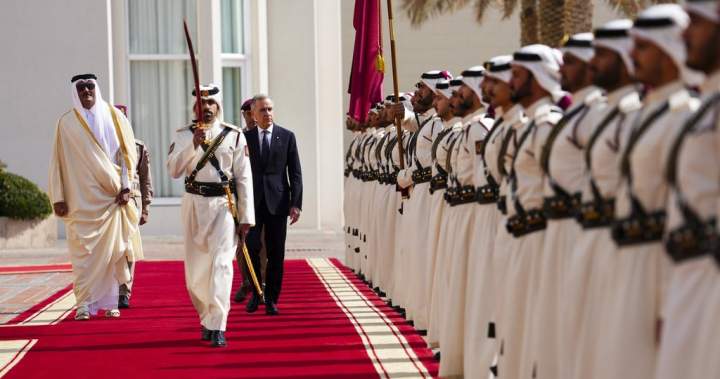
Prime Minister Mark Carney says Qatar has committed to “significant” investments for Canada’s major building projects, calling it a “new chapter” in bilateral relations.
Carney made the announcement Sunday following his meeting with Sheikh Tamim bin Hamad Al Thani, the Emir of Qatar.
The new measures will include the finalization of the Investment Promotion and Protection Agreement with Qatar, a deal that has seen years of stalled negotiations, Carney said.
“We are raising our relationship and our level of alignment by making friends with strategic partners,” Carney said. “To launch this new chapter in our relationship, I’m pleased to announce that Qatar has committed to make significant strategic investments in Canada’s nation-building projects.
“This capital will help the projects get built faster and supercharge our energy industries, while helping to create thousands of high-paying careers for Canadians.”
He also said the new agreement will help Canadian businesses to “more easily” expand operations in Qatar as well as attract investment from the country.
Get daily National news
Get the day’s top news, political, economic, and current affairs headlines, delivered to your inbox once a day.
According to a readout from the Prime Minister’s Office, air services between Canada and Qatar will also be expanded and a defence attache from Canada will be posted in the country.

According to the PMO, the two countries have agreed to launch negotiations on a new framework focused on military, security and defence matters, and expand investment opportunities on areas such as AI.
The PMO said the two leaders agreed to stay in touch and Carney noted Sunday he had invited the Emir to visit Canada later this year and attend the World Cup match between their two countries with him.


The plans with Qatar are Carney’s latest in a slew of agreements and travel to other countries to discuss trade deals since his election last year.
Asked about his ongoing efforts to meet with countries interested in trade, Carney told reporters that multilateral relationships are “being eroded.”
“The consequence of that is there is a reduction in freer trade, much more trade is tariff-based or otherwise restricted and there is virtually no, with all due respect to those who are trying, virtually no multilateral progress,” Carney said.
“Where there is progress, and where Canada and like-minded countries are looking to make progress, is through pluriality deals… which is multiple countries but not all countries.”
On Friday, Canada announced that 49,000 Chinese-made electric vehicles (EVs) would soon be imported each year with a lowered 6.1 per cent tariff after Carney struck a deal with Chinese President Xi Jinping.
Carney added on Sunday that Xi showed interest in expanding China’s trade relations with other countries, and that’s why Canada is establishing trade deals with other countries, such as Qatar.
“In this more uncertain and dangerous world, we’ve chosen to create greater stability, security and prosperity together,” Carney said.
© 2026 Global News, a division of Corus Entertainment Inc.
World leaders are raising alarm after U.S. President Donald Trump threatened to impose sweeping tariffs on European allies in an effort to pressure Denmark into negotiations over Greenland.
The move is sparking protests across the Arctic and sharp rebukes from Europe and Canada.
On Saturday, thousands of people marched through snow and ice in Greenland’s capital, Nuuk, chanting “Greenland is not for sale,” waving national flags.
Police described the demonstration as the largest they have ever seen in the city.
About 825 kilometres away, dozens of people rallied in Iqaluit, Nunavut, in a show of solidarity with Greenlanders.
“Greenland is owned by the Greenlandic people,” protesters chanted in Inuktut as they marched for an hour in freezing, windy conditions.
The protests came as Trump announced he would impose a 10 per cent import tax starting next month on goods from eight European countries.
These nations include Denmark, Norway, Sweden, France, Germany, the United Kingdom, the Netherlands and Finland, because of their opposition to U.S. control of Greenland.
Get breaking National news
For news impacting Canada and around the world, sign up for breaking news alerts delivered directly to you when they happen.
The tariff would rise to 25 per cent on June 1 if no deal was reached for what Trump called the “Complete and Total purchase of Greenland.”
The president suggested the tariffs were leveraged to force talks over Greenland, a semi-autonomous territory of NATO ally Denmark that Trump says is vital to U.S. national security.
French President Emmanuel Macron said France stands firmly behind Greenland’s sovereignty and rejected the use of trade threats.
“Tariff threats are unacceptable and have no place in this context,” Macron wrote on social media, adding that Europeans would respond “in a united and coordinated manner” if the measures are confirmed.
British Prime Minister Keir Starmer said Greenland’s future is for Greenlanders and Denmark to decide.
“Applying tariffs on allies for pursuing the collective security of NATO allies is completely wrong,” Starmer said, adding the issue would be raised directly with the U.S. administration.


Bob Rae, former Canadian ambassador to the United Nations, also chimed in on Trump’s announcement.
The tariff threat could mark a significant rupture between the U.S. and its NATO allies.
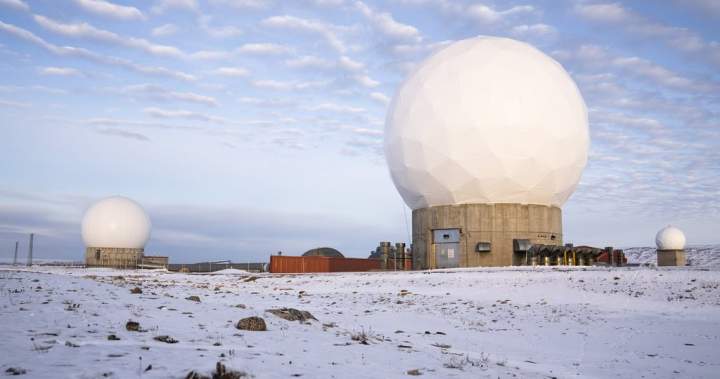
Greenland already hosts the U.S.-run Pituffik Space Base under a 1951 defence agreement with Denmark, supporting missile warning, missile defence and space surveillance for the U.S. and NATO.
“There is no sign of the Trump war of aggression against Greenland and Denmark letting up. It is not about ‘security’ any more than Venezuela was about ‘narco-terrorism.’ They are both about seizing control and plunder.”
He further added, “No country, including my own, Canada, is safe or secure.”
The tariff threat could mark a significant rupture between the U.S. and its NATO allies.
Trump is expected to face questions about the proposed tariffs and Greenland later this week.
He is scheduled to attend the World Economic Forum in Davos, alongside several European leaders he has threatened with tariffs.
— With files from The Canadian Press
© 2026 Global News, a division of Corus Entertainment Inc.
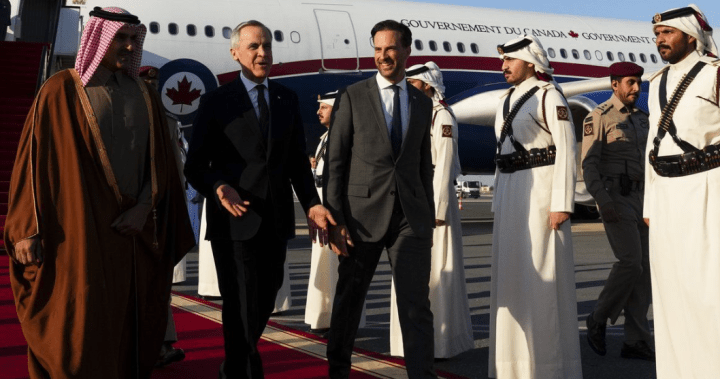
Prime Minister Mark Carney arrived in Doha on Saturday as part of a push to attract foreign investment and deepen Canada’s economic partnerships beyond its traditional allies.
Carney’s visit comes on the heels of his visit to China and follows the recent presentation of a new federal investment budget aimed at positioning Canada as a stable, attractive destination for global capital.
In a news conference on Saturday, Finance Minister François-Philippe Champagne said Canada is working to broaden its economic relationships as global trade patterns shift.
Qatar is viewed by Ottawa as a strategic partner, with officials pointing to the country’s significant investment capacity and growing influence on the global stage.
Get breaking National news
For news impacting Canada and around the world, sign up for breaking news alerts delivered directly to you when they happen.
“We need to reduce our dependence and increase our self-reliance to find a strategic path forward,” Champagne said.
“Engaging with the Middle East and China is necessary for Canada, just like our European partners have done,” Champagne added. “We buy more from the U.S.A. than anywhere else, but the trading climate right now is different.”
The conference highlighted Canada’s industrial capacity and trade advantages as key selling points for potential investors.
Champagne also said international engagement is critical as Canada works to raise its profile among global investors.


“We are one of the G7s with very big industries. We build cars, planes, ships, we have an abundance of energy, and we are the only one with free trade with all G7,” Champagne said. “With the way the world is changing, you better diversify, supply chain is changing and we need to adapt.”
Prime Minister Carney is expected to meet with senior Qatari officials, including Emir Sheikh Tamim bin Hamad Al Thani, as well as representatives of the Qatar Investment Authority.
His office says the talks will focus on expanding trade access and forging partnerships in artificial intelligence, infrastructure, energy and defence.
The visit comes amid heightened geopolitical tensions in the region, though officials say the schedule remains unchanged.
© 2026 Global News, a division of Corus Entertainment Inc.


Qatar to invest in Canada’s major building projects, Carney says – National TenX News

“Unacceptable’: Allies react to Trump Greenland tariff threats – National TenX News

Canada talks trade with Qatar as Carney touches down in Doha – National TenX News


-

 Fashion10 months ago
These ’90s fashion trends are making a comeback in 2017
-

 Entertainment10 months ago
The final 6 ‘Game of Thrones’ episodes might feel like a full season
-

 TenX Exclusive10 months ago
अमर योद्धा: राइफलमैन जसवंत सिंह रावत की वीरगाथा
-

 Politics9 months ago
Before being named Pope Leo XIV, he was Cardinal Robert Prevost. Who is he? – National TenX News
-

 Politics9 months ago
Puerto Rico faces island-wide blackout, sparking anger from officials – National TenX News
-

 Fashion10 months ago
According to Dior Couture, this taboo fashion accessory is back
-

 Tech10 months ago
Indian-AI-software-which-caught-30-thousand-criminals-and-busted-18-terrorist-modules-its-demand-is-increasing-in-foreign-countries-also – News18 हिंदी
-

 Politics9 months ago
Scientists detect possible signs of life on another planet — but it’s not aliens – National TenX News