
Politics
IMF cuts global growth forecast by 0.5% amid U.S. tariffs: ‘New era’ – National TenX News

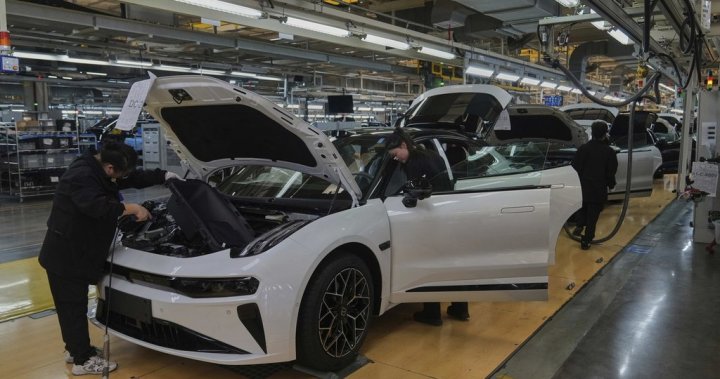
The U.S. and global economies will likely slow significantly in the wake of President Donald Trump’s tariffs and the uncertainty they have created, the International Monetary Fund said Tuesday.
The IMF said that the global economy will grow just 2.8 per cent this year, down from its forecast in January of 3.3 per cent, according to its latest World Economic Outlook. And in 2026, global growth will be three per cent, the fund predicts, also below its previous 3.3 per cent estimate.
And the Fund sees the world’s two largest economies, China and the United States, weakening: U.S. economic growth will come in at just 1.8 per cent this year, down sharply from its previous forecast of 2.7 per cent and a full percentage point below its 2024 expansion. The IMF doesn’t expect a U.S. recession, though it has raised its odds of one this year from 25 per cent to about 40 per cent.
China is now projected to expand four per cent this year and next, down roughly half a point from its previous forecasts.
“We are entering a new era,” Pierre-Olivier Gourinchas, chief economist at the IMF, said. “This global economic system that has operated for the last eighty years is being reset.”
The forecasts underscore the widespread impact of both the tariffs and the uncertainty they have created. Every country in the world is affected, the IMF said, by hikes in US import taxes that have now lifted average U.S. duties to about 25 per cent, the highest in a century.

The forecasts are largely in line with many private-sector economists’ expectations, though some do fear a recession is increasingly likely. Economists at JPMorgan say the chances of a U.S. recession are now 60 per cent. The Federal Reserve has also forecast that growth will weaken this year, to 1.7 per cent.
The IMF is a 191-nation lending organization that works to promote economic growth and financial stability and to reduce global poverty.

Get daily National news
Get the day’s top news, political, economic, and current affairs headlines, delivered to your inbox once a day.
Gourinchas said that the heightened uncertainty around the import taxes led the IMF to take the unusual step of preparing several different scenarios for future growth. Its forecasts were finalized April 4, after the Trump administration announced sweeping tariffs on nearly 60 countries along with nearly-universal 10 per cent duties.
Those duties were paused April 9 for 90 days. Gourinchas said the pause didn’t substantially change the IMF’s forecasts because the U.S. and China have imposed such steep tariffs on each other since then.
The Trump administration has slapped duties on cars, steel, and aluminum, as well as 25 per cent import taxes on most goods from Canada and Mexico. The White House has also imposed 10 per cent tariffs on nearly all imports, and a huge 145 per cent duty on goods from China, though smartphone and computers have been exempted. China has retaliated with 125 per cent duties on US goods.
The uncertainty surrounding the Trump administration’s next moves will also likely weigh heavily on the U.S. and global economies, the IMF said. Most traded goods are parts that feed into finished products, and the tariffs could disrupt supply chains, similar to what occurred during the pandemic, Gourinchas warned in a blog post.
“Companies facing uncertain market access will likely pause in the near term, reduce investment and cut spending,” he wrote.
The U.S. tariffs are also expected to hit less-developed nations, with Mexico’s economy now expected to shrink this year by 0.3 per cent, down from a previous projection of 1.4 per cent growth. South Africa is forecast to grow just one per cent this year, down from a 1.5 per cent projection in January.
While the U.S. economy will likely suffer a supply shock, Gourinchas said, China is expected to experience reduced demand as U.S. purchases of its exports fall.


Inflation will likely worsen in the United States, rising to about three per cent by the end of this year, while it will be little changed in China, the IMF forecast.
In his blog post, Gourinchas acknowleged that there is an “acute perception that globalization unfairly displaced many domestic manufacturing jobs” and added that “there is some merit to these grievances.”
But he added that the “deeper force behind this decline is technological progress and automation, not globalization.” Gourinchas noted that both Germany, which has a goods trade surplus, and the U.S., which has a deficit, have seen factory output remain relatively level in recent decades even as automation has caused manufacturing employment to decline.
The IMF expects the tariffs to take a big chunk out of China’s economy, but it also forecasts that additional spending by the Chinese government will offset much of the hit.
The European Union is forecast to grow more slowly, but the hit from tariffs is not as large, in part because it is facing lower U.S. duties than China. In addition, some of the hit from tariffs will be offset by stronger government spending by Germany.
The economies of the 27 countries that use the euro are forecast to expand 0.8 per cent this year and 1.2 per cent next year, down just 0.2 per cent in both years from the IMF’s January forecast.
Japan’s growth forecast has been marked down to 0.6 per cent this year and next, 0.5 per cent and 0.2 per cent lower than in January, respectively.
In a separate report Tuesday, the IMF warned that “global financial stability risks have increased significantly,’’ along with the deteriorating economic outlook. The fund noted that some stock and bond prices remained high despite the recent market rout triggered by Trump’s tariffs – which means they are vulnerable to further drops.
The IMF also cautioned that “some financial institutions could come under strain in volatile markets,’’ pointing in particular to heavily indebted hedge funds and asset management companies and the risk that they will be forced to raise cash by selling investments into an already-fragile market.
—AP Economics Writer Paul Wiseman contributed to this report.

Politics
X outages reported by tens of thousands of users worldwide: Downdetector – National TenX News
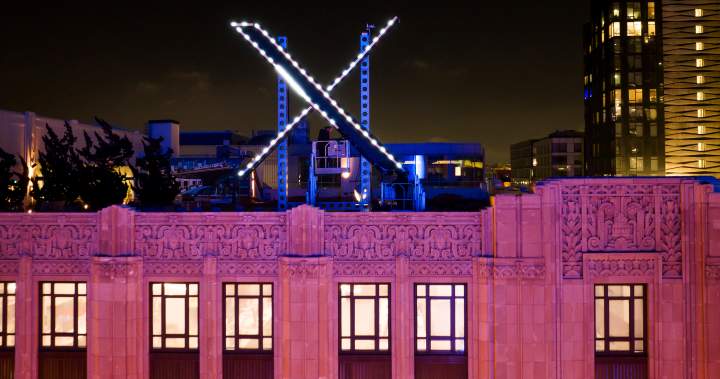
X, formerly Twitter, was down for tens of thousands of users worldwide on Friday, according to outage tracking website Downdetector.com.
There were more than 62,000 reports of issues with the social media platform as of 10:22 a.m. EST, according to Downdetector, which tracks outages by collating status reports from a number of sources.
Get daily National news
Get the day’s top news, political, economic, and current affairs headlines, delivered to your inbox once a day.
Users in the U.K. reported around 11,000 incidents and over 3,000 issues were reported in India.


The actual number of affected users may differ from what is shown on the platform, as the reports are submitted by users.
Politics
Trump says he may tariff countries that don’t ‘go along’ with Greenland plans – National TenX News
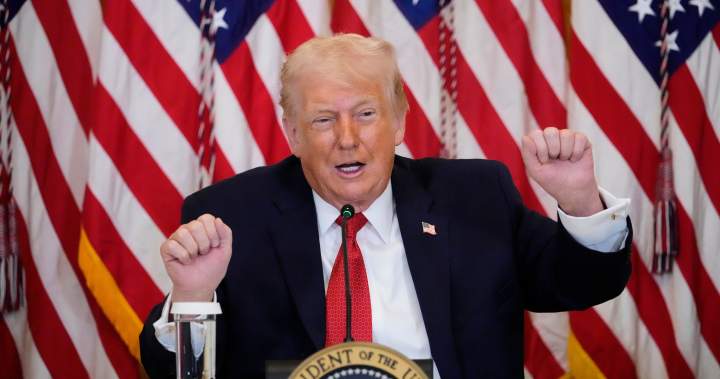
U.S. President Donald Trump suggested Friday that he may punish countries with tariffs if they don’t back the U.S. controlling Greenland, a message that came as a bipartisan Congressional delegation sought to lower tensions in the Danish capital.
Trump for months has insisted that the U.S. should control Greenland, a semiautonomous territory of NATO ally Denmark, and said earlier this week that anything less than the Arctic island being in U.S. hands would be “unacceptable.”
During an unrelated event at the White House about rural health care, he recounted Friday how he had threatened European allies with tariffs on pharmaceuticals.
“I may do that for Greenland too,” Trump said. “I may put a tariff on countries if they don’t go along with Greenland, because we need Greenland for national security. So I may do that,” he said.
He had not previously mentioned using tariffs to try to force the issue.
Earlier this week, the foreign ministers of Denmark and Greenland met in Washington this week with U.S. Vice President JD Vance and Secretary of State Marco Rubio.
That encounter didn’t resolve the deep differences but did produce an agreement to set up a working group — on whose purpose Denmark and the White House then offered sharply diverging public views.
European leaders have insisted that is only for Denmark and Greenland to decide on matters concerning the territory, and Denmark said this week that it was increasing its military presence in Greenland in cooperation with allies.

A relationship ‘we need to nurture’
In Copenhagen, a group of senators and members of the House of Representatives met Friday with Danish and Greenlandic lawmakers, and with leaders including Danish Prime Minister Mette Frederiksen.
Delegation leader Sen. Chris Coons, a Delaware Democrat, thanked the group’s hosts for “225 years of being a good and trusted ally and partner” and said that “we had a strong and robust dialog about how we extend that into the future.”
Get daily National news
Get the day’s top news, political, economic, and current affairs headlines, delivered to your inbox once a day.
Sen. Lisa Murkowski, an Alaska Republican, said after meeting lawmakers that the visit reflected a strong relationship over decades and “it is one that we need to nurture.” She told reporters that “Greenland needs to be viewed as our ally, not as an asset, and I think that’s what you’re hearing with this delegation.”
The tone contrasted with that emanating from the White House. Trump has sought to justify his calls for a U.S. takeover by repeatedly claiming that China and Russia have their own designs on Greenland, which holds vast untapped reserves of critical minerals. The White House hasn’t ruled out taking the territory by force.
“We have heard so many lies, to be honest and so much exaggeration on the threats towards Greenland,” said Aaja Chemnitz, a Greenlandic politician and member of the Danish parliament who took part in Friday’s meetings. “And mostly, I would say the threats that we’re seeing right now is from the U.S. side.”
Murkowski emphasized the role of Congress in spending and in conveying messages from constituents.

“I think it is important to underscore that when you ask the American people whether or not they think it is a good idea for the United States to acquire Greenland, the vast majority, some 75%, will say, we do not think that that is a good idea,” she said.
Along with Sen. Jeanne Shaheen, a New Hampshire Democrat, Murkowski has introduced bipartisan legislation that would prohibit the use of U.S. Defense or State department funds to annex or take control of Greenland or the sovereign territory of any NATO member state without that ally’s consent or authorization from the North Atlantic Council.

Inuit council slams White House
The dispute is looming large in the lives of Greenlanders. Greenland’s prime minister, Jens-Frederik Nielsen, said on Tuesday that “if we have to choose between the United States and Denmark here and now, we choose Denmark. We choose NATO. We choose the Kingdom of Denmark. We choose the EU.””
The chair of the Nuuk, Greenland-based Inuit Circumpolar Council, which represents around 180,000 Inuit from Alaska, Canada, Greenland, and Russia’s Chukotka region on international issues, said persistent statements from the White House that the U.S. must own Greenland offer “a clear picture of how the US administration views the people of Greenland, how the U.S. administration views Indigenous peoples, and peoples that are few in numbers.”
Sara Olsvig told The Associated Press in Nuuk that the issue is “how one of the biggest powers in the world views other peoples that are less powerful than them. And that really is concerning.”
Indigenous Inuit in Greenland do not want to be colonized again, she said.
© 2026 The Canadian Press
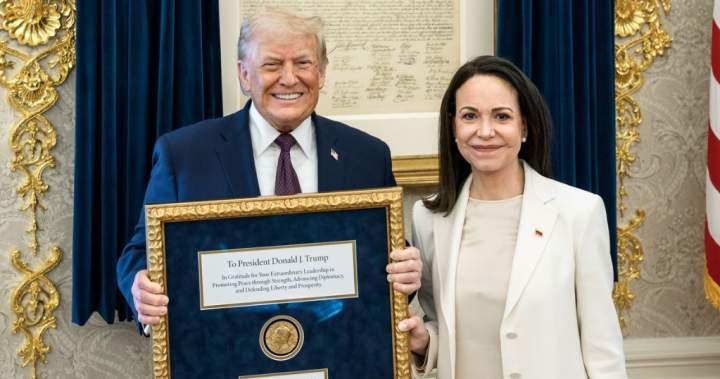
Venezuelan opposition leader María Corina Machado said she presented her Nobel Peace Prize medal to President Donald Trump at the White House on Thursday even as he has questioned her credibility to take over her country after the U.S. ousted then-President Nicolás Maduro.
The Nobel Institute has said Machado could not give her prize to Trump, an honour that he has coveted. Even if the gesture proves to be purely symbolic, it was extraordinary given that Trump has effectively sidelined Machado, who has long been the face of resistance in Venezuela. He has signalled his willingness to work with acting President Delcy Rodríguez, who had been Maduro’s second in command.
“I presented the president of the United States the medal, the Nobel Peace Prize,” Machado told reporters after leaving the White House and heading to Capitol Hill. She said she had done so “as a recognition for his unique commitment with our freedom.”

Trump confirmed later on social media that Machado had left the medal for him to keep, and he said it was an honour to meet her.
“She is a wonderful woman who has been through so much. María presented me with her Nobel Peace Prize for the work I have done,” Trump said in his post. “Such a wonderful gesture of mutual respect. Thank you María!”
The White House later posted a photo of Machado standing next to Trump in the Oval Office as he holds the medal in a large frame. A text in the frame reads, “Presented as a personal symbol of gratitude on behalf of the Venezuelan people in recognition of President Trump’s principled and decisive action to secure a free Venezuela.”
Trump has raised doubts about his stated commitment to backing democratic rule in Venezuela, giving no timetable on when elections might be held. Machado indicated that he had provided few specifics on that front during their discussion.
Get breaking National news
For news impacting Canada and around the world, sign up for breaking news alerts delivered directly to you when they happen.
She did not provide more information on what was said.
‘We can count on President Trump’
After the closed-door meeting, Machado greeted dozens of cheering supporters waiting for her near the White House gates, stopping to hug many.
“We can count on President Trump,” she told them without elaborating, prompting some to briefly chant, “Thank you, Trump.”
Before her visit to Washington, Machado had not been seen in public since she travelled last month to Norway, where her daughter received the peace prize on her behalf. She had spent 11 months in hiding in Venezuela before she appeared in Norway after the ceremony.
The jubilant scene after her meeting with Trump stood in contrast to political realities in Venezuela. Rodríguez remains in charge of day-to-day government operations, along with others in Maduro’s inner circle. In her first state of the union speech Thursday, the interim president promoted the resumption of diplomatic ties between the historic adversaries and advocated for opening the state-run oil industry to more foreign investment after Trump pledged to seize control of Venezuelan crude sales.

Trump has said it would be difficult for Machado to lead because she “doesn’t have the support within or the respect within the country.” Her party is widely believed to have won 2024 elections rejected by Maduro.
White House press secretary Karoline Leavitt called Machado “a remarkable and brave voice” but also said the meeting didn’t mean Trump’s opinion of her changed, calling it “a realistic assessment.”
Leavitt told reporters that Trump supported new Venezuelan elections “when the time is right” but did not say when he thought that might be.
A ‘frank and positive discussion’ about Venezuela
Leavitt said Machado had sought the face-to-face meeting without setting expectations for what would occur. She spent about two and a half hours at the White House.

“I don’t think he needs to hear anything from Ms. Machado,” the press secretary said while the meeting was still going on, other than to have a ”frank and positive discussion about what’s taking place in Venezuela.”
After leaving the White House, Machado went on to a closed-door meeting with a bipartisan group of senators.
Sen. Chris Murphy, D-Conn., said Machado told them that “if there’s not some progress, real progress towards a transition in power, and/or elections in the next several months, we should all be worried.”
“She reminded us that Delcy Rodríguez is, in many ways, worse than Maduro,” he added.
Asked if Machado had heard any commitment from the White House on holding elections in Venezuela, Murphy said, “No, I don’t think she got any commitment from them.”

Sen. Bernie Moreno, an Ohio Republican, was exultant following the meeting, saying Machado “delivered a message that loud and clear: What President Trump did was the most important, significant event in Latin America. That getting rid of Maduro was absolutely essential.”
Machado’s Washington stop coincided with U.S. forces in the Caribbean Sea seizing another sanctioned oil tanker that the Trump administration says had ties to Venezuela. It is part of a broader U.S. effort to take control of the South American country’s oil after U.S. forces captured Maduro and his wife less than two weeks ago at a heavily guarded compound in the Venezuelan capital of Caracas and brought them to New York to stand trial on drug trafficking charges.
Leavitt said Venezuela’s interim authorities have been fully cooperating with the Trump administration and noted that Rodríguez’s government said it planned to release more prisoners detained under Maduro. Among those released were five Americans this week.
Trump said Wednesday that he had a “great conversation” with Rodríguez, their first since Maduro was ousted.
Machado doesn’t get the nod from Trump
Just hours after Maduro’s capture, Trump said of Machado that “it would be very tough for her to be the leader.” Machado had steered a careful course to avoid offending Trump, notably after winning the peace prize, and had sought to cultivate relationships with him and key administration voices like Secretary of State Marco Rubio.
The industrial engineer and daughter of a steel magnate, Machado began challenging the ruling party in 2004, when the nongovernmental organization she co-founded, Súmate, promoted a referendum to recall then-President Hugo Chávez. The initiative failed, and Machado and other Súmate executives were charged with conspiracy.
A year later, she drew the anger of Chávez and his allies again for travelling to Washington to meet President George W. Bush, whom Chávez considered an adversary.
Almost two decades later, she marshalled millions of Venezuelans to reject Chávez’s successor, Maduro, for another term in the 2024 election. But ruling party-loyal electoral authorities declared him the winner despite ample credible evidence to the contrary. Ensuing anti-government protests ended in a brutal crackdown.


X outages reported by tens of thousands of users worldwide: Downdetector – National TenX News

Trump says he may tariff countries that don’t ‘go along’ with Greenland plans – National TenX News

Trump gifted Nobel Peace Prize by Venezuela’s María Corina Machado – National TenX News


-

 Fashion10 months ago
These ’90s fashion trends are making a comeback in 2017
-

 Entertainment10 months ago
The final 6 ‘Game of Thrones’ episodes might feel like a full season
-

 TenX Exclusive10 months ago
अमर योद्धा: राइफलमैन जसवंत सिंह रावत की वीरगाथा
-
 Politics8 months ago
Before being named Pope Leo XIV, he was Cardinal Robert Prevost. Who is he? – National TenX News
-

 Politics9 months ago
Puerto Rico faces island-wide blackout, sparking anger from officials – National TenX News
-

 Fashion10 months ago
According to Dior Couture, this taboo fashion accessory is back
-

 Tech10 months ago
Indian-AI-software-which-caught-30-thousand-criminals-and-busted-18-terrorist-modules-its-demand-is-increasing-in-foreign-countries-also – News18 हिंदी
-

 Politics9 months ago
Scientists detect possible signs of life on another planet — but it’s not aliens – National TenX News